Categories
Games

PAX East 2014

I went to PAX East again this year, and although I didn’t see quite as much as I would’ve liked (and forgot a few things I meant to check out), I still had a great time and found some interesting new games.

Favorite Not-Game: Sid Meier’s Civilization: Beyond Earth Reveal
Firaxis announced Beyond Earth during a panel, and it’s basically Alpha Centauri 2. (Unfortunately, Firaxis doesn’t have rights to the Alpha Centauri name.) I loved Alpha Centauri and have wanted a modern reimagining for some time, and this looks like it will be exactly what I want. And the best part: it’s scheduled to come out later this year. (Fingers crossed.)

Favorite Game: Distance
This was apparently the first time Distance has been playable at a show. I backed it on Kickstarter way back in Oct. 2012, and while the screenshots and videos they’ve been releasing in updates have looked gorgeous, I always wondered how it played. The guys at Refract Studios have done a great job of making a game that’s beautiful, plays very well, and is extremely fun. The ability to fly makes it possible to create your own shortcuts on levels, and it looks like there’s actually a story – something I didn’t expect in a racing game.

Games
Darkest Dungeon
I never backed this on Kickstarter, but this is an Roguelike RPG that looks amazing and seems incredibly difficult.

Gods Will Be Watching
I’m not sure entirely how to categorize this one, but it’s another difficult game that requires a player to keep a number of things in check to prevent everything from falling apart and losing.

There Came An Echo
I backed this one on Kickstarter as well, and I was most excited to try out the voice recognition. I was impressed that the voice recognition worked incredibly well, even with the din of the show floor in the background.

Invisible, Inc.
A stealth turn-based strategy game where your agents attempt to break into corporations to steal secrets. I didn’t play it at the show, but bought a Steam early access key, which they were selling on the show floor.

Orcs Must Die: Unchained
I’m not sure how happy I am to see one of my favorite co-op MOBA-like games go full-on competitive MOBA, but hopefully there will be a co-op mode I can enjoy.

Soda Drinker Pro
Upgraded with new levels for an even better virtual soda drinking experience.

Lovers in a Dangerous Spacetime
Didn’t play it, but this looks really interesting. It’s a 2-player local co-op game where you fly a spaceship and have to move around between different consoles in the spaceship to control weapons, engines, shields, etc. Hopefully they add an internet co-op mode, because I’d like to play it, but local co-op isn’t going to cut it.

Transistor
Made this the first thing I did at the show because the lines got long fast last year. The time-stopping mechanic is fun to play with, and as will all Supergiant Games, it looks fantastic.

Hack-n-Slash
An RPG from Double Fine where hacking into enemies and the environment is a major piece of the game. It’s still early, but it wasn’t very fun – just very boring and lots of block-moving puzzles. Plus, I managed to get myself stuck in about 5 minutes and had to restart the game.

Extrasolar
A browser-based game where you manage an expedition to another planet. Everything plays out in real time, so if it takes 8 hours for a signal to get sent to your rover, that’s how long it takes in real life. It’s an interesting idea, but probably not the sort of thing I’m interested in.

Aaru’s Awakening
A platformer. It’s got a nice art style, but it’s relatively generic. I felt like I had played it before and it wasn’t a lot of fun.

Galactic Strike Force
This one’s a card game from the guys that made Sentinels of the Multiverse. Like Sentinels, it’s a co-op game where all the players team up against a villain. It was fun, but the guy demoing the game obviously didn’t understand the rules well enough, so everyone was confused about what to do.

Lichdom: Battlemage
A nice-looking game where you play a mage with three schools of magic (ice, fire, bio), and can create new spells. It was fun to play but I didn’t understand what my health was, so I died just before defeating the demo boss.

Mewgenics
A game about breeding cats from Team Meat. Looks good, but didn’t get a chance to play it.

Hotline Miami 2
It’s more Hotline Miami.

Summary
There were plenty of things to see. PAX is quickly becoming indie-focused, with several big publishers a no-show this year: Nintendo wasn’t there at all, and Sony had a tiny “PlayStation Community” booth in the corner. This isn’t a bad thing – the indie games are interesting and new, whereas a lot of the big games are just the same stuff we’ve seen before. Wolfenstein was there, which I have absolutely no interest in; Titanfall had a booth, but I didn’t enjoy that game, either. Unfortunately, PAX East has also become huge, with way too many people there.

Categories
Games

SimCity

SimCity launched on March 5, 2013. I bought it on release day excited to play the first new SimCity game in ten years. (Societies doesn’t count.) Like most people who experienced SimCity’s launch, I was extremely disappointed. Actually, that’s an understatement… If I hadn’t bought from Origin and been stuck with it, I would have returned it and been done with it. The issues with the launch are well documented. For me, at least, part of the problem was that I could see a great game under all the problems.

The new SimCity did a great job of making the complicated workings of a city (water, electricity, sewage, etc) easy to understand. Watching power travel across the map slowly powering buildings is simply beautiful. However, the new always-online multiplayer-only aspects caused numerous problems. For what it’s worth, the network problems were ironed out relatively quickly, though I lost several cities while they fixed the problems. I stuck with the game for about two months, and the problem that finally killed the game for me was something so basic: traffic.

I had cities that functioned perfectly: smooth traffic and raking in simoleons. Suddenly, something would happen in the region and my cities would be flooded with traffic that would never disappear. I saw cars get stuck inside black holes in intersections, constant traffic jams that no amount of public transport would fix, and just bug after bug that made the game impossible to play. Instead of playing the game and having fun, I was searching for a way to relieve the traffic pressures. Instead of building my city, I was trying tricks and gimmicks to produce a barely-functioning city. My best city, with a highly educated population, slowly devolved into a slum as traffic prevented the police, fire department, and hospital from reaching homes. Traffic kept people from my university, turning the highly-educated workforce into an uneducated mob. Shortly after, my nuclear power plant suffered a meltdown due to the lack of educated workers. Any city I started was just a ride toward disappointment. It was extremely frustrating and made the entire game a chore to play.

Fast forward to early January. I had been thinking about SimCity for a while, wanting to give it another try and see how it’s improved. A friend said it was much better and that the expansion, Cities of Tomorrow, was fun to play. It was just the push I needed to give it another try. I fired up the game for the first time in nearly a year expecting very little in the way of improvements; I didn’t want to get my hopes up. To my surprise, my traffic problems magically disappeared simply by loading my cities. And while two of my cities seem to be lost (can’t load them, can’t recover, can’t abandon), the ones I can access seem to be working fine. SimCity was actually fun to play, so I decided to give the expansion a try as well.

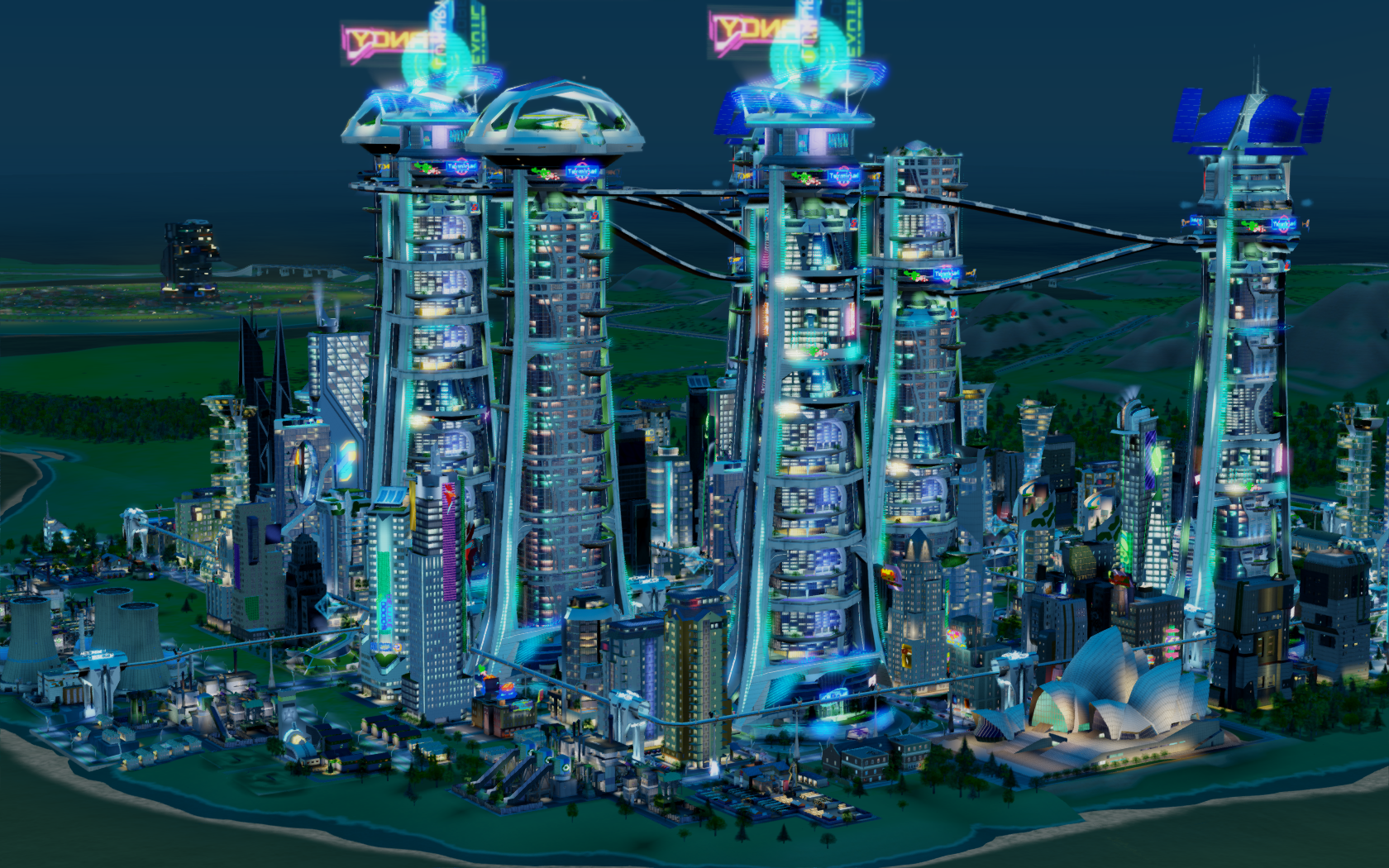
Cities of Tomorrow adds several new structures, two new resources, and some very interesting ways to deal with running your city. With SimCity, there are generally two paths: clean and expensive green cities, or dirty and profitable industrial cities. In Cities of Tomorrow this continues with the introduction of The Academy and Omega Co.. The Academy is a high-tech research center which produces green technologies that keep cities clean and running smoothly. Omega Co. specializes in industry and slowly monopolizing entire regions. Both paths produce a dystopian futuristic city that’s fun to play with. I’ve always preferred clean, green cities to industrial cities, so I immediately gave “The Academy” a try.

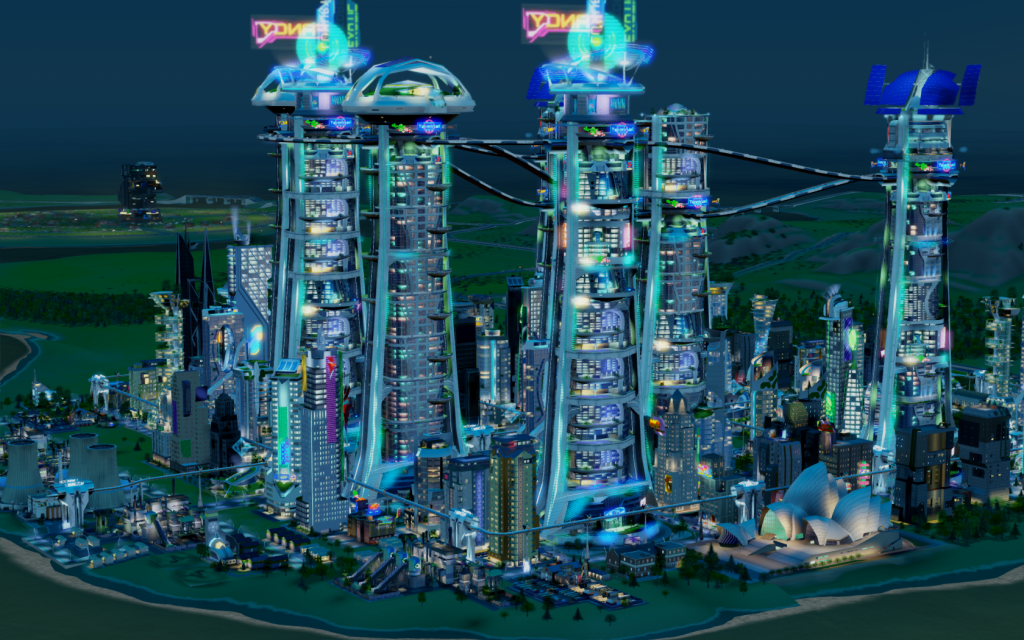
A city focused on clean energy, with a few gleaming megatowers.

Some of the new technologies from The Academy include a Sewage Sanitizer that converts sewage to clean water, a Garbage Atomizer that destroys garbage without pollution, a Wave Power Plant that can produce power from ocean waves, and a fusion power plant that produces vast amounts of clean energy. All this fancy technology is powered by a new resource called “ControlNet”, which is produced by The Academy and ControlNet Facilities. Without ControlNet, your structures will stop operating, and bad things start to happen. So while many of them are quite useful, their non-ControlNet counterparts are often easier to deal with. However, if your city is focused on being green, The Academy is definitely a good path to take.

After playing with a green city I decided to try out the Omega Co. vision of the future. The goal of Omega Co. is to turn every factory and store into an OmegaCo franchise, while making every sim buy OmegaCo products. All this starts with an Omega Factory, which produces Omega; a resource that slowly turns buildings into franchisees. Each franchisee earns you a bit of extra cash, so taking this route can produce a wealthy city very quickly. After planting an OmegaCo HQ and a Robotics HQ you can start to produce drones, which are one of the best parts of Omega technology. Drones can be used to put out fires (“FireDrones”), catch criminals (“LawDrones”), and heal injured sims (“MediDrones”). Drones can only be used once (putting out a single fire, apprehending a single criminal, or healing a single sim) so you have to constantly produce more. On the other hand, drones fly so they can’t be caught in traffic. Drones can even be shipped out to homes and converted to “BuyDrones”, which will go shopping for your sims, relieving traffic. But the best thing about OmegaCo’s path for the future is the Blade Runner-esque style your cities take.

Whichever path your cities take, you can build huge “Megatowers” which are tiny arcologies you can build with housing, shopping, workplaces, and service facilities. You can connect these towers with “Skybridges”, giving sims a way to move between them without using the streets. Towers are topped with a “crown”, which can provide a nice bonus to the tower. They’re an excellent way to expand your city without needed more room.

To summarize: SimCity is much improved and Cities of Tomorrow is fun to play and adds a lot of new stuff. That said, I think the $30 price tag on the expansion is a bit high – $20 is probably a more appropriate price. I can at least recommend SimCity now that it’s working much smoother, and the promise of offline play in the near future makes it worth it.

Categories
Games

Oculus Gaming: Lunar Flight

Back in May, I ordered an Oculus Rift Dev kit. I’ve been excited about it for a while and held out as long as I could, but the excitement finally got to me and forced a purchase. I haven’t done any actual development with it (a three-month Unity Pro trial just isn’t enough time), but I’ve been playing a few games and enjoying a few tech demos. I stopped using it for a few weeks because, honestly, I was a little disappointed. I couldn’t find any games that were fun to play, well implemented, and didn’t immediately make me nauseous. I’ve been keeping up with games that introduce support, however, and during my browsing of riftenabled.com, I stumbled on a Steam game that recently started an Oculus Rift beta: Lunar Flight.

My friends know I’ve been addicted to Kerbal Space Program for a while now, so when I saw Lunar Flight was a fancy lunar lander simulator, I was immediately interested. (The words “lunar” and “flight” also caught my attention.) I didn’t already own the game, so I decided to do some investigating. After watching a few YouTube videos of Oculus Rift gameplay, and seeing a few comments saying it was the best Oculus Rift game people have played – and more importantly that it caused no nausea – I decided to give it a try. I was not disappointed.

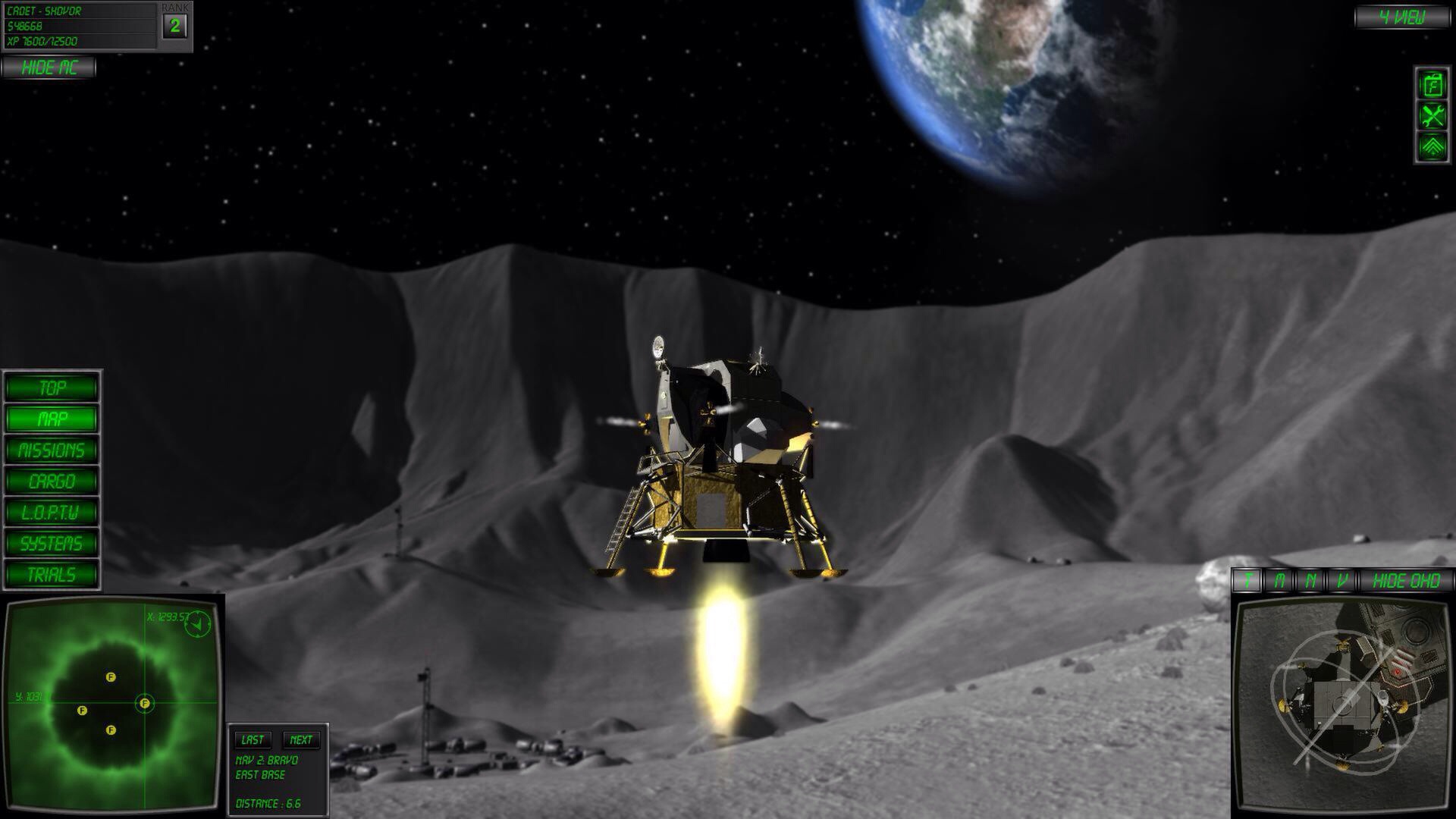
The forum comments were right: Lunar Flight has amazing Oculus Rift support. With the headset on, it’s like you’re in a virtual lander cockpit. You can even see your shoulders when looking left and right, or your feet when looking down. If you look down at your lap, you can even see hands holding an Xbox 360 controller, so the immersion was complete. As you look around the cockpit, there are several displays and buttons you can interact with. When you look at something you can interact with, a context arrow appears and points at that item. When you press the context button on the controller (Y), you press that button or toggle that screen – a simple and elegant solution to the myriad of controls around you.

20130923-232012.jpg

The game looks fantastic, and looking out the cockpit gives you a nice view of the gray lunar landscape. It’s important that it looks good – you end up seeing a lot of it. But the attractive landscape is just the backdrop to the immersion you feel as you guide your lander from base to base, transporting cargo or surveying the area. There’s a display above you that shows (by default) your destination along your velocity vector. It feels fantastic when I get close to a landing pad and use that monitor to line up my landing, then glance down at my fuel meter, out the window to make sure nothing is getting too close, then back at that monitor to make any other adjustments. It’s hard to describe… It just feels right. I know I’m sitting in a dark room with a weird HMD on my face, but it feels like I’m sitting in a lunar lander controlling it’s decent, checking my thrust-to-weight ratios, checking my fuel, navigating from place to place… Because I am. It’s like nothing I’ve played before and finally makes the Oculus Rift seem like the amazing piece of technology that it is.

So after weeks of doing nothing with my fancy VR headset, I finally have a game I play nightly and enjoy immensely. Hopefully I’ll find more in the future, and I hope some developers out there are paying attention to the games that do VR right.

Categories
Games

PAX East 2013

Keeping with what I did last year, I decided I’d do a quick roundup of what I experienced at PAX East this year.

Games I Played
Spaceteam
Spaceteam is a free iOS party game that’s already available. It’s about you and a group of friends shouting technobabble at each other, like “Set the fusenipple to 3!” or “Flush the flux dynamometer!”. Each player is given a control panel with random controls on it, and each player is shown a task. Sometimes it’ll be something the player can take care of themselves, or sometimes they’ll have to shout it out and hope the person with that control is paying attention. If you miss too many tasks, your ship is consumed by a supernova. If you succeed long enough, your ship will warp away and everyone gets a new control panel. Once things start going wrong, you’ll have panels swinging out of place or ooze seeping around panels. Then there’s the random anomalies like “Translator Malfunction”, where your controls are labeled in an alien language and you have to figure out what they do along the way. It’s quick, easy to play, and a lot of fun.

Luftrausers
A crazy 2D shooter where you get to customize your plane and pull off some fantastic moves. It’s amazing to watch in motion.

Dropchord
What appears to be a pretty catchy rhythm-action game is hindered by its reliance on an awkward motion controller.

Soda Drinker Pro
The most advanced soda drinking simulator on the planet. I got to drink soda at the beach.

Games I Saw
Divekick
Right next to the Double Fine/Capy booth, I ended up watching a lot of this game. It involves jumping into the air and divekicking. That’s it. It looks glorious.

Watchdogs
I hadn’t heard anything about this, but it looks like a modern-day (or near-future) Assassin’s Creed, which means I want it. Using a smartphone to control your environment sounds really fun.

Panels
There weren’t many interesting-sounding panels this year. I only went to two.

Mass Effect Retrospective
There were a few bits of interesting information, but it was mainly a BioWare circle jerk.

Terrible iOS Games
One of the best panels I’ve been to. It was entirely about really bad iOS games. Very funny.

Who I Met
I enjoyed being able to walk up to several people and say, “Hi! I backed you on Kickstarter!” Hopefully it came across as the “I support what you’re doing and wish you the best” that I meant it as and not “I gave you money! Give me stuff!”

I got to meet the entire team behind Castle Story and get them to sign a poster. They seemed like really nice guys and I got to claim my free hug. When John commented on liking the Bricktron design because it looked like a smiley face come to life, one of the devs said it’s not supposed to be a smiley face – “Since our AI is kind of dumb, we wanted them to look like they were confused.”

I got Tim Schafer to sign a bunch of my crap. I wish there was time to chat with him about stuff, but there was a huge line waiting to get stuff signed and I already had him signing far too much stuff.

I got to meet a dev from Strike Suit Zero, tell him how much I loved his game, and leverage my Kickstarter backer status to get a free soundtrack.

I got to talk with the dev on Edge of Space. It still looks really early, but it’s come a long way from the last time I played it.

Categories
Games

Review – Strike Suit Zero

One game series that I look back on very fondly is Wing Commander. I absolutely loved those games, and played every last one of them. Then the series just died. There was a movie that should have been killed during its infancy and an XBLA shooter that was attached to the series only by name and the fighters themselves, but as far as I’m concerned, the series is still dead.

Spaceflight games in general have been few and far between, largely left to indie developers who have fond memories of Wing Commander and the like. And thanks to Kickstarter, we’re starting to see these games make a bit of a comeback in the indie game realm.

And so we come to Strike Suit Zero, with the tag line “Space. Combat. Reborn.” If this is the rebirth of spaceflight games, I think I’ll be pretty happy.

Gameplay
Strike Suit Zero is very fast paced. Throughout the campaign, you’ll fly four different ships: a fighter, bomber, interceptor, and the eponymous strike suit. Each ship has slightly different stats – the fighter is a balanced craft, the bomber is slow but armed with an unlimited number of capital-ship destroying torpedoes, the interceptor is fast and agile, and the strike suit… Well, I’ll get to that later.

You’re allowed to customize the weapons on your ship. Most ships have two primary weapons – a plasma cannon that does moderate damage to shields and hull, and a rapid firing machine gun (“rapid projectile emitter”) that chews through shields but does less damage to armor. As you progress, you unlock new weapons to fill these slots, though they’re just stronger or weaker variants with different stats.

The real customization comes in your secondary weapons, where you have a variety of missile and rocket systems to choose from. You can mix and match, or simply load up on a single type. Personally, I like the swarm missiles. They do low damage, but you get a ton of them and can lock up to 10 at a time.

The game is by no means easy. You’ll have to face enemy fighters, corvettes, frigates, cruisers, and carriers, and they’re all deadly. Luckily, there are checkpoints during missions where you will respawn if you die, with full armor and restocked ammo. Sometimes a few extra missiles make all the difference.

Large ships like frigates and carriers are armed with a number of turrets – flak, plasma, and beam cannons. You often have to prioritize which to target – flak turrets are going to chew you up, but that beam cannon is hammering away at friendly capital ships. However, once a capital ship has been relieved of turrets, it’s basically giant, slow-moving target practice.

The missions in the game give you a variety of tasks, from protecting capital ships, to assaults on enemy bases, to your standard dogfights. You can replay the missions whenever you like, attempting higher scores or unlocking upgrades for your ships.

The Strike Suit
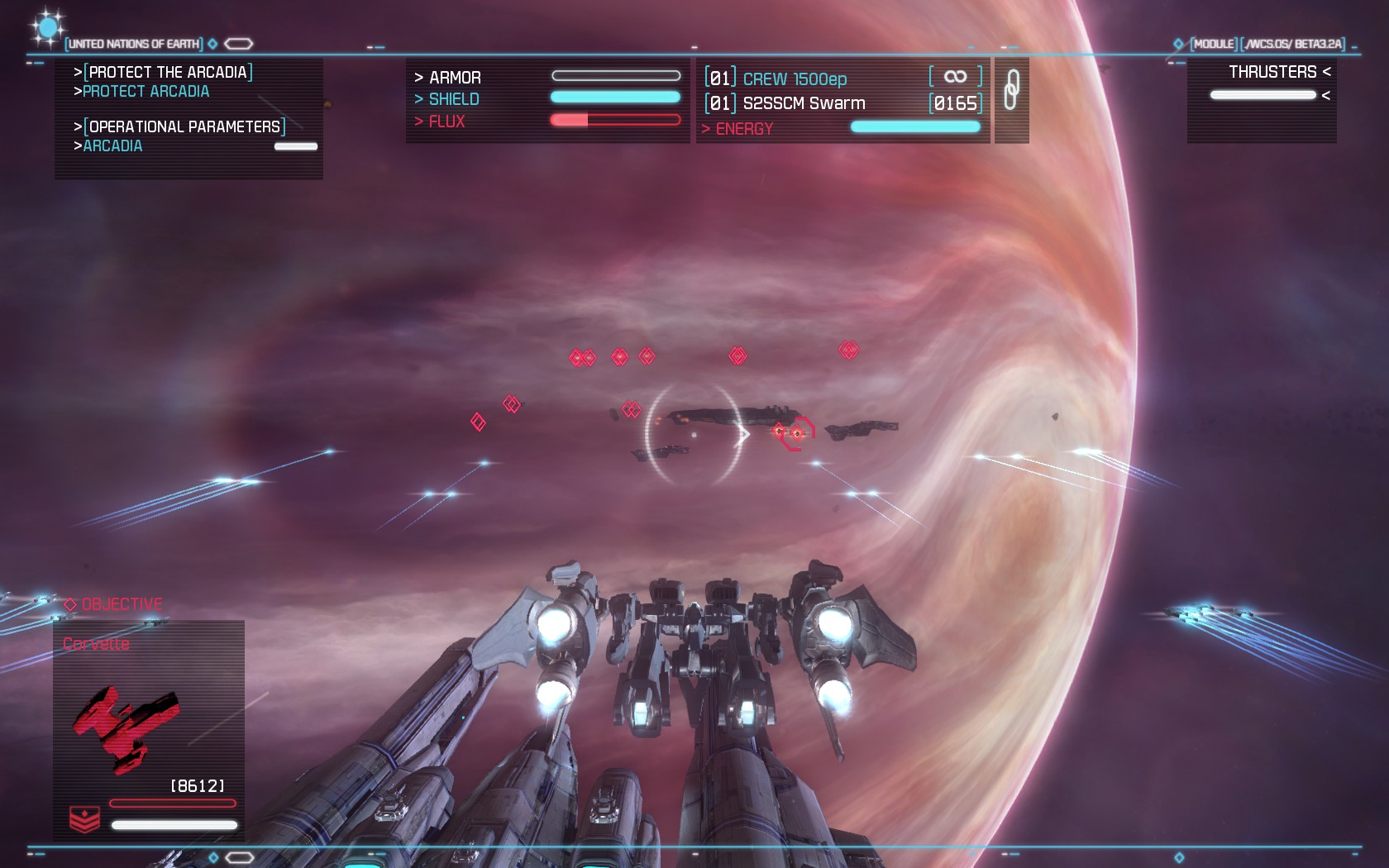
I love this thing so much I’m giving it its own italicized section. The strike suit is a transformer, changing from a fighter form to a mecha-style robot with unlimited ammo. When you transform, the controls change allowing you to strafe, lock-on, and dodge. You’re not invulnerable, but in strike suit mode your damage increases significantly.

The controls for the strike suit work so well that it is perfectly possible to pull off moves you’d see in stuff like Macross or Gundam (or any anime with giant transforming robots). There were several times I’d race to my carrier as torpedoes were headed its way, arrive just seconds before the torpedoes would hit, transform, spin toward the torpedoes, destroy them all, transform back into a fighter, and blast away. It felt amazingly badass.

Of course, with so much power in strike suit form, there has to be a balance, and that comes in the limited use of the mode. The strike suit runs on “flux” energy, which slowly accumulates over time but can be filled much more quickly by destroying enemies. Once filled, it’s usually a good idea to transform and empty your flux so you can start acquiring more strike-suit energy. You can remain in strike suit mode as long as you like, but your weapons drain your flux energy.

The strike suit is armed with two weapons: a flak cannon that does significant damage, and a powerful missile that can lock on up to 40 at a time, across multiple targets. You’re only given 40 missiles at a time, but they recharge slowly. Your flak cannon will drain your energy more slowly, but it’s fairly inaccurate. Your missiles, on the other hand, drain energy with each lock, so how many lock-ons you can acquire is dependent on how much energy you have.

Graphics and Sound
The game is beautiful, with colorful backgrounds, detailed ships, and ribbons of color that trail fighters. Screenshots look gorgeous, but the game is just as lovely when it’s in motion.

Ships are also a bit color-coded. Friendlies all sport blue colors and trails, while enemies have red colors and trails. It’s easy to see where you’re needed most.

Sound is also fantastic. All the effects sound great and work perfectly in the style of the game. But the music deserves a special note. The music was written by the same person behind Homeworld’s soundtrack. It’s moody and dramatic and fits the story perfectly.

Controls
I’ve already touched on the strike suit controls, but I want to mention that all the controls work great. I played the majority of the game with a joystick (and I was overjoyed to have a game that works well with a real joystick), but I played the beta with the keyboard and mouse, which works surprisingly well. It takes some getting used to, with the mouse controls pitch and yaw, and the keyboard controlling speed and roll, but it’s fairly easy to understand, and probably a bit easier overall. (I still think the joystick was more fun)

Story
Honestly, the story is a bit generic, but not bad. The closest approximation might be Battlestar Galactica, but there are a lot of elements similar to other sci-fi stories. It doesn’t feel like there’s a lot of depth to the world (it’s no Halo or Mass Effect), but the backdrop for the game is fleshed out enough to be interesting, if a bit cliché.

Summary
I love Strike Suit Zero. It’s beautiful. It’s hectic. It’s fun. Sometimes the game felt difficult, but success was never out of reach. There are only 13 missions, but each can take an hour to finish at times (especially if you die a lot), putting it somewhere around 8-10 hours to complete. There’s not much here for replayability, other than the sheer enjoyment of the dogfights, which might be enough.

Strike Suit Zero retails at $20, which might be a bit high for an indie game, but it’s worth every penny, as far as I’m concerned.

Categories
Games

Review – Far Cry 3

I came into Far Cry 3 without any expectations. I played – but never finished – Far Cry, and I never even started Far Cry 2. Far Cry 3 had me hooked within the first few hours, and quickly became one of the best games I’ve played in a long time.

Gameplay
Far Cry 3 is an open-world first-person shooter. As you play, you slowly unlock an arsenal of weapons from which you can carry four. These weapons can also be upgraded with various attachments – like silencers, scopes, or extended magazines – so you can customize them to fit your play style.

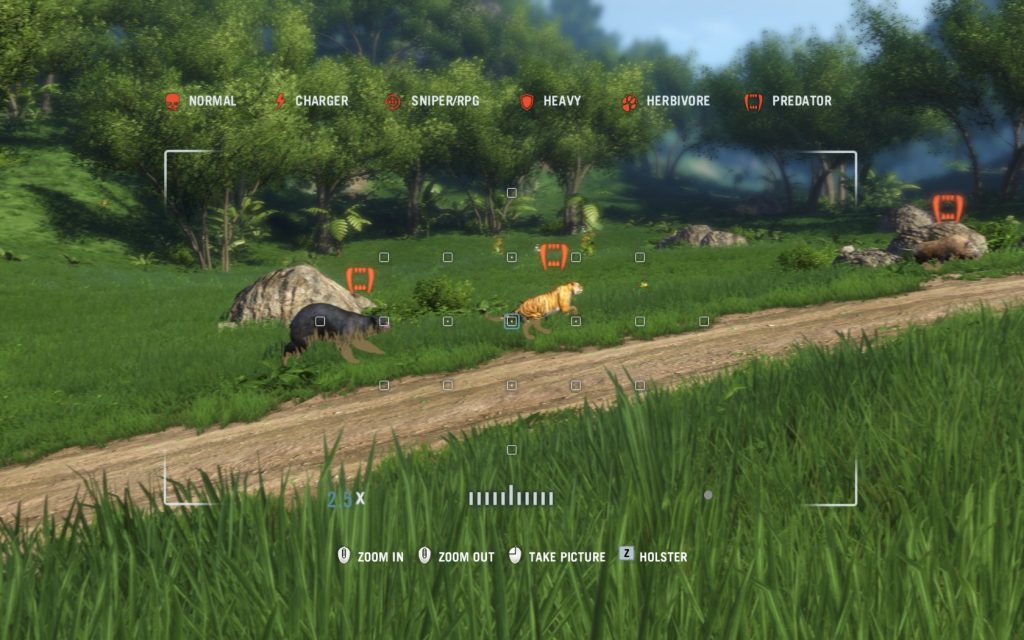
The game is played in a jungle, and you spend a good bit of time just running from one place to another. The jungle is filled with animals – some dangerous – that you can hunt and skin. You use animal skins to upgrade your equipment, then to sell once your equipment is fully upgraded.

A boar being chased by a tiger and a bear at the same time.

Initially, much of the map is hidden. You slowly reveal the map by activating radio towers. The radio towers are like small puzzles – you have to find the path to the top of the tower to remove a jamming device and reactivate it. It’s usually not difficult to find the correct path, but it’s a nice change of pace from the rest of the game, and you’re rewarded with a quick overview of what’s in the area when you reactivate the tower.

There are also enemy outposts scattered across the map. While these outposts are in enemy hands, you’ll see enemy jeeps and patrols in the area, which will attack you on sight. Once you clear an outpost, however, these patrols are replaced by allies, who will come to your aid if you enter battle nearby. Clearing an outpost also unlocks it as a fast-travel location, so it’s usually a good idea to clear them soon after finding them (if only to make getting around easier). Clearing an outpost also rewards you with a decent bit of experience.

While the game encourages being stealthy by rewarding you with extra experience for stealth kills or clearing an outpost while remaining undetected (if you’re detected, you’re only given a third of the experience), playing the game loaded with RPGs and light machine guns is just as viable, and sometimes much easier. Running through the game mowing down enemies with a hail of gunfire is probably going to slow down your progression, though. I played the game with a silenced sniper rifle, crossbow, silenced SMG, and silenced assault rifle – if at all possible, I killed everyone without being noticed. The AI is a bit dumb, so they can be eluded fairly easily, but there are times when they’ll immediately spot you if you poke your head out. These times were few and far between, however.

The AI will react fairly well to your actions. If you leave a body in the open, someone will notice (“Is that a body?!”) and start investigating. If you headshot the person standing next to someone, they’ll immediately go on alert (“Holy shit!”) and head toward the source of the shot. You’re given the ability to throw a stone as a distraction from the start of the game, but I rarely used it, preferring to snipe from a distance instead. However, you could probably make use of the distraction to get close-range takedowns throughout the game, and there are a few missions where you’re required to use the stone-throw ability,

With each level you gain, you earn a point to spend in the skill tree, which is split into three sections focused on certain abilities – takedowns (stealth melee kills), guns, or survival. Nearly every ability in the tree is useful, and by the end of the game it’s easy to acquire every skill. Some skills unlock new abilities, while others simply make existing abilities stronger or add convenience (like auto-looting enemies when you use a takedown).

Graphics and Sound
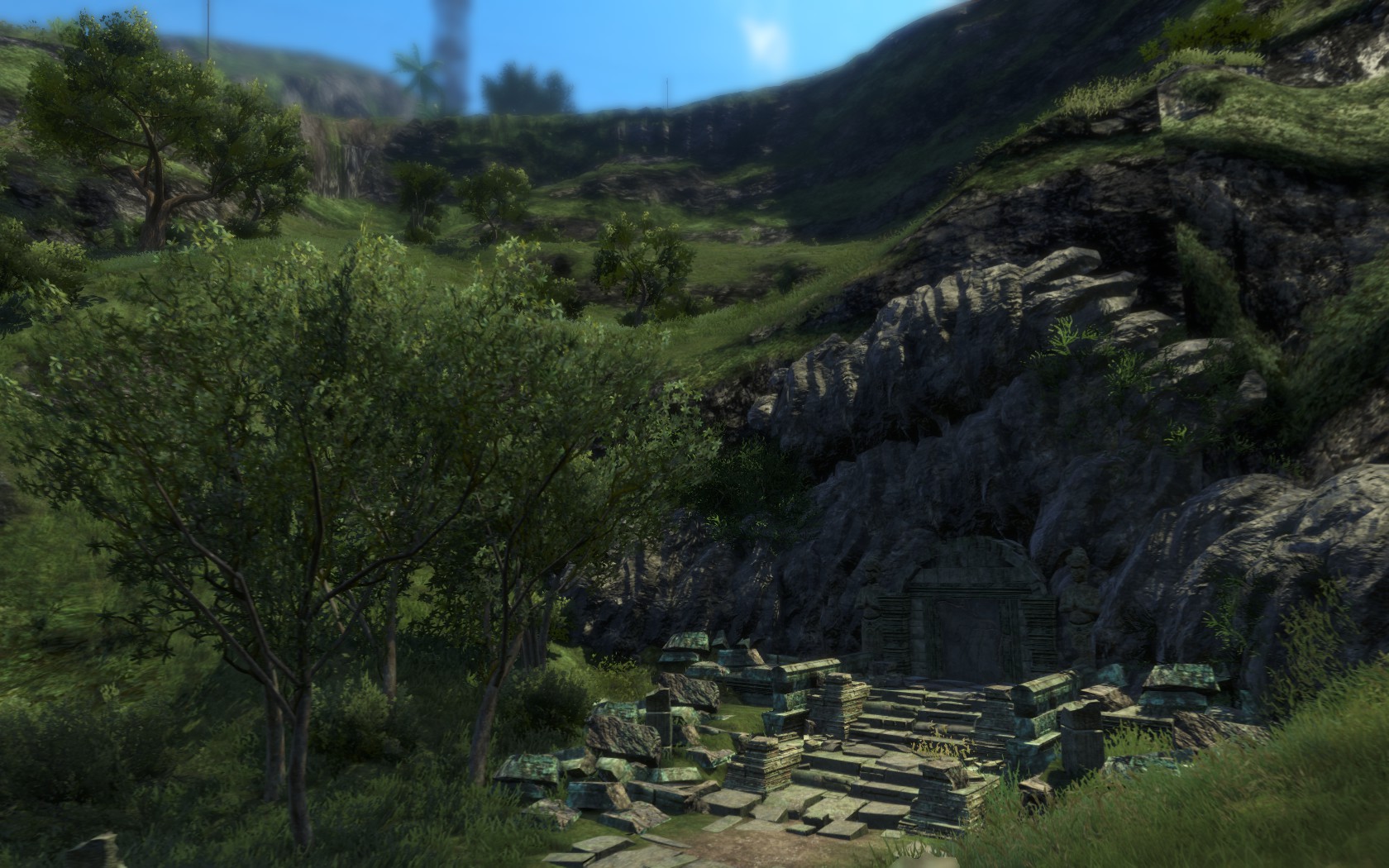
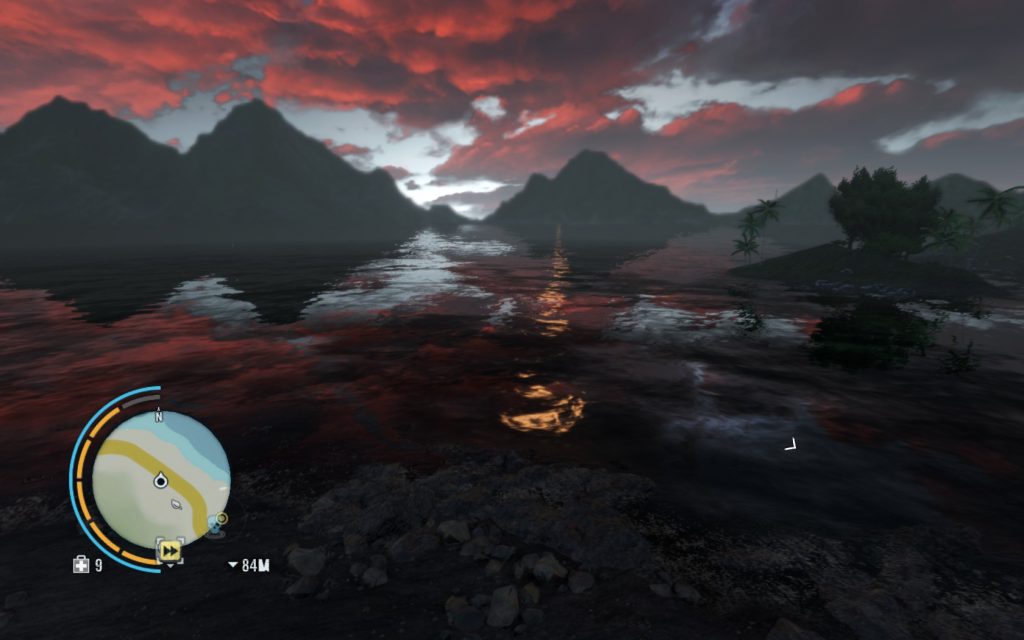
Far Cry 3 is gorgeous. The jungle is a beauty to behold, with a full day-night cycle. The game is played entirely from a first-person view, even when driving and during cutscenes. It’s a good thing, too, because your character looks like a total d-bag. (My reaction when I saw my character in the game’s “handbook” was: “Oh god, that’s what I look like?”)

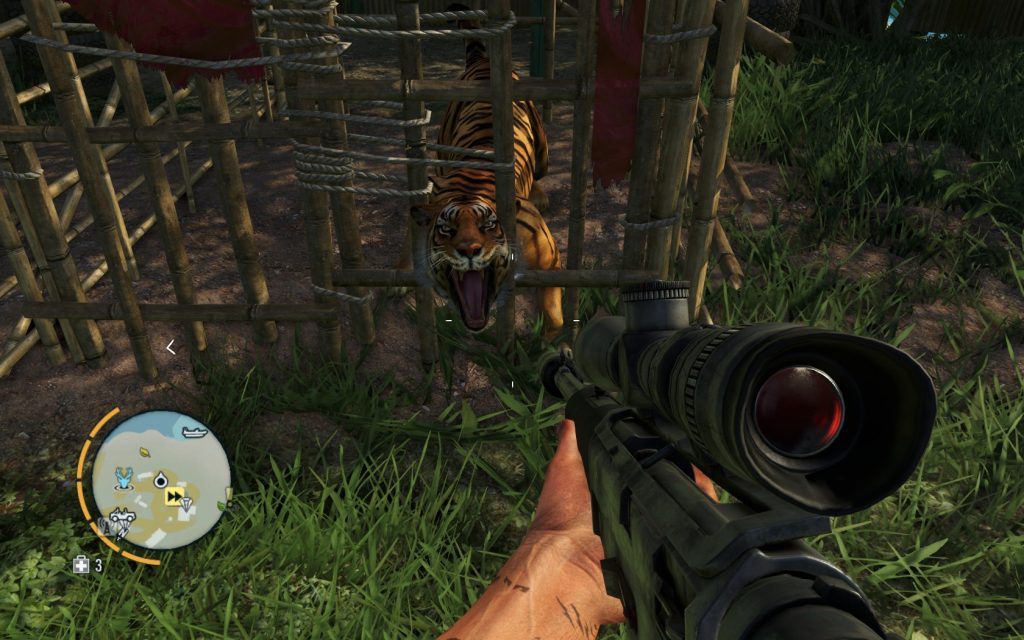
The sound is equally fantastic. I’d often be sprinting through the jungle then suddenly stop and crouch when I heard the growl of a tiger nearby. Enemies will shout to their comrades when they see you or find something suspicious. Music cues are also used well, making it easy to know when an enemy or animal knows you’re around.

Good tiger.

Summary
Far Cry 3 was fun to play from start to finish. The game is structured and paced very well – there was never a point where I was bored. The gameplay never felt repetitive, despite doing the same few things over and over again (like outposts and radio towers). There’s plenty of extra things to do (hunts, assassinations, challenges, and random side quests) so you can always take a break from the story. In fact, I spent the first several hours of the game just hunting and upgrading my equipment. As a whole, Far Cry 3 is a fantastic game that I could recommend to almost anyone.

Categories
Games

Review – Steel Battalion: Heavy Armor

Let me mention a few things up front:

  • I like giant robots.
  • I bought and enjoyed the original Steel Battalion, difficult as it was.
  • I like the Kinect.

That said, let’s move on to the review:

I don’t care how good the graphics, how elaborate the storyline, or how realistic the gameplay: if your controls don’t work, you don’t have a game. After playing the tutorial and having my virtual self flail about the cockpit like an idiot, I quit, packed the game back in its GameFly sleeve, and put it in the mail. The Kinect controls simply don’t work. The tracking is terrible and it’s a chore to do anything via the Kinect. Unfortunately, the Kinect part of the game is required. Therefore, the game is not fun, and nigh unplayable.

Congrats, Steel Battalion. You’ve set the low bar for any review I do in the future.

Categories
Games

Review – Towns

I’ve seen Towns compared to Dwarf Fortress, and they have a lot in common. They both have you control a group of people by giving them tasks to perform. They both feature town building, resource management, and combat. They’re also both very hard to get into, but extremely rewarding if you can get past the learning curve.

Gameplay
When you start a new game of Towns, you’re given a handful of townies (apparently what your people are called) in the middle of a randomly generated world. From there you have to set about acquiring resources like wood and stone and building up a small town to support your handful of townies. If you’re lucky, they’ll survive long enough to get a good settlement going. If you’re me, one or two might manage to survive until immigrants arrive.

Most of the game consists of you building your town. You don’t directly command your townies; you simply choose what you want done, and your townies will make sure it gets done. For instance, you can pick where your townies should mine or build, and they’ll set about performing the task. Sometimes this works as expected, but more often than not, you’re left wondering why your townies are doing one thing instead of another. The townies tend to work as a group, but this results in odd behavior at times; I’ve seen a single townie running out to an area where I’ve marked stone for mining, they’ll mine a single block, then run back to town to do something else, while another townie has to travel out to the same spot to mine a different block. Also, the “haul” task is separate from everything else, so even once you have storage areas set up, your townies are more likely to drop materials on the ground randomly instead of carrying it to a nearby container. It’s also difficult to prioritize what they’re doing (beyond a basic priority list). However, when it works, it works well. If things are set up properly, your townies can maintain themselves fairly easily with little assistance; it’s just hard to get to that point.

The user interface is the biggest hindrance to Towns. There’s a lot of information that would be useful if it was presented more clearly (or at all). I’ve had countless townies die because they were stuck on top of a building I was constructing, and all I needed was a “Hey, I’m stuck!” message and I could have saved them. Some messages show up that help, like when you can’t create something because you’re missing a prerequisite. These messages are great, but they’re buried in a menu. A chat-like log would be extremely helpful.

Towns also lacks an effective tutorial. The tutorials provided are very basic – simply a page of text describing what you need to do, and a few objectives like “Get 10 wood”. I played through all the tutorials and still didn’t understand how to create a thriving town. While the tutorials teach you some of the core concepts, they leave out a lot of the detail required to be successful. Luckily, there’s a wiki (www.townswiki.com) that explains what you should be doing much better than the game does. After reading through the wiki, I found I could get the basics set up pretty easily.

Graphics and Sound
The graphics are simple and plain, which works on a certain level but leaves much to be desired. Chopping trees consists of a townie standing on a tree and making a wood chopping sound. Combat shows townies ramming into their enemy repeatedly. Townies will sometimes team up on foes, which creates an awkward-looking orgy as your townies surround the enemy and thrust themselves into it repeatedly.

Sound is similarly bland, though some effects – like chopping wood and mining stone – are easily recognizable and help to indicate what your townies are doing. Death sounds are annoying, especially when animals are naturally dying around your village.

Summary
Towns is still in an alpha state, and it shows. I think Towns will be a fantastic game with a bit more polish. The interface needs a lot of work especially, since I find myself confused about what’s going on most of the time. Even when I think I understand what’s going on, I still can’t figure out why things aren’t working sometimes.

That said, I find myself enjoying the game, so there’s definitely something interesting here. It’s just not ready yet. I’m hoping development continues and the game becomes easy to get into and still remain rewarding when your town thrives.

Towns is currently $15 (on sale for $12) on Steam, and I think that’s a bit much for the current state of the game. $5 or $10 would have been more reasonable. For all these reasons, I can only recommend Towns to someone coming from Dwarf Fortress or deeply interested in micromanagement. Even though I enjoy it, it’s definitely not for everyone.

Categories
Games

Halo 4 – First Impressions

I’m waiting to play the campaign with friends, but tonight I tried out the some of Halo 4’s multiplayer options – mostly the co-op “Spartan Ops” episodes.

The Spartan Ops missions are short and felt very poorly organized. There’s an objective in each mission, but indicators are often hard to miss or don’t show up at all, leaving players confused and disoriented. In most of the missions, the game just throws multiple waves of enemies at you and tells you to kill them. It would probably be fine if they weren’t presented as missions, since they have a lot in common with Reach’s Firefight mode – they’re just not as fun or frantic.

One thing a friend and I both noticed is that many of the weapons don’t have the right feel. The battle rifle’s new effects are great, but the Wraith’s plasma mortar has a quiet launch and a pitiful “poof” when it hits the ground. Gone are the screen-shaking explosions, booming audio, and huge blast. Most of the “big” weapons (rocket launchers, fuel rod guns, etc) are similarly disappointing.

I also played a single round of the “Dominion” mode, where players fight to capture and defend several points. It was fun, but I was vastly under-leveled and was frequently killed by players with weapons I didn’t have access to. The maps usually have weapons lying around, but they were difficult to find if you didn’t know the map. I suppose that’s normal for competitive multiplayer games, however.

Player customization is nice, but there was an anemic selection of foregrounds for player badges. I was extremely disappointed to find my usual “Valkyrie” (sword with wings) badge was gone entirely. Hopefully more badges will unlock as I level my multiplayer character. The leveling system itself is nice, but even after unlocking items by reaching a certain rank, you still have to spend “Spartan Points” on the items to use them. These points appear to be non-refundable and are only awarded by leveling up, so they’re hard to gain and cause the whole leveling system to feel oddly restrictive.

Overall, I was unimpressed by the multiplayer modes. It feels like it’s been done before and better by other games, and I think Reach had a far better array of options. I want to like the multiplayer and maybe I’ll find something I missed, but I’m not getting my hopes up. And hopefully the campaign story is fantastic enough to balance out my multiplayer disappointment.

Categories
Games

Mass Effect 3 – The Ending

There’s been some “discussion” on the Internet about the ending to Mass Effect 3. There’s even a theory that the ending isn’t “real” and coming DLC will reveal the truth – called the “Indoctrination Theory” (GameFront has a good writeup about it here: http://www.gamefront.com/mass-effect-3-ending-analyzing-the-indoctrination-theory/). I’d love to find out BioWare was just tricking us, because the ending as it stands is extremely unsatisfying. The ending is boiled down to a single choice between 3 options, just like Deus Ex: Human Revolution, and none of them are really satisfactory. Unlike most of the game, there’s no clear “Paragon” or “Renegade” choice, and while I loved the hard decisions I was forced to make throughout most of the game, I couldn’t find a choice I liked here – no matter what I chose, I felt like I was making the wrong choice. It’s not like Inception where the ending is left up to interpretation – there’s simply no ending to be had.

Not only that, but your decisions and war assets from the rest of the game don’t make any return for the final scenes. Collecting war assets only contributes to a number that unlocks the third option. And although the third option gave me the “happiest” ending (in my mind, at least), it still didn’t feel right. I love endings that are up to interpretation, but there’s so little closure at the end of Mass Effect 3 that it feels like something’s wrong. The rest of the story was fantastic, and the universe is so fleshed out that it speaks very highly of the writing – dialog is perfect, the characters had so much personality you could become attached to them, and there were several jaw-dropping twists along the way. In spite of all this, the ending feels empty – almost as if they gave up or ran out of time. Or maybe they just couldn’t figure out how to end it and wanted to see how everyone reacted.