Your basic survival city builder boiled down to its most essential parts. You create a flow chart where each node is a building (woodcutter, well, storage), and link things together to transport resources from one to another (the woodcutter produces wood, which you link to the sawmill, which requires wood and produces planks for building). The sound effects and little building effects (“thwack” appears as the woodcutter operates) are a nice touch. Very simple and clean. Another one I might pick up cheap.
Create potions, sell them in your store. The haggling in this game is done through a card game and you expand your deck by forming relationships with various townspeople. I love the art style and the characters are very expressive (the animation is phenomenal). Definitely looking forward to playing this one more.
First-person factory building and exploration, similar to Satisfactory. It’s interesting, but the controls seem a little clunky, and the visual style is a bit bland for my taste.
A story-driven survival game where you customize your blimp and travel between ruined skyscrapers above a green death-cloud. Feels a lot like Raft with a more sci-fi style. I’ve been looking forward to this one, and while it definitely needs some optimization, I like the survival and building mechanics. Demo is time-limited (20 minutes) after the initial tutorial.
Survival city-builder set on the sea floor. Didn’t play this one too long – just enough to get a feel for it, but I’m looking forward to playing more once it releases. Could probably use some UI improvements (some things are a bit crowded), but otherwise it seems like it ticks all the usual survival city-builder boxes.
A first-person puzzle game like Portal. Instead of a handheld portal device, you get an “entropy” device, which rewinds time. I enjoyed the puzzles in the demo – they were pretty simple but require you to think four-dimensionally: you have to move things around in a particular order so when you rewind them, they end up where you want. The backstory to the game sounds interesting, too (with what little you get through devices in the demo), and the trailer makes it look like there might be some action-y sequences as well. Looking forward to the release.
A survival city-builder that appears to have some emphasis on story (hard to tell if it’s just the opener or the tutorial). Looks good and has a deep research tree, so there might be some nice complexity to it. I could see it being as good as Frostpunk. I’ll definitely pick it up once it’s released.
A roguelite city-builder. You choose an area from an overworld map, then build a settlement there while attempting to complete a number of objectives before the queen becomes too impatient with you. If you complete all the objectives before the queen’s impatience maxes out, you win and gain materials to use to improve the Smoldering City and future settlements. If you fail, you return to the overworld map with little to show for it. After a few settlements, the Blightstorm comes, destroying all your towns and reshaping the world. Looks great and it’s fun to play. I’ll definitely be picking this one up.
A management game with cute animal workers. Fun, but I lost my woodcutter to a storm relatively early and could never get enough wood to keep the lighthouse lit and ended up losing. Needs an easier way to recover from that sort of thing, but otherwise it’s a pretty easygoing game.
An old-school adventure game where you explore and upgrade your ship with an objective to rebuild your space station. It’s pretty simple to play, and I like the retro aesthetic, but there were some bugs with graphics rotating too far when turning which got really disorienting.
It’s like Vampire Survivors, but you control a spaceship. Designed for twin sticks, so it’s a little rough to control on a keyboard (WASD movement, arrow key rotation). I might pick it up after it launches.
The demo’s a little rough (missing text, no saving), and the tutorial isn’t very helpful, but I can tell the foundations of an amazing city builder are here. Very organic building (no grids), with some RTS-style army battles as well. This is another one for my wishlist.
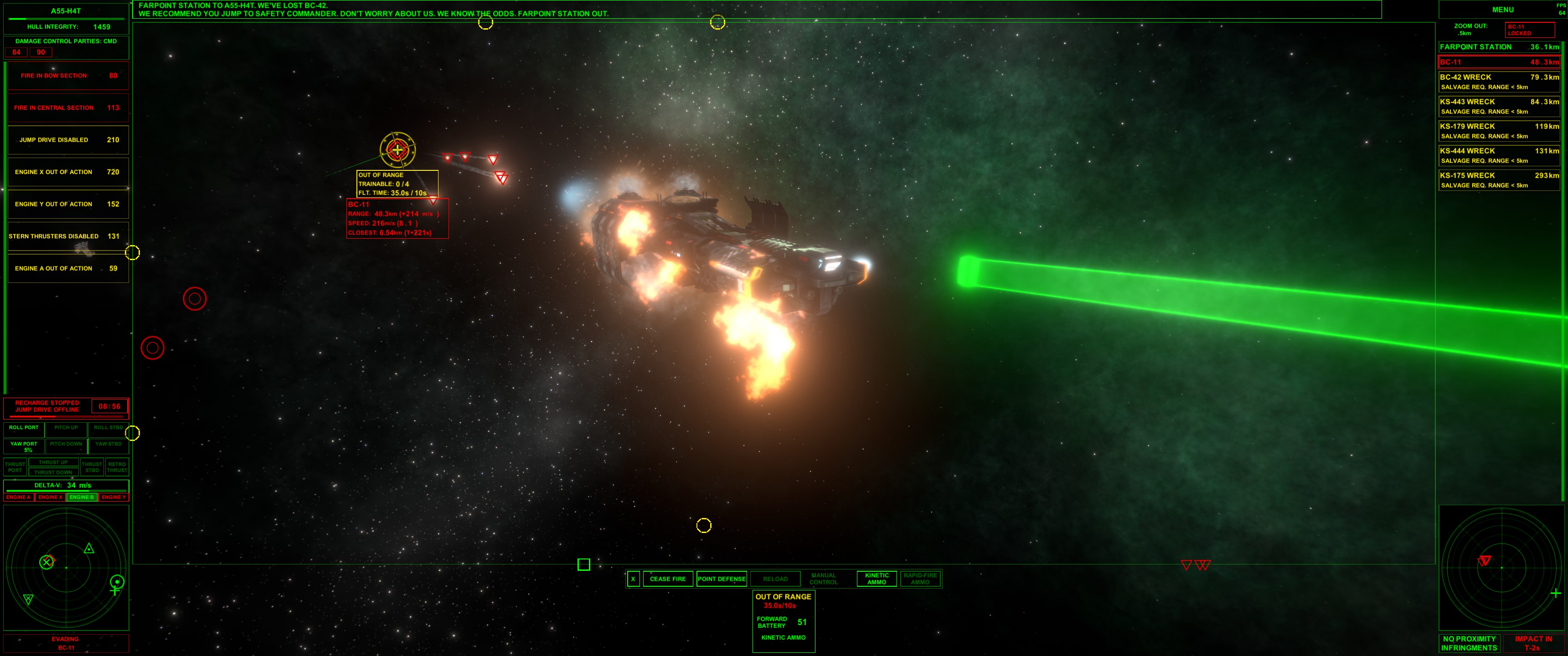
A tactical starship command sim. There’s a lot of depth and complexity, but it’s relatively manageable thanks to auto-pilot. Some people might be turned off by the blocky interface, but I like it – presents a lot of controls and information without blocking too much of the action. I’ll be keeping an eye on it.
A city-builder with streaming resources, terraforming, and some light combat. Pretty easy to play but with a decent amount of depth. Also, everyone is birds. I don’t know why.
The End
That’s the end of this Next Fest. There were a few demos I downloaded but didn’t have a chance to play. Several of the demos above are still available and I’ve noted them (with a little joystick: 🕹️) in case you’d like to try any of them out yourself.
I enjoy the Steam “fests” mostly because they’ve brought playable demos back. I like being able to try out a game with zero commitment. So each time one comes up, I give a handful of games a spin to see if there’s anything coming up that I’m interested in. Here are a few I’ve played over the past week.
Essentially Rimworld in space. You play as a ship’s AI that has been awoken due to a catastrophic accident on your ship, which is carrying a population of humans in stasis to another world. The game starts with your ship in pieces, and you have to start rebuilding and reconnecting the parts of your ship to ensure the survival of the humans on board.
I didn’t play out the entire demo, but long enough to get a feel for the game. It’s definitely one I’m going to keep an eye on.
I’m a fan of Stargate, and Exogate Initiative lets me play out my fantasy of running Stargate Command. The base building draws a lot of inspiration from Dungeon Keeper and Evil Genius (other games I love), and when you send teams to explore other planets, a kind of “choose-your-own-adventure” style dialog plays out. You attempt to gather samples of plants and animals from alien worlds, research them, and use what you discover to earn income for the Initiative via patents.
Pretty easy to play, though they purposely left out a tutorial (there’s a message when you start saying they think players are smart enough to figure things out on their own); I think a short tutorial would have been handy to instruct me to set up certain things before I started hiring scientists, since one quit before I could get a mess hall and barracks built.
Regardless, this was probably my favorite demo from the event. I’ve been looking forward to it for a while already, and it’s likely going to be an Early Access purchase when it’s available.
It’s the creature phase of Spore, but an entire game. The creature creation is great and provides a lot of ways to customize things. I had a little dragon-like creature with a shell and clubbed tail. He was adorable.
A Banished-like game. I played for a bit just to get a feel for it. I was frustrated by the building footprints, which appear to have a “road” space in front of them, but don’t when built, so I had houses basically had connecting front doors with no space for a road between them. It annoyed me, but it’s not bad. I’d probably just play Banished, though.
Start with a ship and slowly acquire/recruit a fleet to flee or fight the “Harvesters”. It’s got an interesting wireframe aesthetic. I was having a good time until I got to a point where my ships stopped responding to my orders and just sat around doing nothing…
A bit like Dwarf Fortress, I think. Huge maps, complex structures (you can design your own building layouts and place items inside), low-detail graphics. The tutorial in the demo is pretty straight-forward, but it’s difficult to know how large I should build something (what’s a good-sized warehouse?).
An easy-to-play text adventure game with an interesting twist at the end. The puzzles were never too obscure – I always knew what I needed to do, though not always exactly how I was going to do it. I enjoyed it and might pick it up cheap at some point.
Kind of an educational game about how viruses work. Pretty simple (too much for my tastes), but if COVID has taught us anything, it’s that people just don’t understand public health.
I enjoy the anthill-style building (like XCOM), but some of the adventure-gamey portions are a little boring. I wish I could queue up actions instead of having to walk my character everywhere and do so much clicking.
I want to love this game, but the demo is confusing and nigh-unplayable. After several restarts, I figured out some basics, but never survived more than about 10-15 minutes before the enemies were blasting me while I was practically defenseless. Desperately needs a tutorial or something. Gorgeous, though.
I love space games. I’ll play any type, really: strategy games, flight games, survival games, shooters. I’ve always had a fondness of spaceflight games since playing Wing Commander in the 90s. These days, there’s Star Citizen (which really only partially exists; and the Squadron 42 part of the game is still in development) and Elite Dangerous. I love Elite, but I don’t like playing because I can’t just have fun and try things – if I die, I lose my ship and a decent amount of cash, which can be a grind to earn. What I really want is a game that I can just play without having to worry about things too much, and that’s where No Man’s Sky comes in.
The Past
No Man’s Sky had a rocky start. A lot of players didn’t like it, claiming it didn’t live up to the hype. That’s at least partially true (there were things that Sean Murray said but was never in gameplay or concept clips; though things were definitely more sparse and typically less interesting than the original trailer would lead you to believe), but I was hooked by the idea of simply exploring a procedural galaxy by my lonesome. I loved No Man’s Sky from the start. It was a chill single-player exploration game. Something you could sit down with and just lose yourself in for a few hours. It was peaceful in a lot of ways, even if you were getting chased by sentinels or hungry predators.
But since then, Hello Games has really turned it into the game that everyone wanted and then some. You can still explore, but now you can play missions with other players, build bases, mine resources, battle sentinels, command freighters, send frigates on expeditions, manage a settlement, tame and ride creatures, cook weird alien food, and more. They’re still adding to the game with new additions like the recent Sentinels update that added more sentinel varieties with specialized roles. A visual improvement a few updates back has made things look fantastic, and you can easily play with friends now.
The Present
I’ve been playing No Man’s Sky pretty heavily over the past few months, slowly building a resource extraction empire so I’ll have an unlimited supply of all the basic resources and plenty of units to buy ships or resources I need. I’ve mostly accomplished that – I have a mining outpost dedicated to every basic resource, a few Activated Indium mines (a high-value resource that can be sold for units), several Runaway Mould farms (which can be processed into nanites, one of the currencies), an A-Tier Freighter (still looking for an S-Tier), and I’ve even been to the center of the Euclid Galaxy (the starting galaxy) by using a portal to teleport a few jumps from the center. I play every expedition (the NMS equivalent of seasonal content in other games) to earn some unique new decorations or gear. I have over a billion units (basic currency), so I can buy whatever I need. I have a small settlement that produces dirt (still need to upgrade it some more). I have a farm that produces all the growable plants and harvests milk and fruit from local fauna. And there’s still more I want to do before I’m “done”, and even then, there’s plenty of cosmetic content that requires a special “Quicksilver” currency to purchase, which can only be acquired from special missions.
Of course, this is all after a relatively long break from No Man’s Sky. When I came back, I had to relearn a lot of different things. Luckily I came back with the second expedition, and the expeditions were designed to help players relearn the game, so it taught me a lot about how to play again. One expedition had a section dedicated to cooking, and I had to learn the cooking systems in the game to get through that (it’s a little boring). The expeditions require a new character and start players from the same place. You’ll see a lot of other players, and if you start a few days after the launch of an expedition, you can probably find a player base filled with resources you can use to get a head start. (In the last expedition, I found an Activated Indium mining base and took about 30k to sell and refine into Chromatic Metal. I was never in need of money or Chromatic Metal through the rest of the expedition.)
That’s not to say everything is perfect. There are still plenty of bugs. I have a base with no Base Computer because it disappeared while I was trying to move it (so I can’t rename or destroy the base now). Some bugs can be game-breaking, but I’ve been fortunate enough not to run into any of those.
Some things could be improved. I wish base building was a little smoother and had more snapping options (there are small floor panels that I have an incredibly hard time getting placed properly). I wish you could make base blueprints to instantly build small outposts. I wish I could customize the visuals of my ship.
You can get around most of problems with save editors since No Man’s Sky is still essentially a single-player game. I haven’t gone that far yet since I haven’t run into any major issues.
The Future
Hello Games continues to make updates that grow the game and add new ways to explore or stake your claim in the universe. Their pace has been pretty consistent and they claim to have plenty of ideas for things to add to the game. I’m still hopeful they add some of the customization options I’d like.
There’s some competition coming with games like Starfield from Bethesda (I’m interested, but not getting my hopes up), but No Man’s Sky has a big head start and some things I just don’t see getting added to other games (space whales seem out-of-place for games like Starfield or Elite).
And luckily, even with all those changes, No Man’s Sky still retains that chill exploration experience. It’s more hectic if you’re in an outlaw system or hazardous planet, but you can still just land on a paradise planet and enjoy the view.
I generally hate PVP games. When games support PVP but have an option to disable it, I usually will. I just have no interest in competing with people who measure their worth by their ability to “own noobs” in a video game. That said, I’ve begrudgingly played PVP in Destiny for several years now; typically just to earn special gear or complete seasonal objectives. I find PVE in Destiny far more satisfying since you don’t have to play the “meta” to get ahead. And as a solo player, it’s a chore finding a team and disheartening when I enter a PVP match against a full clan.
But Bungie has been improving things for solo players. Over the last year, they’ve added “Freelance” modes to several PVP modes (Crucible, Iron Banner, Gambit, and Trials) for solo players where everyone in the match is playing solo. I found I did far better in Iron Banner when solo queueing (maybe I’m not quite as bad as I thought?), making PVP a bit less of a nightmare.
How Trials of Osiris Works
Trials of Osiris is Destiny’s end-game PVP mode, where two teams of three compete over several short rounds (I think there’s a time limit of two minutes), with the first to five wins victorious. Trials is a little different from typical 6v6 PVP, but works a bit more like high-level PVE: when you die, you have to wait for an ally to revive you. A team wins by eliminating the other team, or by capturing a point after the time limit. To enter Trials, you need a “passage” ticket purchased from Saint-14 in the Tower that tracks your wins. If you win seven matches with no losses, it’s a “flawless” ticket and lets you access The Lighthouse, where you can redeem special rewards like “Adept” weapons with slightly better stats or special armor.
Within the past few seasons, Bungie introduced Freelance mode for Trials in a “Trials Labs” option that isn’t always available (unfortunately). This weekend was the first time it’s been available this season, and I’ve been wanting to give it a try (for a chance at some of that sweet Trials loot), so it seemed like it was about time. I headed to Saint-14 to purchase my ticket.
There are four types of passages: Passage of Mercy, which forgives one loss; Passage of Ferocity, which awards a bonus win after your third win; Passage of Wealth, which increases your rank points from reaching 3, 5, and 7 wins on a ticket; and Passage of Confidence, which requires a previous flawless win and grants a bonus reward from the flawless chest.
Dipping my toes
I purchased a Passage of Mercy as a feeble attempt to go flawless. I won my first match thanks to some far better players on my team, but lost my second match relatively quickly, spending my free loss on the ticket. I could have bought another ticket (resetting my progress), but just decided that next time I’ll use Ferocity to get a bonus win and finish the ticket faster.
The rest of my matches over the weekend were about 50/50. Sometimes there were players on the other team that were simply better at PVP, or played the meta better. After seven wins, my ticket was completed and I started getting better rewards after matches; typically just extra Trials engrams, which I opened for a random piece of Trials equipment. (Though I wasted several engrams early trying to get good rolls of one of the few weapons I had unlocked.)
I started off running a PVP build I had seen on YouTube build around the Lorely’s Splendor Titan helm and the Le Monarque bow. Loreley’s Splendor lets you spawn a sunspot when you cast your Barricade, and allows sunspots to heal you, making them a great defensive ability. The Titan’s bottom-tree Sunbreaker subclass gives you a buff called “Sun Warrior” while standing in a sunspot and for five seconds after. This buff gives a 20% damage increase, and a precision shot from Le Monarque against a player with no defensive buff will result in a kill (the headshot does a big chunk of damage, and lingering poison damage finishes them off). I was doing fairly well with the build, but got bored with it and started trying other things. Toward the end, I decided to run with a hand cannon to try to finish an objective, but I’m not very good with hand cannons and had only middling success.
Regardless, I actually found it… Fun? I think? It was great unlocking some new weapons that are actually really effective. No god rolls, but all Trials weapons have an origin trait called “Alacrity” which increases your reload speed, stability, aim assist, and range whenever you’re the last living member of your fireteam or running solo. That last bit surprised me – there’s some really great solo weapons locked behind an endgame team-based PVP mode, which seems odd.
Final Thoughts
I think the “Freelance” mode for Trials needs to stick around just to open it up to more of the Destiny community (all us solo players). I did some searching and found that there’s actually some debate as to whether or not it should be permanent (or exist at all).
The arguments against seemed to be limited to a minority of players that see it as only for “elite PVP players” and there’s no room for filthy solo players or casuals. (The people I mentioned above who measure their worth by their Trials score.)
The arguments for were far more numerous. People generally seem to like opening up the accessibility and letting more players access the content, along with making it easier to earn the special Trials gear. I also saw these players typically acknowledge the general issues with Trials, which mostly just boil down to too much focus on going flawless. A common complaint is around matchmaking, where a top 10% team may get matched against a bottom 20% team, which is far from fair, and a loss kills a chance at flawless. Removing the “flawless” quest would alleviate the problems around getting matched with a far superior team.
My biggest issue with most of Destiny has been the gating of rewards behind certain activities that are inaccessible to some players (typically solo players). I’m fine if the rewards are cosmetic to show off an achievement, but often those rewards are weapons or armor that are significantly better than what can be found elsewhere, which can give an edge to players who are able to engage that content more easily.
All that said, I’ll likely continue playing Freelance Trials whenever it’s available, and hopefully Bungie takes some notice of players like me and makes it a permanent option.
The first week of Destiny 2’s latest expansion, The Witch Queen, is nearly complete and I wanted to share my impressions of the new content and changes that came along with it.
There may be some minor spoilers in here, but nothing that hasn’t been revealed in trailers or introduced almost immediately upon starting the campaign.
Also, I’m going over a lot in here – practically everything that I’ve noticed in my first week – and a lot has changed, so brace yourself.
Story
I’m a longtime fan of Bungie’s ability to craft a world. I loved Halo’s lore to the point of reading several of the novels to learn more about it. There was a dark time in Destiny 2’s history (*cough*Activision*cough*) where there was little story progression each year in Destiny, but the past year changed all that: we saw humanity create allies from former enemies and fight several threats that were all building up to this new expansion. While the end of the last season, Season of the Lost, was a little underwhelming (though the final mission was a lot of fun), so far The Witch Queen campaign and Season of the Risen has been fantastic.
I’ve recently been reading the Destiny grimoires to learn more of the lore, and the grimoire starts with The Book of Sorrow, which details the beginnings of the Hive as we know them in the game. It turns out The Witch Queen delves pretty deeply into this lore as well – during one of the initial cinematics, there were several details that were straight from the lore I’ve been reading. We’re likely to learn a lot about the history of the Hive this year, so if you’re interested in Destiny lore, I think is is going to be a great year.
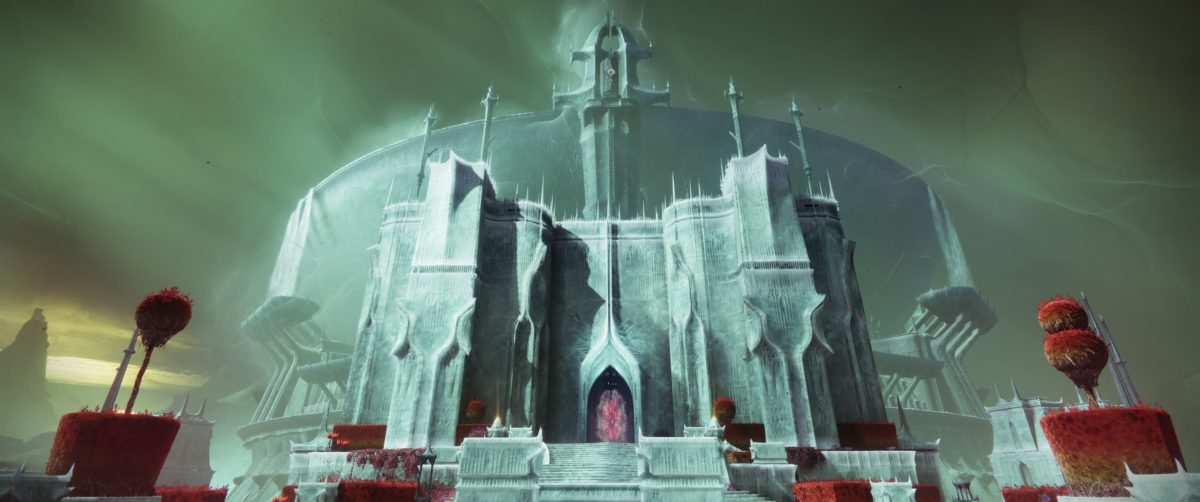
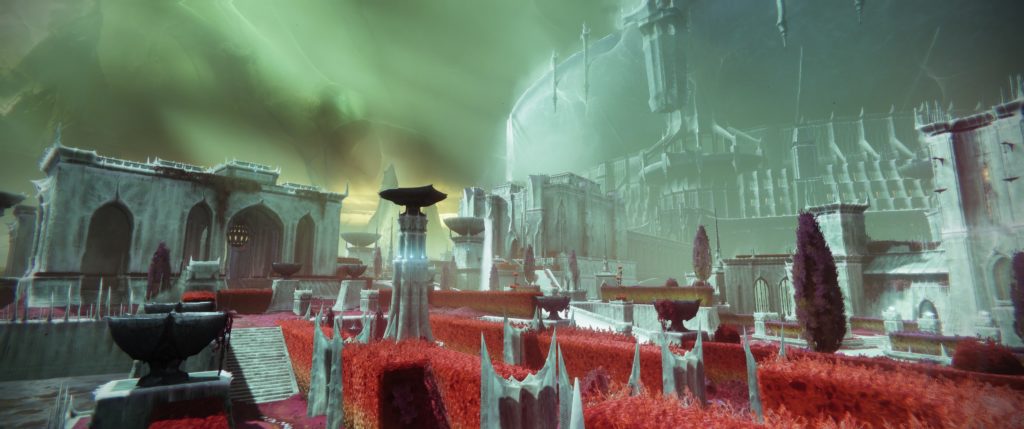
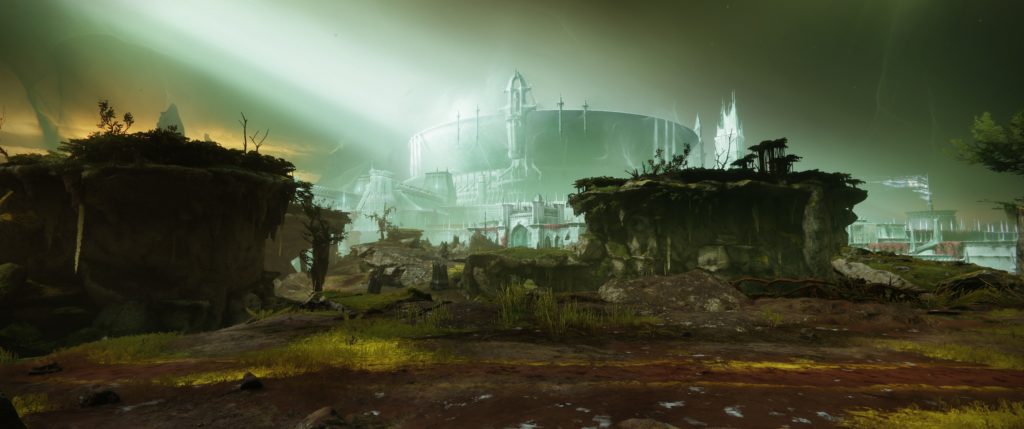
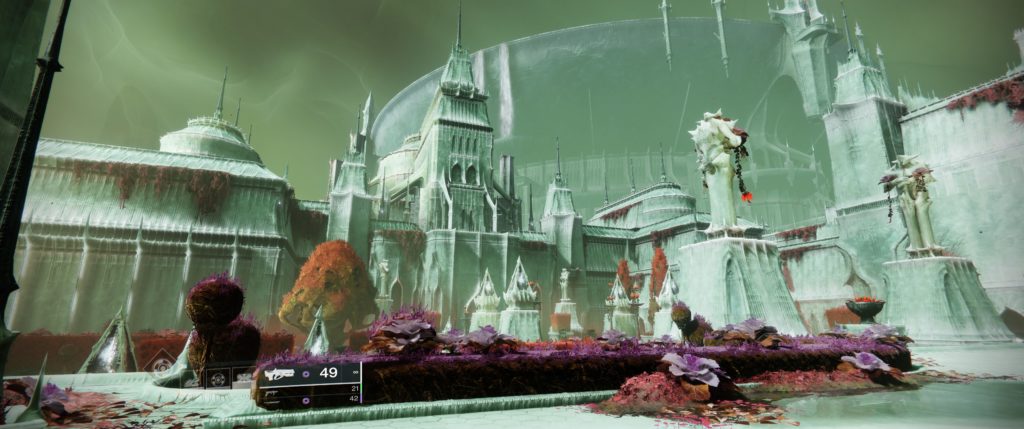
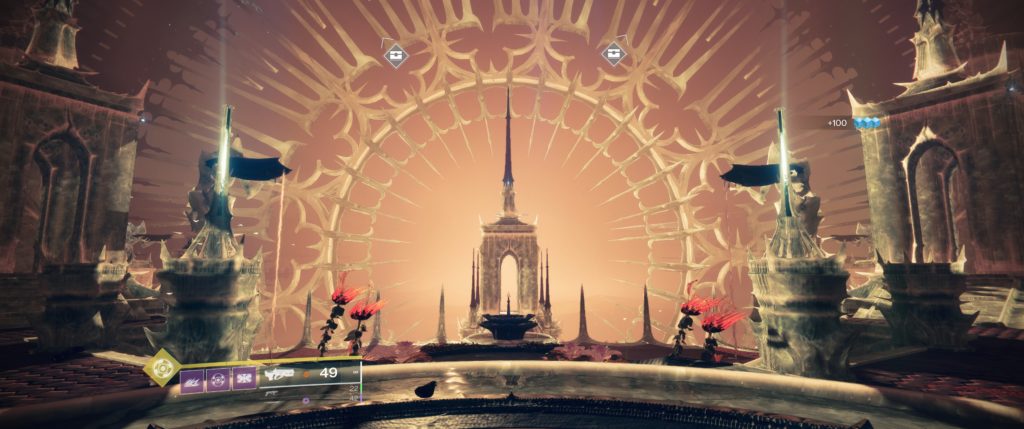
There are a few main themes in The Witch Queen: memory, mystery, deception. They all revolve around the titular character, Savathûn, the Witch Queen herself, and her Throne World – a world of her own creation on another plane. The Throne World destination is pretty large and labyrinthine – while on the surface it may seem about the same size as past destinations in Destiny, there are hidden paths and passages scattered throughout, reflecting Savathûn’s character. As Savathûn has been chasing the light for some time, there are areas that reflect her Hive background (and desire to distance herself from it) next to areas of odd beauty – her chase of the Light.
Within these areas, you use a new “Deepsight” ability to find hidden paths, which are “echos” – memories – of the past state of the world. Below Savathûn’s Throne World, Mars has areas where you can see its past – echos of humanity’s Golden Age. Much of the Witch Queen campaign involves revealing these memories to learn more about how Savathûn now possesses the Light.
And that is the core mystery of the expansion: how did Savathûn steal the Light? The Traveler gifted humanity the Light (and the Eliksni before that); why would it give the Light to the Hive? Did they trick the Traveler somehow? Did she steal the Light from Guardians? In order to find out, you have to chase Ghosts and capture new Hive Lightbearers to extract information with the help of our new Cabal allies. The campaign itself has some great twists and some pretty stunning reveals.
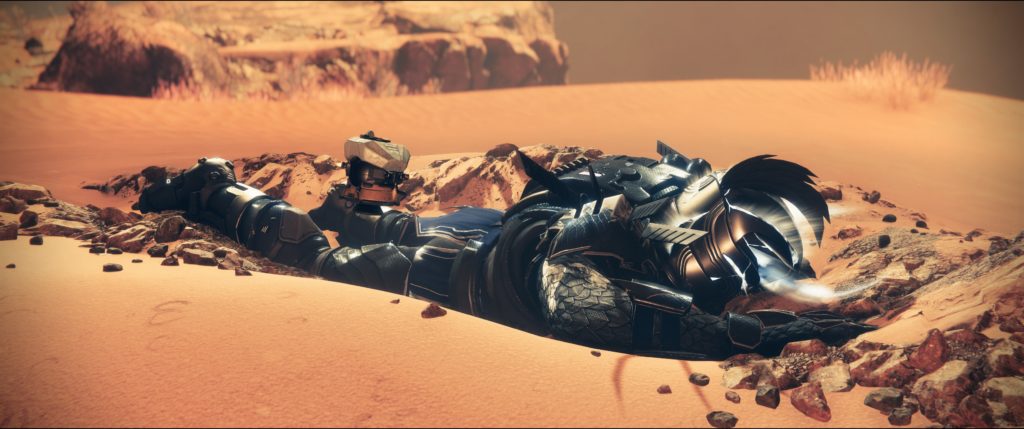
Check out this crater I made.
On a side note, I love Savathûn’s character, and the voice actress does an amazing job bringing her to life.
The Legendary Campaign
I’ve beaten the Witch Queen campaign on Legendary difficulty (took about three days, playing one or two missions a day), both to extend the life a bit and for the rewards granted for completing it at that difficulty. It was tough – there were three bosses I had to use the Destiny app to pull a fireteam together for – but it was still a lot of fun and made the missions feel more dire.
The levels themselves are extremely well designed, with plenty of cover in the respawn-restricted areas. I had to cheese a few encounters or exploit geometry and sightlines to stay safe and get my damage in, but completing these levels mostly solo felt very rewarding and I was able to approach them at my own pace.
Playing the campaign on legendary left me wanting to play past campaigns at a higher difficulty (with appropriate rewards), just because of how harrowing they feel at certain times. It’d be nice to allow matchmaking as well (which might be available when replaying the missions; I haven’t tried).
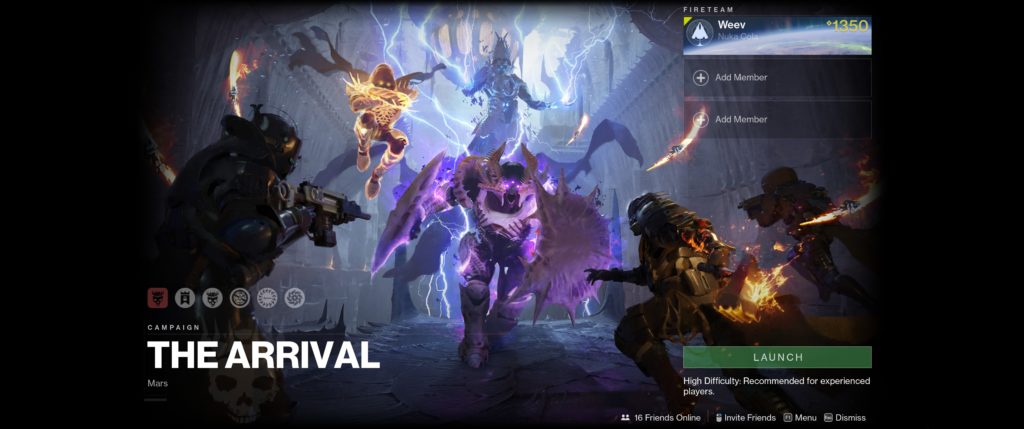
The Legendary Campaign launch screens show the new Hive Lightbearers looking particularly terrifying.
Hive Lightbearers
One of the big changes with The Witch Queen are new Hive Lightbearers, one matching each of the three player classes: Titan, Hunter, and Warlock. The first time you encounter one of these in the campaign, it’s a big deal, and on legendary difficulty is appropriately scary (coming in at the minimum light level for the new content).
Hive Lightbearers tend to be mini-bosses, but I’ve found they’re not too difficult to deal with. Fighting them can be a bit like playing PvP – you can handle them the same way you handle players that use their supers: you can retreat and hide to run out their super timer, or you can try to fight while dodging their attacks. Fortunately, the AI is pretty bad for these guys: Hive Knight Lightbearers – the Titan equivalent – will sometimes stand behind obstacles and hurl their shields at walls right in front of them, to the point where they’re not even a threat. None of the them are as strong as a player Guardian, but they can still be deadly if you don’t keep moving.
Each of the “subclasses” use abilities similar to player classes, with a few exotic variants tossed in. The Titan equivalent for the Hive uses the Void subclass: summoning barricades, throwing suppression grenades, and throwing shields during their super. The Warlock equivalent uses Arc abilities and can summon a rift to heal (and maybe empower?) themselves. Finally, the Hunter equivalent uses Solar abilities, throwing knives during their super and sometimes becoming invisible.
Overall, the Hive Lightbearers are really just new bosses with attack styles that mimic players. They can be difficult at times, but more often you just fight them like any other boss – with ample use of cover and frequent movement.
Void 3.0
Another big change with this expansion is the introduction of a Void subclass rework, dubbed “Void 3.0”. As a Titan main, Void was my least-used subclass; it generally felt less powerful than other subclasses, though the Ward of Dawn was useful for high-level content. The Void 3.0 updates have changed that – it’s now one of my favorite subclasses for survivability. I wouldn’t have made it through the legendary campaign without the new overshield mechanics for Titans.
As they did with the Stasis subclass, Bungie focused the Void changes around a handful of keywords: Overshield, Invisibility, Devour, Volatile, Weaken, and Suppress. Each class has a buff and debuff it specializes in, though all classes have some access to the entire set. Along with the ability changes are the aspect and fragments like the Stasis subclass.
I’m most familiar with the changes for Titan, but I’m going try to give a brief update for each class:
Titans
I love the changes to Titans. Void Titans now specialize in overshields and making enemies volatile, which causes them to explode when killed. What I love best about the changes is that it clearly turns Void Titans into a “protector” class – they deploy shields and barriers to give their teams extra durability.
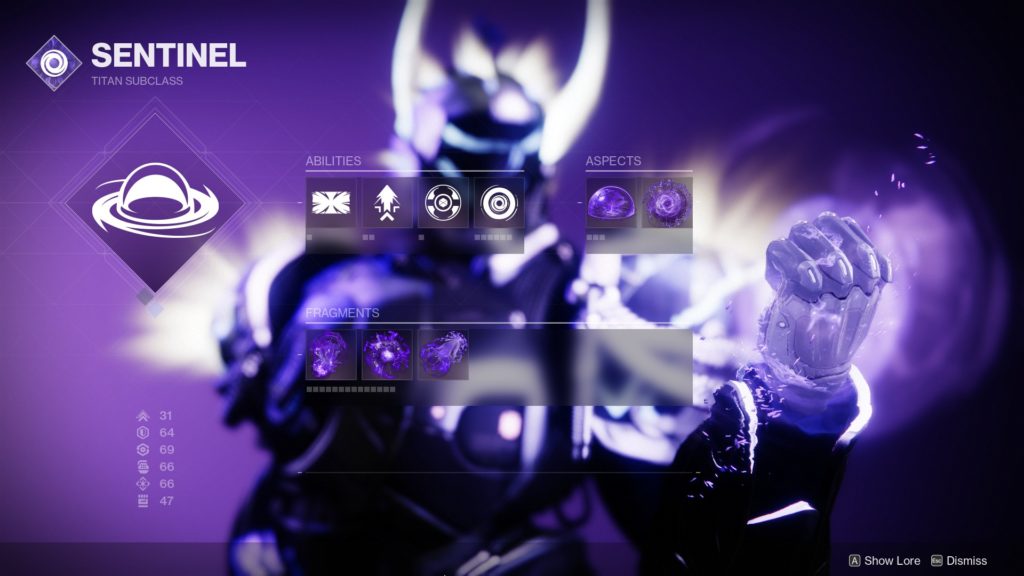
While the other classes get three super options (matching the old Void trees), Titans only get two: Sentinel Shield and Ward of Dawn. The Sentinel Shield basically works like the previous Code of the Commander shield, where guarding creates a barrier that allies can shoot through for increased damage. Ward of Dawn has a significantly decreased cooldown, so you can use it more often now, which is great for moments when you need some breathing room or need to control an area. (I played the campaign with Sentinel Shield and really wish I had used Ward of Dawn.)
While the Titan Barricade and Jump abilities didn’t change, the melee abilities did, and Bungie included something that seems like a no-brainer in hindsight: a shield throw melee ability. Along with the old shoulder charge melee, Titans have an option where they throw their shield, which will bounce off terrain and enemies. It takes some practice, but you can hurl it across large areas and deal some damage with the ricochet. It doesn’t seek as much as the super shields, but if you’ve got a line of enemies coming at you, it can typically plow through them. And while the Barricade abilities themselves didn’t change, their animation did: instead a shoulder-bash style deployment, Void Titans summon their shield and slam it into the ground to create their Barricade.
The Titan aspects allow builds to focus on overshields granted from barricades and supers, or making enemies volatile to create chain explosions. I ran the campaign with Bastion and Offensive Bulwark, granting me regenerating overshields behind my barricade and increased grenade recharge. It was a heavy-defense build, but that’s what was most important during the campaign.
Warlocks
From what I’ve read, Warlocks arguably got the best upgrades with Void 3.0. Warlocks specialize in Devour (increased grenade recharge and heal on kill) and Suppression (blinds enemies and prevents ability use). Their super options remain the same as before, as well as their class and jump abilities. They have an aspect called “Child of the Old Gods”, which lets their Rift summon a Void Soul that can weaken nearby targets and deal damage, as well as recharging abilities or healing (based on the type of Rift used).
Hunters
That leaves Invisibility and Weaken for Hunters. I’ve seen a lot of complaining from players online about the changes, but the changes seem in line with the way Void Hunters operate. I had a few Hunters in my team during the campaign, and they’re still plenty strong; they just don’t have the survivability options Titans and Warlocks have (though being able to become invisible is pretty powerful). I can admit the changes seem less drastic for Hunters, however.
Like Warlocks, Hunters keep their previous three super options, as well as jump and class abilities. Their Aspects generally cater to staying invisible and granting invisibility to allies.
Fragments
Fragments are the same for all classes, and I won’t go into each, but I used three throughout my entire campaign run: Echo of Exchange, which grants grenade energy on melee kills; Echo of Resistance, which causes Void buffs to have increased duration (longer-lasting overshields); and Echo of Expulsion, which causes enemies killed by Void abilities to explode. There are a few other I’d like to try out, like Echo of Remnants (increased duration for grenade effects) and Echo of Provision (melee energy on grenade damage), but I was pretty happy with the ones I chose.
PsiOps Seasonal Activity
Each season comes with a new seasonal activity, and this season’s “PsiOps Battleground” is a fine addition. I feel like Bungie has a solid formula for creating these activities, with a clear structure that consists of several “stages” to complete. While PsiOps probably isn’t the best they’ve produced, it’s still pretty simple and straightforward. I imagine it’ll evolve over the course of the season.
New Weapons and Perks
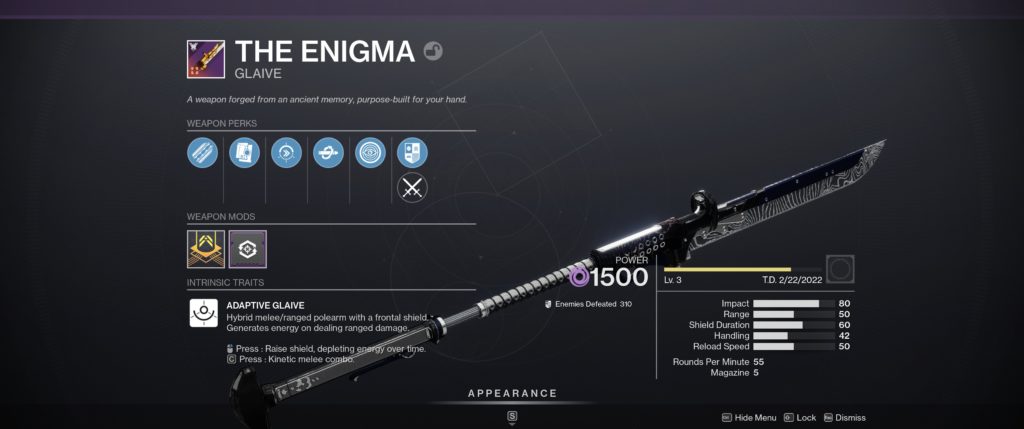
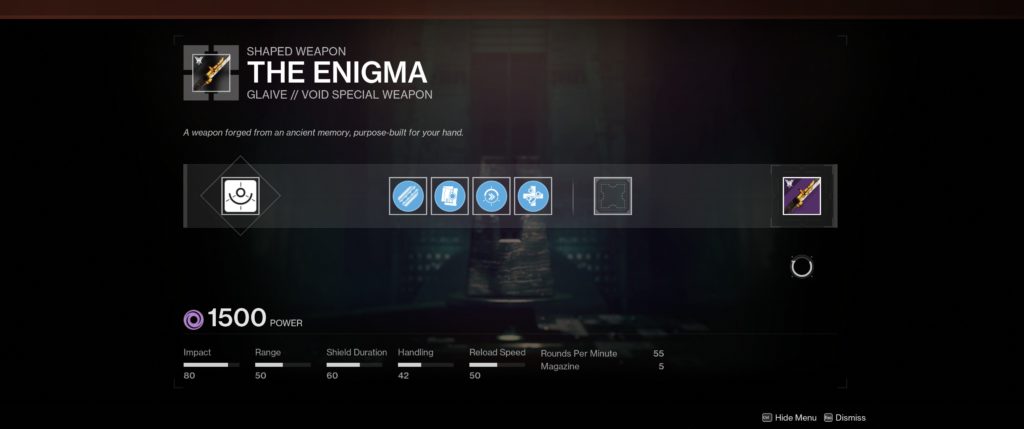
The big new weapon this season is the glaive, which feels great. When wielding it, your melee ability is replaced with glaive strikes, which have a strong three-hit combo. They can also fire a ranged blast that uses special ammo. And finally, they can deploy a short-duration shield to block incoming fire (which recharges a bit on projectile kills). My only complaint on the glaive is the difficulty in recharging the shield, but that might be a balance consideration; I could see them being annoying in PvP if everyone could just charge into melee range with a shield up constantly. There are also several seasonal mods this season to buff glaives, making them very useful.
The new “origin” traits for weapons are nice, subtle effects. They don’t make a huge difference most of the time, but they can be handy. Most new weapons have an origin trait based on the “make” of the weapon, and activities like Strikes, Crucible, and Gambit give an additional origin trait option based on where you found the weapon. I’m most excited about the Vanguard trait, which causes final blows to heal.
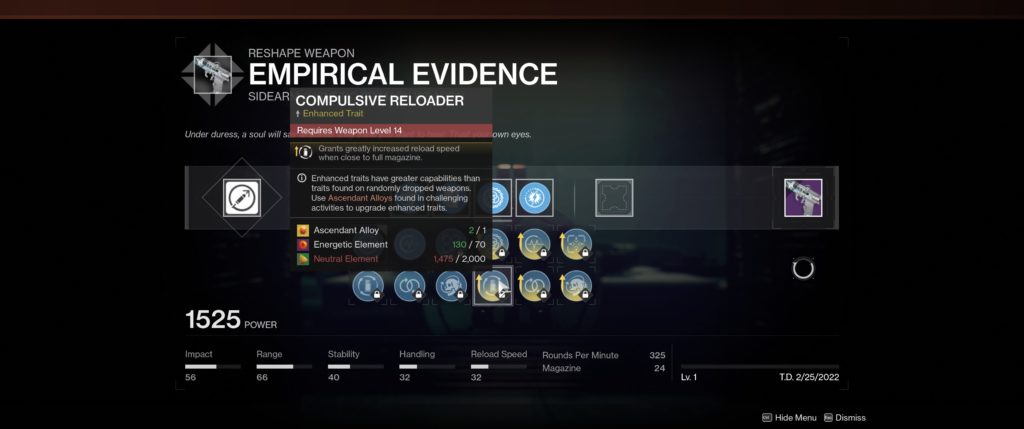
There are also a lot of fun new perks, like “Compulsive Reloader”, which gives you faster reload speed when close to a full magazine (basically the opposite of the existing “Alloy Magazine”, which reloads an empty clip faster).
Weapon Crafting
Finally, the thing I’ve been most excited about with this expansion: weapon crafting. I’ll say what’s here is a decent start, but it’s far from what the game needs.
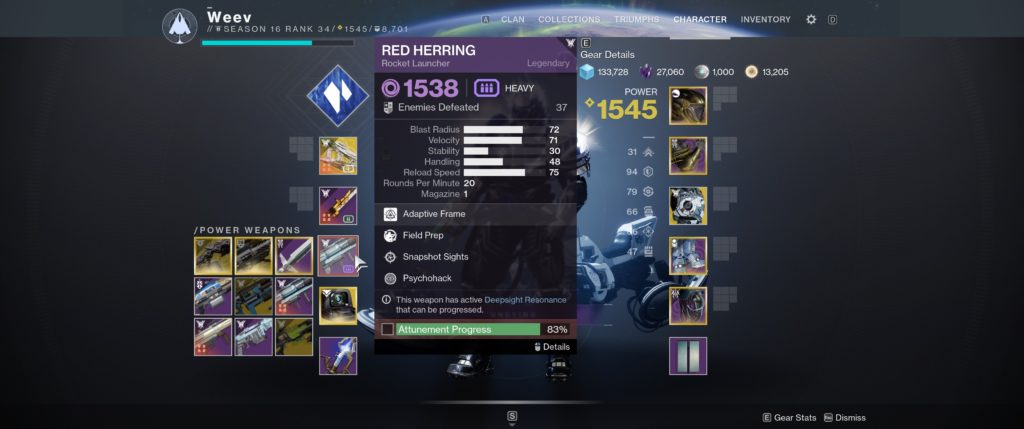
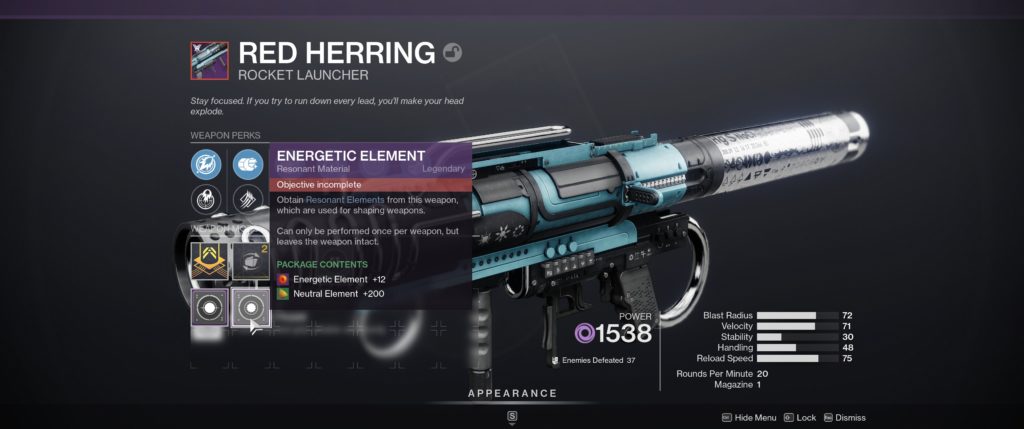
Crafting a weapon requires a “pattern” and a variety of resources. You can obtain weapon patterns from quests or by extracting materials from weapons that have “Deepsight Resonance”, which drop randomly in the world. Once you have a weapon with resonance, you need to use it (getting kills or completing activities) before you can extract the materials from them. It’s basically a mini-quest on random weapons that encourages you to try them out, and you can typically complete them in about 10-20 minutes using them at a destination (or with a single run of an activity like a strike). Extracting materials from some of these weapons will progress you toward unlocking the pattern (some patterns require extraction from multiple copies), at which point you can craft your own version with whatever perks you want. Requiring use of the weapon can help you get a feel for which perks you like best, but it also means that sometimes you have to use a poorly-rolled weapon just to get the resources.
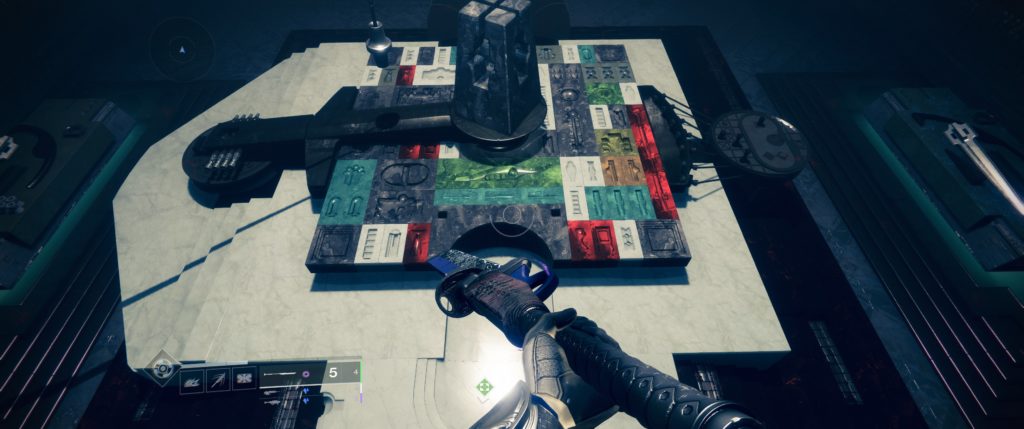
I guess it works like Play-Doh.
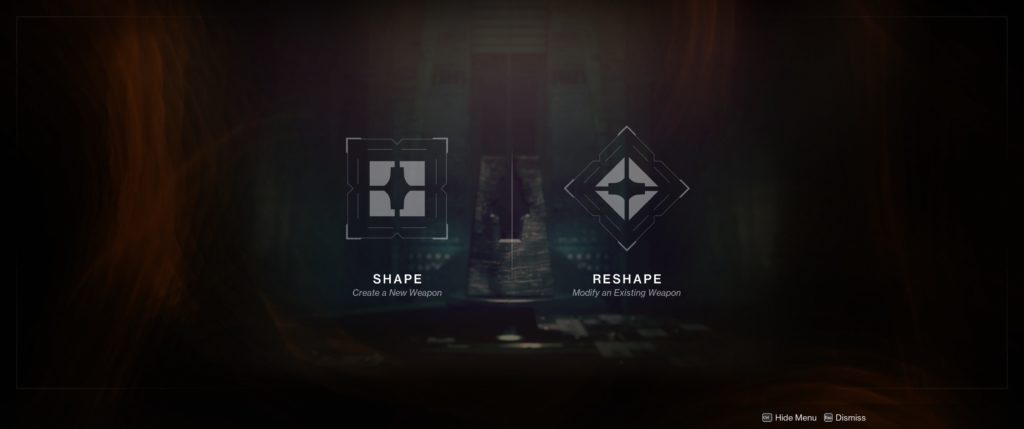
Once you have a pattern and the necessary resources, you just head to the Enclave on Mars (a new area) and use the “Relic”, which is basically a big table with molds for different weapons. You get to select the weapon you want to shape, the frame and perks you want, and finally create the new weapon. Most of the options for perks on the weapon are locked until you level it, which comes through extensive use.
I know one of the goals Bungie had for the system was creating a connection between the player and their weapons. In that regard, the system largely works – because of the effort you put into obtaining the pattern, gathering materials, and finally levelling the weapon, it creates an affinity for the weapon. Crafted weapons even show the date they were crafted, so you can celebrate their birthday if you like. I know I’ll always keep the glaive I crafted on release day, just as a memento, even if better options come along.
My concerns with the system are around the variety of materials needed (and acquiring those materials) for crafting and the cost of reshaping a weapon. Different perks use different materials (which you can choose when extracting the material from resonant weapons), which means you have to stockpile different types of materials to match, but you can only store 250 of each type so your ability to stockpile is limited. If you select the materials based on the perks you like when you used the weapon, you should be able to keep plenty on hand, but a single resource (with a large storage limit) would streamline the system. This is in addition to a basic material that you get every time you extract (a few hundred each time), but is consumed in large amounts during the shaping/reshaping process (advanced perks can use 2000 each).
Reshaping also has a large cost involved, especially for higher-level perks, and even after a perk has been used before, you have to pay a cost to select them again. I was hoping that as you unlocked perks, they’d permanently be available at no cost (similar to how mods work, just for a particular weapon). This would help to balance the shifting meta, where a god-roll weapon one season may be supplanted the next; being able to add the best perks and swap on-the-fly would help players adapt to the changes without stockpiling weapons. Without this, players will just need to stockpile different versions of crafted weapons with different perk sets since it costs a fortune to reshape a weapon to try out something new. You’re also limited by the RNG nature of acquiring weapons to extract resources from (drop rates are apparently very low), and limitations on acquiring Ascendant Alloys – a costly resource required for high-level perks.
This has happened before – the launch of the transmog system had a lot of issues at first, and they were quickly resolved by the next season. (I was just hoping Bungie had figured out that time-gating and reliance on random drops was a bad thing; apparently not.) I enjoy the ability to craft weapons, and I think this change is definitely a step in the right direction, but there’s some work still to be done to improve things. I know more weapons are coming to the crafting system, but I’d like to see weapon crafting become a more integral part of the game, replacing random drops with a directed system for players to obtain weapons built exactly as they like.
Miscellaneous
Along with all the changes above, there have been a bunch of UI tweaks (tightening up a few things so the new weapon perks can all fit on the screen), some welcome masterwork changes to armor (vastly reducing the cost to change the element on masterwork armor), and changes to Banshee’s reputation (doesn’t require inventory materials). They’re little changes that add up.
Unrelated: my space minivan that I acquired during the 30th Anniversary event.
Summary
So far I’m really happy with the new expansion. Although weapon crafting needs some work, I already have a few weapons I’m growing attached to (my glaive isn’t even a week old and already level 14! they grow up so fast), and I’m really enjoying the new story arcs.
I found Vampire Survivors while looking through my Steam discovery queue. With 99% positive reviews and priced at $3, I figured I’d give it a try.
I’m not typically into rogue-lites or bullet hell shooters, but a while back I picked up Nova Drift and had a great time with it – runs may only last a few minutes, but you always get to try something new. Vampire Survivors is similar, but you don’t control when you fire (your abilities just constantly fire without input), so you’re only focused on dodging enemies and picking up experience and various power-ups. Your abilities don’t combine quite like Nova Drift, but there are a few weapon and passive combinations that allow you to “evolve” the weapon into a significantly more powerful version.
You earn coins during each run that you can use to buy permanent buffs and unlock new characters. Each character starts with a different weapon and has a custom buff that improves as they level. My favorite is Mortaccio, who has a custom bone weapon they toss out that bounces around between enemies. (And his buff is a max +3 projectiles, which is really powerful.)
If you last 30 minutes, all the enemies disappear and Death appears, darts to your location, and instantly kills you, ending your run and granting you bonus coins. Along the way, swarms of enemies fill the screen and you mow them down.
Overall a lot of fun for a small price. It’s still in early access, so I’m hoping they continue to add new characters, levels, and abilities to keep mixing things up. It’s a lot of fun, though definitely an easier and “lighter” game than Nova Drift. (Which I recommend if you like Vampire Survivors.)
I typically write up one of these every year and then forget to post it. But since I’d like to blog more often, I figured I’d get this one up quick and add to it over time if I feel I need to.
Write more
I always want to blog more often than I do, but I usually forget about it and just fall into my usual day-to-day. Going to try to push myself to blog more often this year by posting short reviews and first impressions of games, TV, movies, etc. And as a bonus, I can just link to those posts in my typical year-end wrap-up.
Read more
I’ve started reading more over the past few years, and I want to keep that up this year. Still working on reading A Promised Land, Barack Obama’s memoir, which is a pretty heavy read. Might need to break it up with some other books.
Work on my personal projects
I typically plan this every year, and I always make some progress, but here’s hoping I get far enough on my current project that I feel like I can start sharing some information about it.
Upgrade my 3D printer and build an enclosure
I’ve had the parts printed for the upgrade for months… I just haven’t gotten around to it. Same for the enclosure. Just need to push myself to get it done.
Get rid of junk
Another thing I’ve been slowly working on over the years. We have a ton of boxes lying around full of stuff we don’t need or care about. I need to organize this stuff and donate or trash what I’m not interested in.
Donate to causes
I’ve been thinking about doing this for years and time just keeps slipping by. I support a few things through Patreon and Kickstarter and such, but I really want to start donating directly to organizations that pursue goals I support.
Legend 🌟 A personal favorite. (Not necessarily for everyone.) ✔️ Beat the game. 👍 Recommended if you haven’t played it. 👎 Avoid it. It’s terrible.
PC
Since 2021 saw me shift to permanently working from home, I did little console gaming, but there’s a lot of PC games I played this year. This list is by no means complete, and may see a few updates.
Satisfactory 🌟 Update 5 released this year, which brought a lot of quality-of-life improvements. Building practically anything is easier than ever, and vehicles are a reliable way to transport products now.
Star Trek Online Toward the end of 2020, I started finding a new love for Star Trek Online. A lot has been added, and while I still don’t really like how it’s monetized, the space combat is as fun as ever.
Destiny 2 🌟 I was on the verge of leaving Destiny 2 behind this year, but Bungie’s refocus on story, PvE, and solo content pulled me back in. Enjoying the game more now than ever before. My only complaint is the gear that’s only available in certain high-end, group-focused content (raids, Trials of Osiris) – as a solo player, that stuff is pretty much impossible to attain, and it tends to be the best gear in the game. Luckily, the addition of cross-play has meant that I don’t have to deal with those high-level weapons nuking me in PvP constantly like I did before. Season of the Chosen had some great new content and started a theme of turning enemies into allies. Season of the Splicer was outstanding, telling a great (if somewhat predictable) story and showing the other side of some allies and enemies. (It was my favorite season of the year) Season of the Lost acted as a great buildup to The Witch Queen. The 30th Anniversary event has been outstanding, introducing possibly the greatest 6-player PvE event in the game’s history with a great tongue-in-cheek tone.
Fallout 76 Played a bit into 2021, then uninstalled it and never turned back. If the seasons were better structured, I think I could stand it, but it’s more a chore than fun.
Cyberpunk 2077 Played for a few months into the year. I didn’t run into as many issues as some others, but stopped just before finishing the story (because I’m a completionist but got distracted).
Mindustry 🌟 I love Mindustry, and the 6.0 update introduced a world map with many more maps than prior versions, adding a lot of replayability.
Spacebase Startopia Played the beta and release. Feels like a good modern update to the original Startopia. A few of the campaign levels are a bit difficult.
Per Aspera
Surviving Mars Finished terraforming Mars. I liked it better red.
Everspace 2 🌟 Even in early access, this game is fantastic. It’s gorgeous, the gameplay is still incredibly solid, and all the new ships and abilities are great.
Dyson Sphere Program Command a mecha, build production lines spanning planets and star systems. Sure, it’s another factory game, but it’s fun and looks fantastic.
Evil Genius 2 Enjoyed this even more than the original.
Genesis Noir ✔️ This “game” was weird and I still don’t get it.
Cyber Hook Fun speed runner with a neon retro art style.
Before We Leave ✔️ A fun, easy-going city builder.
Slipways Great 4X puzzle game.
Timberborn 🌟👍 A survival city builder with adorable little beavers? What’s not to love?
The Ascent ✔️👍 A great cyberpunk action shooter. I played the Game Pass version, which had a really rocky launch and was buggy through my entire playthrough. My biggest complaint, however, was the lack of a manual save. There were many times I needed to quit but had to keep checking the menu to find out if there was a recent save.
Starmancer Played at early access launch on Game Pass. Super buggy to the point where it was unplayable.
Hades Gorgeous action rogue-like.
StarCraft II Played a little of this earlier in the year, but uninstalled it in “protest” of Activision Blizzard’s sexual harassment and discrimination.
Mini Motorways 👍 A great sequel to Mini Metro.
Shortest Trip To Earth A lot like FTL. I enjoyed it.
Atomicrops Fun and unique, but didn’t really hook me like I had hoped.
Grim Dawn ✔️🌟👍 Started playing with my wife as a replacement for Diablo. It’s way better than Diablo in basically every way – it’s darker, it has more variety and replayability, and the endgame is great. And it turns out I actually backed it on Kickstarter ages ago and forgot about it completely.
The Riftbreaker 🌟👍 Action RPG base-building. A lot of fun.
No Man’s Sky The new Expeditions this year were a great way to reintroduce players to the game and provide some seasonal rewards. Still a lot of fun.
Chorus 👎 Played the demo. I had high hopes for this game, but the designers don’t seem to understand how space works. (No strafing? Seriously?) Everspace is far superior.
Maneater Got this through Humble Bundle and thought it looked interesting. A bit like GTA, except you’re a shark. So much fun to leap out of the water, snatch a hunter off a boat, and dive back underwater while thrashing him to death.
Hardspace: Shipbreaker A few updates this year, and I can now play it the way I like – with no time limitations. I can play spaceship surgeon as long as I want.
The Pedestrian A great puzzle game.
Loop Hero A unique take on the RPG rogue-like.
Final Theory
Endzone – A World Apart A fun little post-apocalyptic city-builder.
Potion Craft
Space Crew Fun. A lot like Bomber Crew.
MechWarrior 5: Mercenaries Since I’m not interested in MechWarrior Online, this is basically all I’ve got. I don’t like some of the grind, but the expansions definitely improved it.
House Flipper ✔️ I enjoyed this a lot more than I expected. Great casual game.
Pathfinder: Wrath of the Righteous The Mythic Paths in WOTR fix a lot of the annoyances of Pathfinder itself and can make the game a lot more interesting. (I love how the Trickster path breaks the game.)
Portal Reloaded It’s more Portal, and the new mechanics are a great new twist.
Valheim I stopped playing with the update that made enemies more aggressive toward player structures. Definitely didn’t want to spend all my time repairing my house(s).
VR
Toward the end of the year, I upgraded to a Valve Index VR headset, and started playing VR games a bit more. I found a few new ones I really enjoy.
I Expect You To Die 2 👍 A great puzzle game like the first, though a bit more difficult.
Until You Fall 👍 Surprise hit for me. From the same people that do I Expect You To Die. Some of the best swordplay in any VR game I’ve played.
Boneworks Refunded. Sudden and extreme motion sickness whenever I played.
Raw Data Doesn’t work well with the Index controllers.
The Room VR I’ve always loved the Room series, and the VR version doesn’t disappoint. Another solid VR puzzle game.
Battlegroup VR Bought this during the holiday sale and wasn’t sure what to expect. Turns out it’s a great tactical space RTS in VR. A little buggy, though.
PS4
God of War ✔️🌟👍 Finally finished this one. Loved it. Got bored with the endgame pretty quickly, though.
Board Games
7th Continent I’ve owned this game for a while but never got around to playing it. My wife and I started a game this year but quit after about 6 hours of play. I love the choose-your-own-adventure style mechanics, but a lot of the gameplay is tedious. After introducing some house-rules, it got better, but we haven’t been back to it to finish our first curse.
Unsettled 👍 Unsettled was the board game sleeper hit for me in 2021. We played 7th Continent earlier in the year, and while I liked the mechanics, I found the gameplay tedious. Unsettled is a similar game (co-op vs. the environment), but has better theming, better gameplay, and the best storage system I’ve ever seen in a board game. My wife and I just barely beat the first mission (got lucky with special equipment for our robot), and are looking forward to playing more.
Arcane Academy A simple engine-builder. I like the artwork and components, but I have better games, so unfortunately this one is going in the donate pile.
Terraforming Mars: Ares Expedition 👍 A great deck-building version of Terraforming Mars. Plays quicker and easier than the full game, but it’s still Terraforming Mars at its core.
Dinosaur World Build your own Jurassic Park and populate it with cute dinosaur meeples.
Dice Throne 👍 Easy to play, lots of fun. The character variety is great.
Canvas 👍 A beautiful game about creating unique works of art.
Pandemic: Fall of Rome 👍 Loved it. Better and deeper than the original.
Trogdor!! The Board Game Fun game with a Strong Bad theme. Brought back memories of watching those videos in college.
The Butterfly Garden Simple game about gathering butterflies.
Mining Colony
Agropolis
7 Wonders: Duel 👍 A fantastic version of 7 Wonders for two players.
Plague, Inc: The Board Game Appropriate for our current times. Feels a lot like the digital game.
Chimera Station A worker-placement game with a gene-splicing mechanic.
Cavemen: The Quest for Fire
Caper A fun two-player game with classic spy movie styling.
Forbidden Sky It’s fun to make the rocket launch at the end.
Small Star Empires Like chess, but with spaceships and colonies.
Core Worlds
Lanterns: The Harvest Festival
Patchwork: Halloween Edition We already own Patchwork, but the Halloween Edition uses eyeballs instead of buttons and cute Halloween-themed fabrics.
Space Cadets: Away Missions Like a mini tabletop RPG. Pretty easy to play.
Keeping up the tradition, here are the games I played in 2020.
Legend 🌟 A personal favorite. (Not necessarily for everyone.) 👍 Recommended if you haven’t played it. 👎 Avoid it. It’s terrible.
Xbox One
Darksiders Genesis Played a bit of this with my wife for some couch co-op fun.
Switch
Marvel Ultimate Alliance 3: The Black Order A fun beat-em-up in the Ultimate Alliance franchise. Got boring fairly fast, though.
Animal Crossing I still have a love-hate relationship with Animal Crossing. Building stuff is fun, but it feels like too much of a chore. I stopped playing after a few months.
PC
Destiny 2 🌟👍 I still love Destiny. Beyond Light introduced a bunch of changes that I really appreciate, though it’s starting to get a little boring.
My festive FICSMAS factory
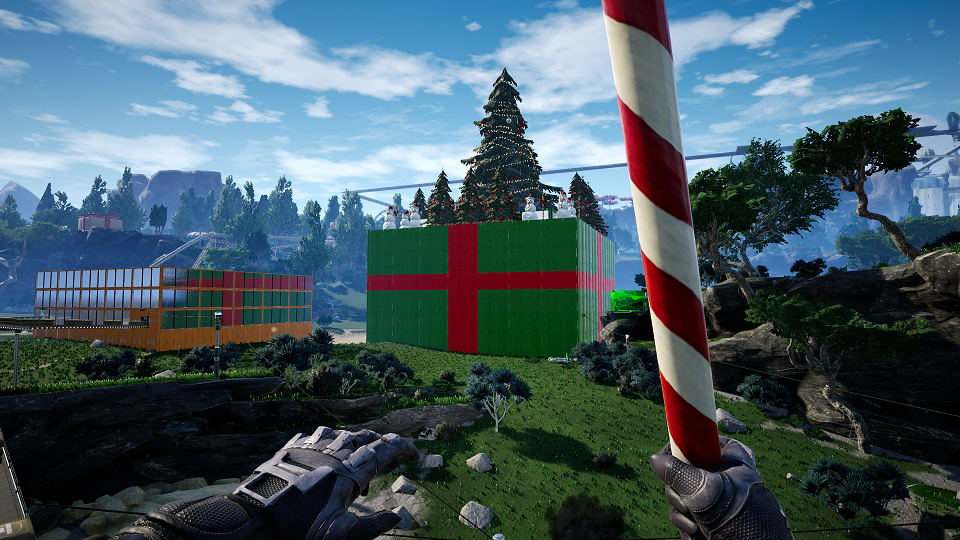
Satisfactory 🌟👍 My newest gaming addiction. Played this hard for a while, building up a factory, oil refinery, and a skybridge that circled the map. Stopped playing for a while once I had unlocked everything, then came back for the extremely well-designed FICSMAS event.
Kerbal Space Program 🌟👍 Started playing this again to see where it’s come in the time since I’ve been away. It got a lot more fun once I started using MechJeb extensively to handle launch and rendezvous so I could just focus on designing rockets and missions.
X4: Foundations 🌟👍 Played a lot of this. I’ve always enjoyed the X series, but X4 is one of the easiest to play. I barely even touched the story missions until I already owned about half the galaxy and had several shipyards. (I also did a lot of idling, letting my fortune grow while working.)
Hardspace: Shipbreaker A puzzle game where you’re slicing open ships to salvage them, using the money you make (after fees from your employer) to upgrade your equipment. A time limit on each shift is your biggest obstacle, forcing you to cut corners to save time. If you’re not careful, you can cause an explosive decompression, slice a fuel tank, or cause a reactor explosion. And any accidents cut into your income. There’s also a hyper-capitalist dystopian backstory here. You’re an “independent contractor” and you’re charged rental fees for your equipment and housing, so that $1M in salvage may only net you about $200K. Eventually you’ll save up enough to buy your equipment outright and avoid the fees, but it’s a long road to get there.
Diablo 3 Season 20: Barbarian. Season 21: Demon Hunter. Season 22: Skipped.
Trailmakers Got this in one of the Humble Monthly bundles. It’s a fun little vehicle-building game using Lego-like components. I had a hard time designing anything I really wanted, so I ended up pulling things from the Steam Workshop to finish out the campaign.
Pathfinder: Kingmaker Loved this. It’s a great CRPG with the depth of Pathfinder underneath, though you can’t always pull off some of the builds you can with the pen-and-paper version.
Jurassic World: Evolution Kept playing this in 2020. Still love it.
Warframe I don’t play a lot of Warframe, but I still enjoy it. Came back this year for some 7th Anniversary events.
Command and Conquered: Remastered Collection I love classic C&C, and this brought back some memories.
Spacebase Startopia One of my favorite games from the 90s. Played the beta. Still a little rough, but all the basics are already there and it definitely feels like the original. Planning to have a lot of fun with this after release.
Observation 👍 Great sci-fi story. Basically a story-driven puzzle game. It’s pretty easy and relatively short, but worth playing.
MechWarrior 5: Mercenaries Starts off slow, but once you get a few pilots to fill out your lance (after the third or fourth mission), it gets better. It’s a bit of a grind to earn reputation and c-bills, and it’s difficult to find good mechs and pilots until later in the game. Overall, it’s good, but not great.
Spiritfarer👍 A fun game about ferrying spirits to the afterlife. You have to keep them happy and solve their problems so they can rest.
Not For Broadcast I don’t think I’ve played a game like this before. It’s difficult and has a very odd story. If you like British humor, definitely give it a try.
Supraland A fun little first-person Metroidvania. Good humor and some great Easter eggs.
Gris 👍 Deserves all those awards.
Phoenix Point Fun. Similar to XCOM.
Everspace 🌟👍 I’m typically not a fan of rogue-likes, but something about Everspace clicked with me and I loved it.
Nova Drift 🌟👍 Surprise hit for me. It’s a rogue-like shooter with some incredible ability combinations. Every run is fun even if it’s short-lived.
Genesis Alpha One Another rogue-like where you build up your ship and crew until you can start a “Genesis” colony on an alien world. Fun and super creepy at times.
Little Big Workshop Build a factory, hire workers, build stuff. Cute, but gets tedious.
The Universim I’ve been playing this through several betas (even before it was on Steam). A civilization builder that’s had a lot of content added.
Railway Empire Got through Humble Monthly, played because I was bored. If you like trains, it’s good. I found some of the rail laying annoying, but overall a solid tycoon game.
Inch By Inch Bought and played this after seeing it on YouTube. It’s a short, simple puzzle game with an interesting mechanic. Won’t take long to beat it for the first time, but you can adjust the settings to customize your challenge.
No Man’s Sky Decided to play some more of this after the Origins update to see where it’s come. It’s still a great solo exploration game, but they’ve added a lot of extra content to really expand on the original formula. I’ve always been a fan.
Fallout 76 Played this because it was part of Xbox Game Pass. When I started, my one-sentence review was: “It has the Fallout setting, but not the soul.” After playing further, I’ve started to see that Fallout is here, setting and soul, but I’m convinced Bethesda just doesn’t know how to build a multiplayer game like this. That said, they’re slowly getting better. The One Wasteland For All patch fixed a lot of issues with exploration and quest progression (for example: low-level quests with steps in high level areas, lack of content for mid-level players). Plans to build equipment and structures are difficult to find. In my opinion, the worst part of the game continues to be the “Fallout 1st” subscription; it seems like you’re actively punished for not paying. Weight is constantly an issue, but Fallout 1st members get containers with unlimited capacity (scrapbox to store as many crafting components as they want). I desperately want to like this game, but there’s so much that’s annoying by design. There’s content to enjoy here, but unless you have people to play with regularly – or are a huge Fallout fan – probably avoid it.
Marvel’s Avengers 👎 Super buggy. The single player storyline can’t figure out what type of game it wants to be (beat-em-up? stealth-action? adventure?) and does a poor job being anything.
Star Trek Online I haven’t played this in several years, but I wanted to fly around in a spaceship and shoot things, so I started playing again. I’m not a fan of the daily grinding for things, and the inflation of the real-money store is crazy ($30 for a single ship). There’s a lot of pay-to-win stuff going on here (and I don’t like the gambling in lock boxes), but through lots of gameplay, you could actually convert earned resources into premium currency and buy things (which partially contributes to the inflation). As long as you’re not playing PvP (which I’m not), there’s still a lot of fun content here. Can be played solo, but a lot of content is behind fleets (several ship upgrades, officers, some items).
Tropico 6 Good old Tropico. Hasn’t changed much, but that’s not a bad thing when the game was already great.
Everspace 2 After playing Everspace, I got really excited about Everspace 2. Played the prototype during a Steam event and I love where it’s going. Unfortunately, the Cyberpunk juggernaut pushed the release into 2021.
Per Aspera Mars resource management strategy with an interesting story. Played during one of those Steam demo events and ended up buying it when it released.
Mars Horizon Played the demo. A simplified version of the history of spaceflight. (Maybe a little too simplified.)
Fights in Tight Spaces Played the demo. Loved the concept and execution of this one.
5D Chess with Multiverse Time Travel And here I thought I was pretty good at chess. I’m still having trouble wrapping my head around this one.
MarZ: Tactical Base Defense A really good tower defense game about zombies on Mars.
Siege of Centauri Another sci-fi tower defense game. Not quite as refined as MarZ, but still fun to play.
Mindustry The 6.0 update made some major changes to how the game is played and vastly expanded how much game is here.
Wash your face.
Cyberpunk 2077 🌟👍 I played this on PC, so I didn’t really run into many of the problems I saw making the rounds online. Still working through the story after 70 hours, and still enjoying every minute with my quickhack-focused build. This is probably my GOTY for 2020.
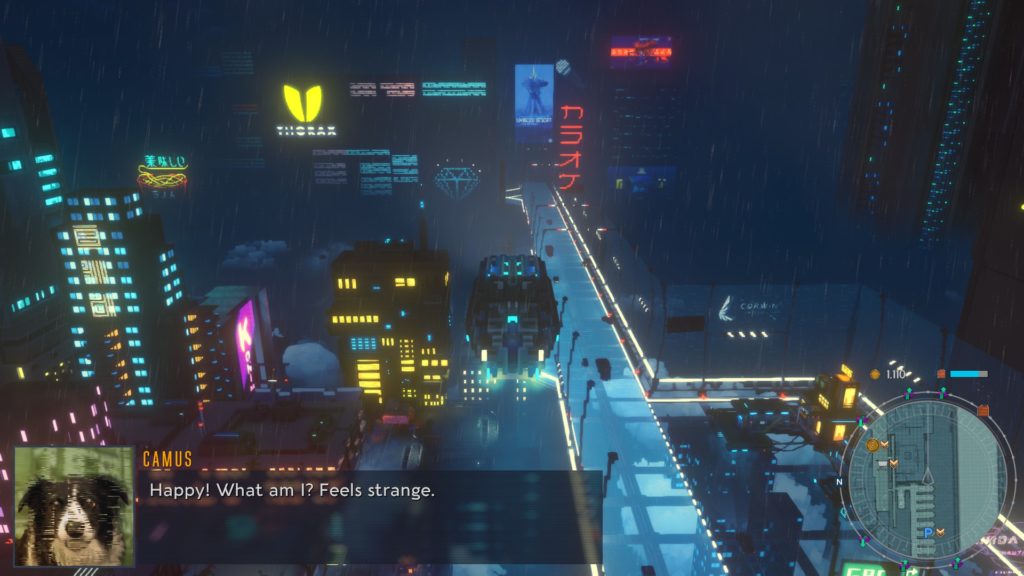
Camus is a good boy. And temporarily trapped in a car body.
Cloudpunk It’s like a chill version of Cyberpunk.
Iron Harvest Haven’t managed to put a lot of time into this yet, but first few levels make this look like a highly tactical RTS. (Positioning and cover are extremely important.)
Tabletop
Wingspan 🌟👍 Wingspan continues to be one of the best board games I own.
Azul: Summer Pavilion
Queendomino
Fences
Darkrock Ventures
Chai
Kodama
Tiny Epic Dinosaurs I love the “Tiny Epic” series of games. The label fits: they’re small-box games with big gameplay. In this one, you’re managing a tiny dinosaur park; buying and selling dinosaurs for points. There’s some puzzle-style gameplay and a ton of cute, tiny dinosaur meeples.
Ticket to Ride: Nordic Countries I don’t think this is as good as the original. It’s a tighter map, but my wife and I both had a hard time getting the colors we needed to complete things. Locomotives are still wilds in this version, but can only be used on ferries and tunnels.
Horizon: Zero Dawn The Board Game 🌟👍 Captures the fun of hunting robot dinosaurs across several short encounters.
Kingdom Rush: Rift in Time 🌟👍 Tower defense in board game form. My wife and I loved this one. It’s like playing a series of tiny Tetris games. Narrowly beats Horizon as my 2020 Board-GOTY.
Seven Wonders Owned this for a while but only just got around to playing it for the first time this year. Fun, but a little awkward with two players. (Probably should play Duel for two players.)
Elder Sign Despite winning, I didn’t really enjoy this game. Felt too random.
After my Fallout 76 Review, I had some additional thoughts about the game regarding some of my frustrations. There was also a “Bombs Drop Event” this past week – celebrating the day everything went to hell in the Fallout universe – which provided one-week access to Fallout 1st perks, so I now have some firsthand opinions about those perks.
Build Frustrations
I touched on this in my review, but I wanted to elaborate on some of the frustrations I have about build balance. I understand a game with as much variation as Fallout is difficult to balance for multiplayer (which is another reason it probably shouldn’t exist as a multiplayer game), but the amount of imbalance continuously annoys me. I’ve built my Fallout 76 character as a stealth sniper – a style I’ve always enjoyed because it deals high damage without the use of heavy weapons. When I’m free exploring, this build works great, as I can typically handle anything I find in my travels without much difficulty. Unfortunately, this build is at a distinct disadvantage when it comes to most high-level content. Most of the Fallout 76 endgame is structured around public events and the new “Daily Ops” introduced in the One Wasteland for All patch. These events all work in a way that makes the rifleman build weaker than the alternatives.
In “Daily Ops”, enemies have two mutations that make them more difficult than usual. One of these mutations is permanent and provides them with heightened perception that makes stealth useless. These events also require you to defend points in the area, which means all the enemies know where you are and you can’t hide from them. You can manage through with a rifle, but stealth just won’t work, so all the perks I have to boost my stealth and my sneak attack damage are worthless. I also don’t have any perks in the same stats to replace them, so I just have several wasted points when I’m playing these events.
In most other endgame events, you’re either fighting a boss or defending against waves of enemies. The rifleman build works for a few of these where the enemies are relatively few and weak (the lower-level events), but in most cases high-powered single-shot rifles put you at a disadvantage; mostly just because of the way experience works in the game. Players will gain experience for any kill on an enemy they’ve damaged, regardless of who gets the kill. As a result, players who carry heavy, rapid-fire weapons like gatling lasers or miniguns tend to gain experience the fastest, as they can simply spray an area and hit nearly everything. In most high-level content, I find myself fighting alongside players in power armor toting gatling lasers, gatling plasma, or miniguns (usually explosive miniguns). The only way I’ve found to keep up is by using a tesla rifle, which shoots lightning that will arc to multiple targets (or off the environment), allowing me to hit multiple targets at once; though it will also arc to players, so if there are several hulking power armors between me and an enemy, I’m still not likely to get a hit. Even the players who aren’t carrying heavy weapons are typically using automatic rifles, which works the same way.
Rifles also end up being extremely weak against bosses. Because of their low rate-of-fire, rifles perform very poorly when fighting a boss with high resistances. Even with all my bonuses and using my highest-powered rifles, I can’t cause much damage to high-level bosses, while players with heavy and automatic weapons will regularly chew through bosses much faster. Semi-automatic rifles have a damage boost over automatic weapons, but it’s not enough to make up for the difference in fire rate. With the disadvantages rifles have in most of the multiplayer content, it seems they should be much stronger to compensate (likely to the point that a rifle-focused build should one-shot most enemies), or automatic weapons weakened to bring them in line. (I doubt either will ever happen.)
The only “disadvantage” to automatic rifles and heavy weapons is the amount of ammunition you need to carry (and its weight). There are perks to reduce the weight of the ammunition (to the point where it’s practically weightless), so that’s already balanced out. You need the crafting materials to craft ammunition as well; but lead, steel, and gunpowder are easy to find and there are perks to increase the amount of ammunition you craft. Maybe you could point to the amount of scrap you need to keep on hand as a potential disadvantage, but it turns out there’s a way around that, too; it just costs real-money dollars.
Fallout 1st
After a one-week trial of Fallout 1st, I can say this much with certainty now: it’s not worth the asking price and the scrapbox should be given to all players.
The scrapbox is a storage item you can place in your camp that stores an unlimited amount of scrap. When I started the trial week, I immediately crafted it and moved all my scrap over. Half of my 800-pound stash was scrap material. Over the week, I grabbed everything that wasn’t nailed down so I could scrap it and put it in this magical box of scrap-holding; just so I would have a stockpile once I could no longer add to it. (When your Fallout 1st subscription lapses, you can still remove items from the scrapbox; you just can’t add to it.) And while I certainly won’t hoard as much junk now that I can’t put it all in this container, I did notice a change for the week I had it: I was less stressed. Constantly having to worry about your storage space is annoying. You can’t just sell all the scrap, since vendors will only buy so much per day. I can sell to other players, but until someone buys it, the scrap continues to take up space. So ultimately, I’m left carrying a significant amount of my junk on my person, with the Pack Rat perk reducing the weights to make it manageable. This one item actually made the game more fun, and I don’t think it’s a good idea to lock items that make the game fun or less stressful behind a subscription fee.
The Fallout 1st trial also game with use of the survival tent, which is a freely-movable fast travel point with some storage and crafting items. This was convenient to use, but this is one of those items I’m OK having behind the subscription. I’d love if everyone had access to it, but it’s not as game-changing as the scrapbox. While the fast travel tax is annoying, it’s not as stressful as the inventory management needed to handle all that scrap.
Finally, the trial gave players a few free items – a wallpaper and a flooring. Woo. Sure, give these to subscribers for free; doesn’t bother me at all.
The trial didn’t provide the stipend subscribers get (understandable; it’s approximately $16.50 worth of premium currency), but I think the stipend is just thrown in there to make it seem “worth” the asking price. Personally, I don’t think giving away $13 (or $8.25/month at the $99/year) of my real-world dollars is worth it for $17 of Fallout fun-bucks. Just give me a $5/month or $50/year option just to get a few free items and the tent. That seems worth it and much more fair to players.
Seasons
The past week also provided players with double experience and double score for the season. I was able to progress very rapidly (both because of the bonuses and because of the scrapbox; less time managing my inventory means more time actually playing), and managed to get to rank 80. I still think I’m going to have to play daily to just barely finish the season, but at least it feels more attainable. I think this serves as a sign that the amount you have to put into the season needs to be reduced, as the current model adds to the stress. I feel like I should be able to finish the season in about a month if I play daily. If Bethesda wants to keep players engaged for a longer time, they need to provide content, not yet another thing to grind through.
Fallout can be better
I think Bethesda could learn a lot from Bungie and Destiny here. I can complete a Destiny season in about a month of regular play. The “subscription” is a $60-70 expansion pass each year, and that pass comes with a lot of new content – strikes, patrol zones, Crucible and Gambit maps, gameplay modes, events. While paying for the expansions and seasons will give you several items up front, everything is attainable by free-to-play players (aside from some cosmetics). Even the cosmetics in the Eververse store can be had with enough gameplay – you can finish quests for Bright Dust and buy items from Eververse in the weekly rotations. Sure, Destiny is a grind, but I never feel particularly disadvantaged.
The only experiences in Destiny that I don’t get to experience are the raids and challenging quests. These events are interesting and provide some great gear, but typically require a well-coordinated team and a large time investment. While I’d love to have that gear, I’m just fine without it, and the only time it actually affects me is during PvP, which I don’t really like anyway. There’s also enough alternative options to reduce the sting of getting taken out by a weapon I’ll never be able to have. This is the one area where I feel Fallout does better, multiplayer-wise: I can play end-game events because they don’t require a well-coordinated team; just players who can fight back enemies. Daily Ops are like Destiny strikes, and the world events are like Destiny’s public events. They’re not always quite as interesting in Fallout, but they’re accessible, and that’s what I like most about them. Bethesda just needs to work on making everything in Fallout 76 that accessible.