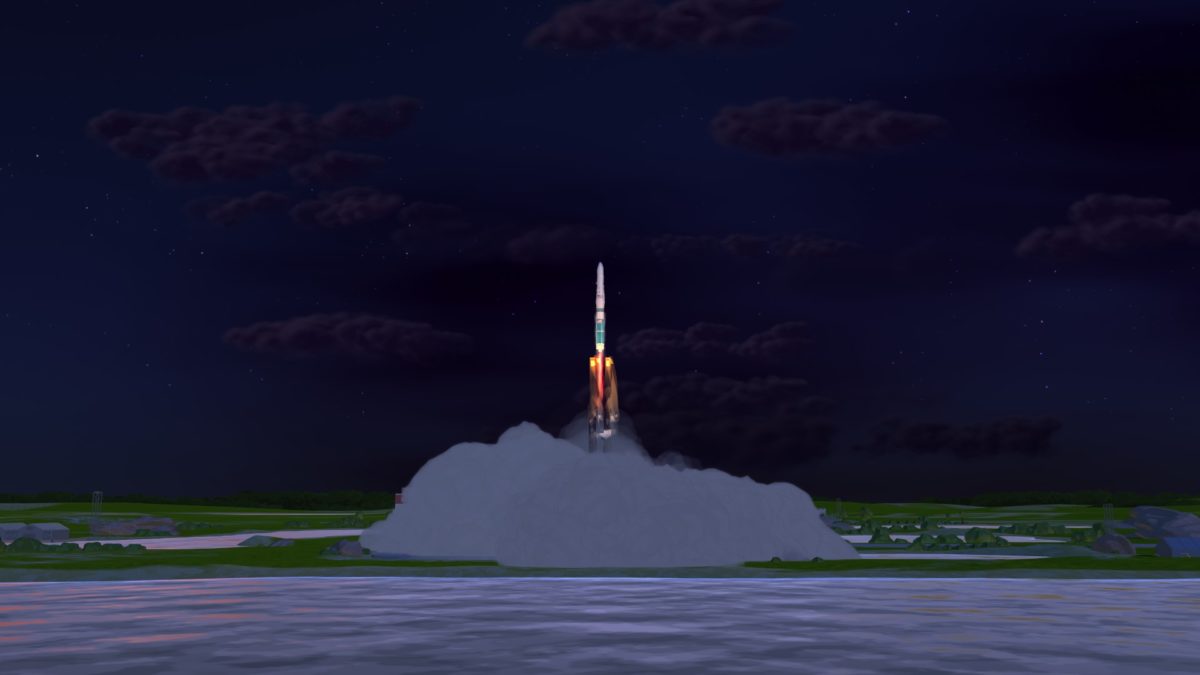
I played the demo for Mars Horizon a while back and it had me interested. It’s definitely not Kerbal Space Program or Simple Rockets; it’s more of a space program management game than a rocket building game, with some interesting mechanics during space missions. Because of that, there’s some tedium in managing certain aspects, but nothing I’ve found to be too boring.
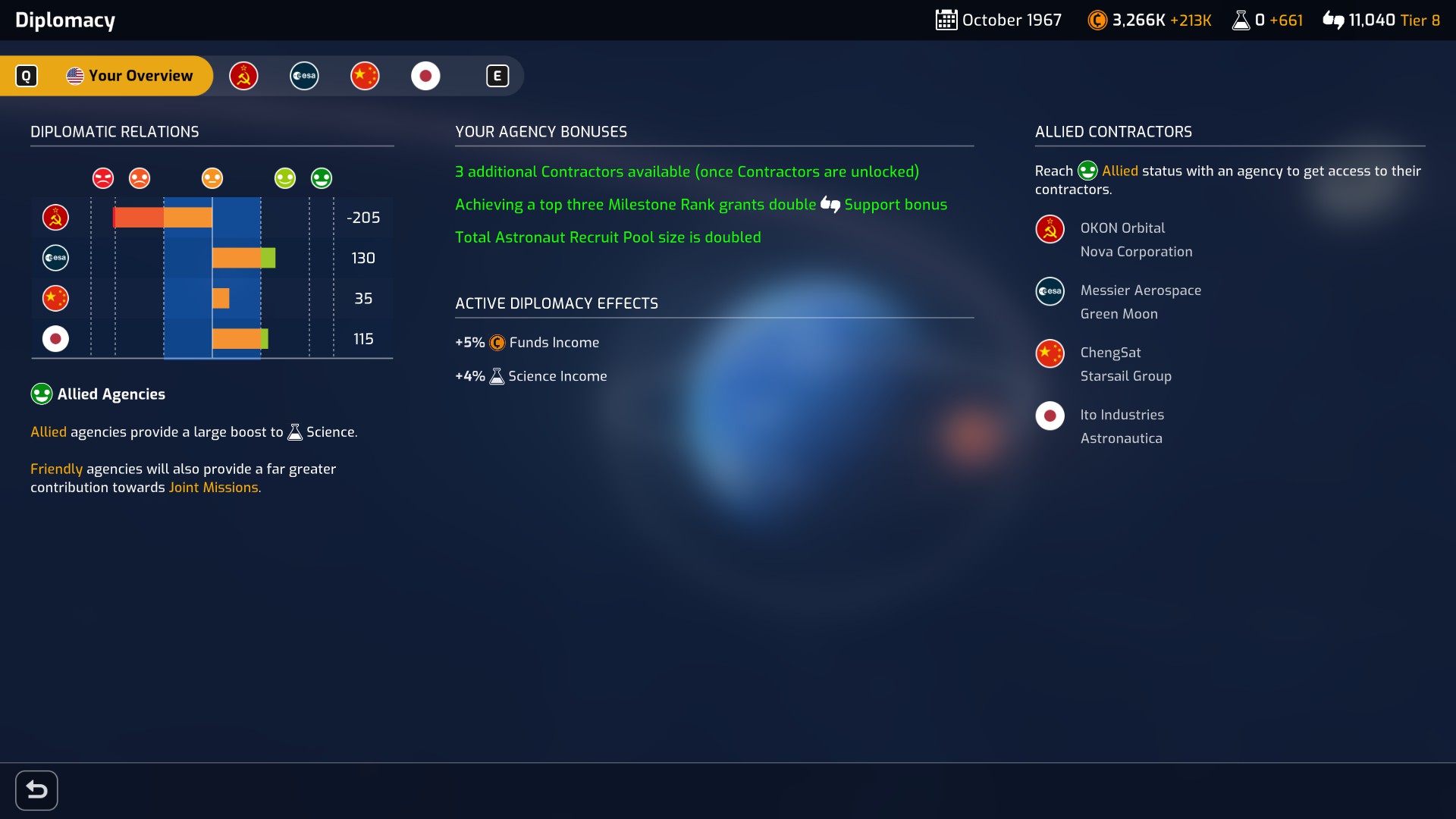
Mars Horizon puts you in charge of a space program. There are several real-world programs you can choose from (NASA, ESA, JAXA, etc.) or you can create your own with custom perks. Each has slightly different bonuses, but none have a custom campaign: you’re simply participating in the space race. There’s also diplomacy, where you get bonuses for good relations and a funding increase for poor relations. You can also participate in joint missions, where you both get a bonus afterwards. Though for most of the game, the other agencies are opponents you’re trying to beat to each milestone.
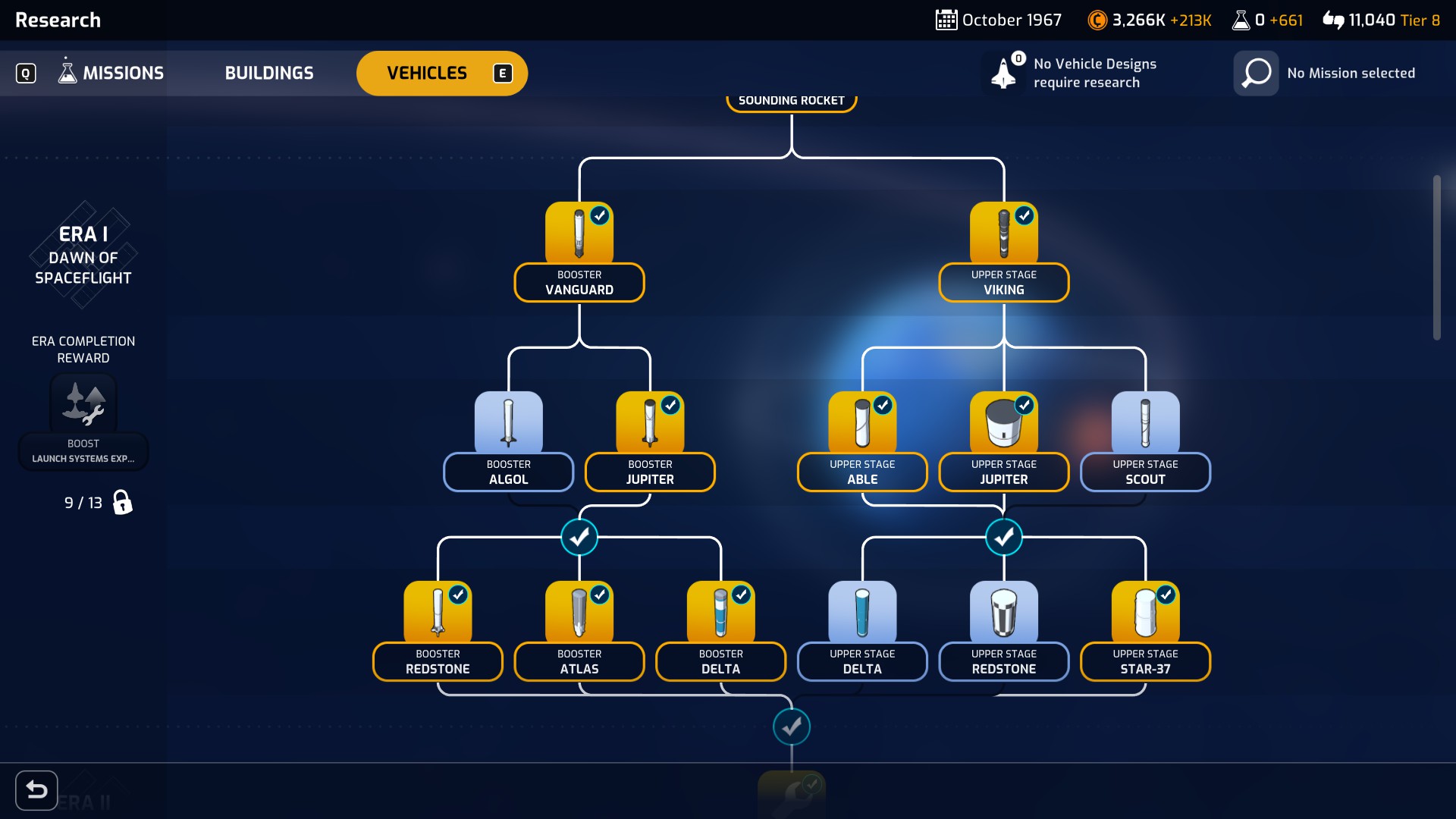
Like the space programs, the tech tree unlocks real-world rocket parts and missions. Your first milestone mission tasks you with launching an artificial satellite. Beyond that, there are many options, and you can either attempt to beat everyone to major milestones (first person in space, first person on the moon) or attempt everything available. Playing NASA, I launched my “Laika” rocket putting an animal in space instead of pursuing the first lunar orbit. There’s no need to follow historical events here, though it’s often important to be the first to reach an objective, since there are bonuses for the first three to complete a new mission.
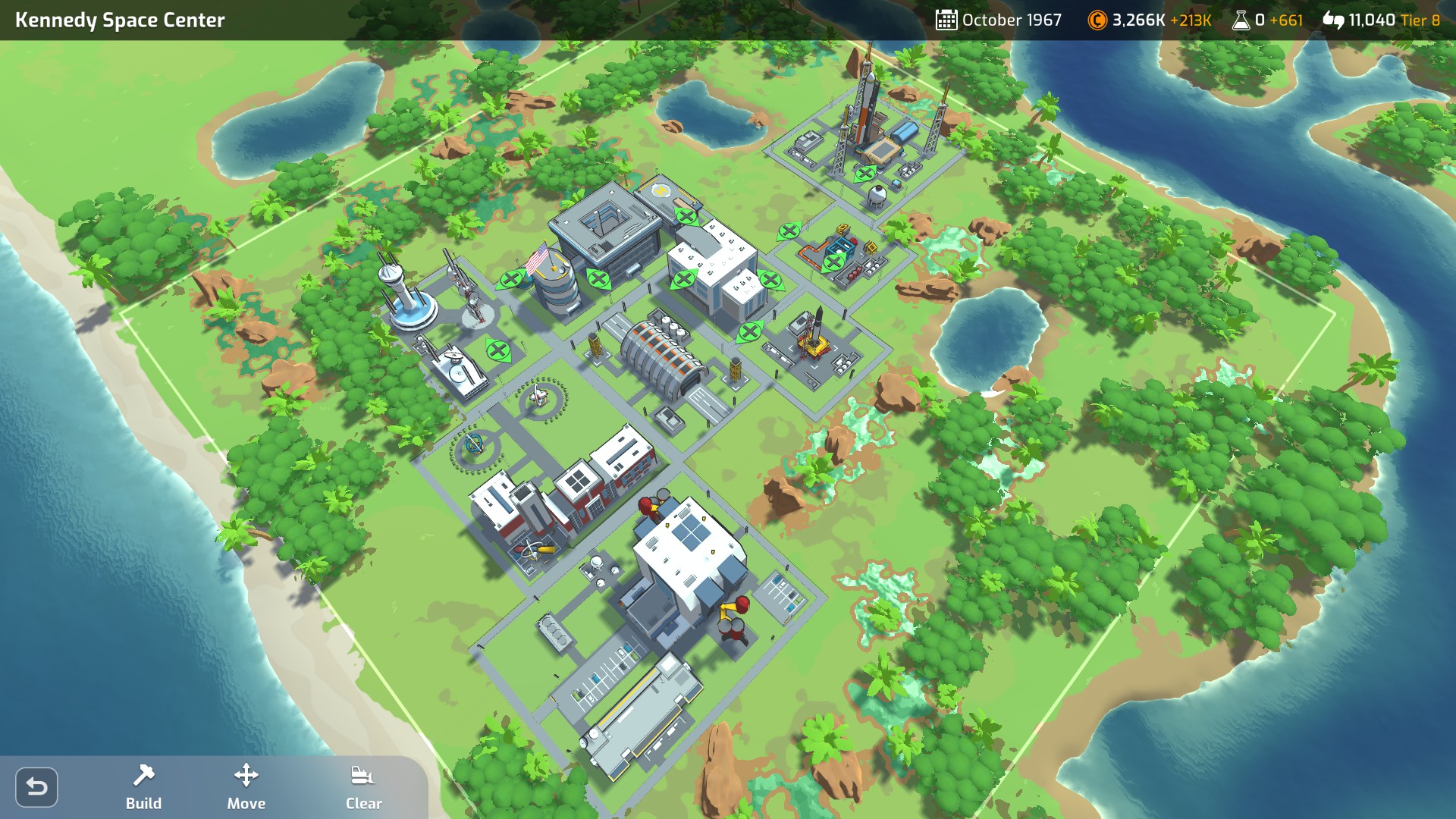
Alongside the rockets, you get to build up your space center, researching new buildings and constructing them to improve your capabilities. There’s a bit of a puzzle to the base building, as buildings can have adjacency bonuses, encouraging you to keep certain buildings touching and others apart from each other. I’m sure there’s a guide somewhere that details the optimal space center layout, but the bonuses aren’t so dramatic as to require perfect placement.
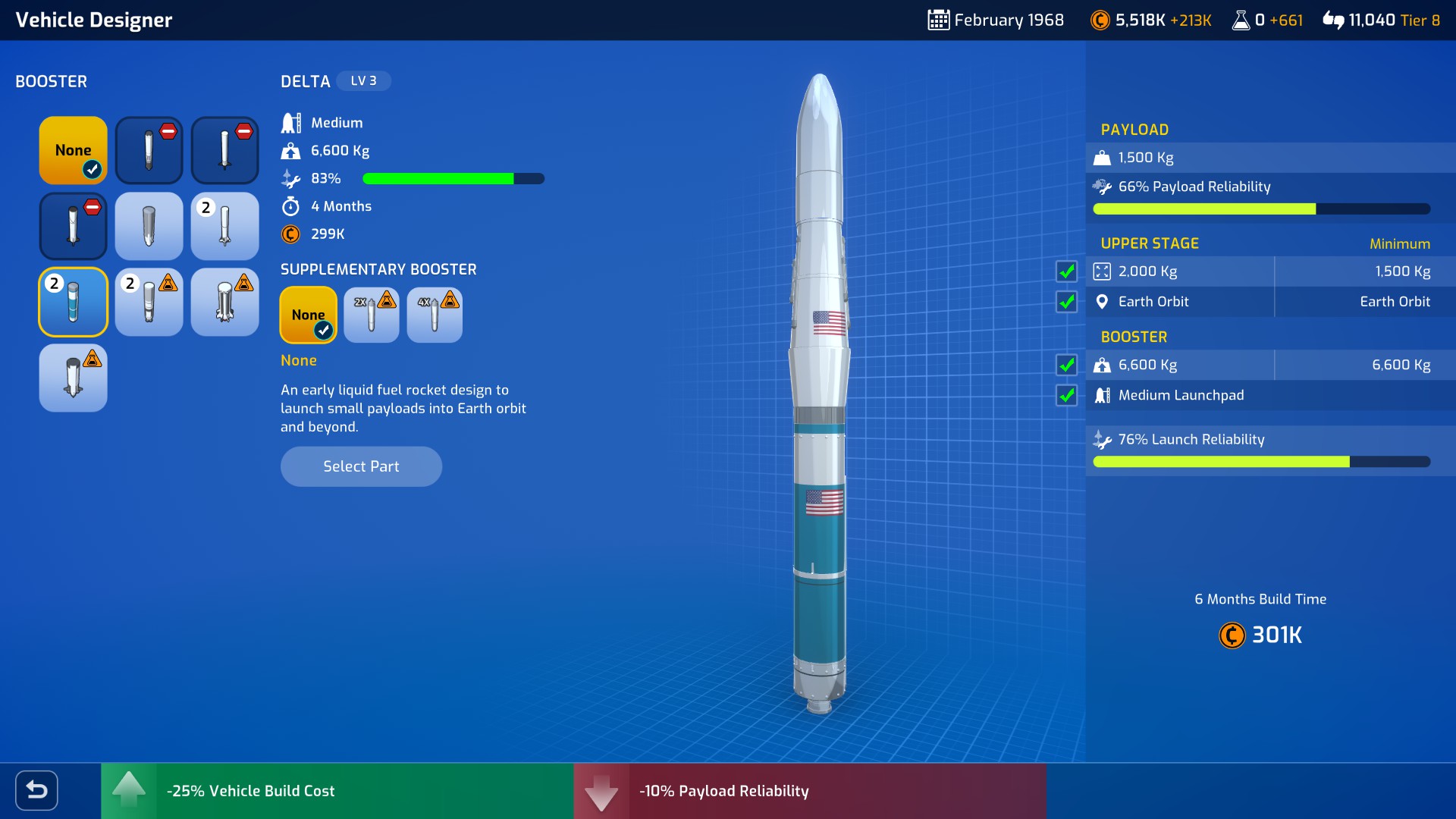
When you decide on a mission to pursue, you have to build the payload and rocket, selecting from the parts you’ve unlocked. You can also select parts you haven’t researched, and the game will indicate those in the research tree to keep track of which you need for the mission. Each part you select has various stats, the most important of which is its reliability: the more reliable a part is, the less likely it is to fail during a mission. Your parts will level up as you use them, becoming more reliable with each launch, but the most reliable parts are also the most expensive to build.
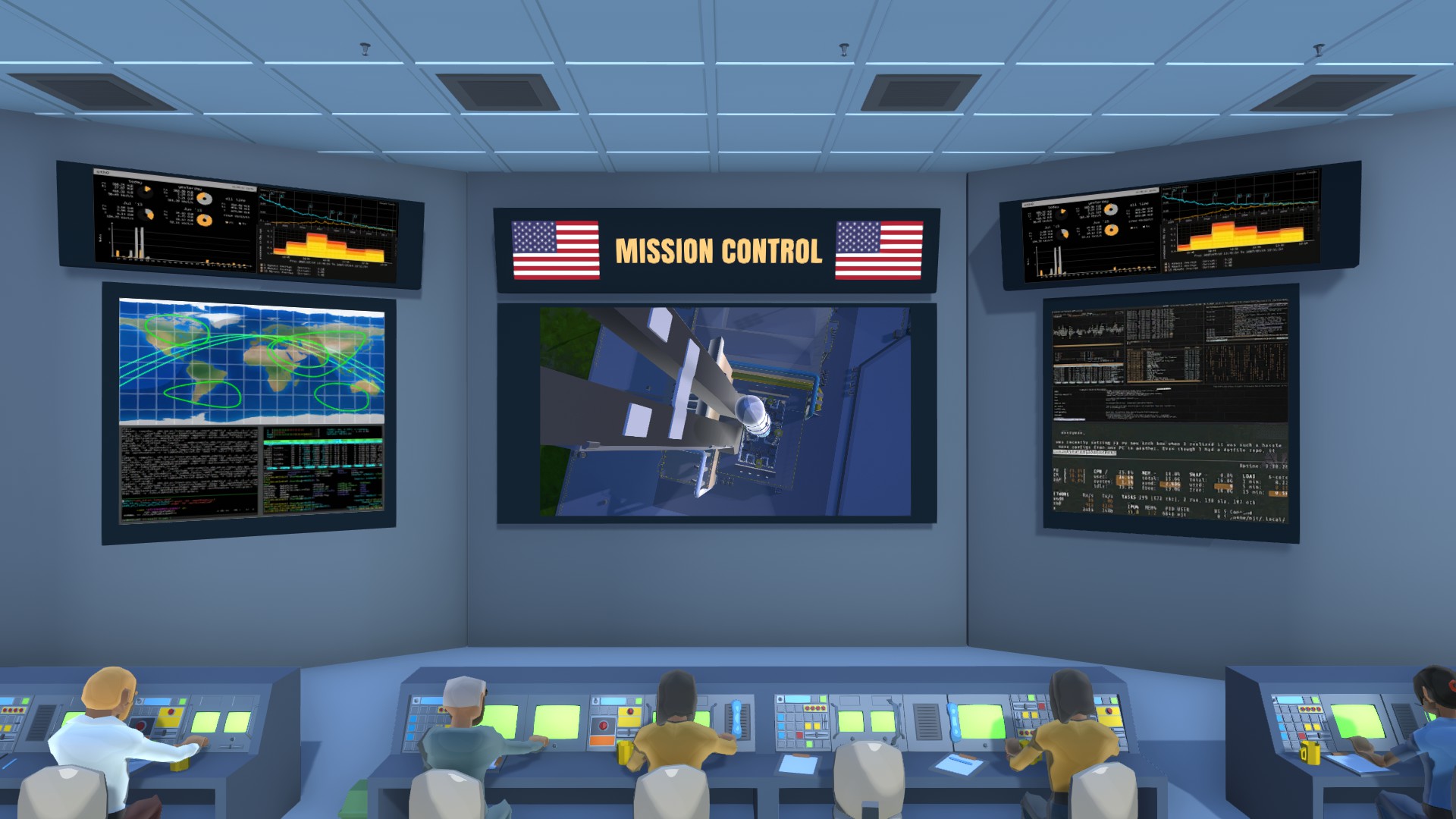
Once you’ve got your rocket constructed, it’s time to prepare the launch. You get to select the crew (for crewed missions), a launch bonus that increases the longer you wait before launching (like bonus reliability), and a launch date. While you can select any launch date you’d like, there are certain months where the conditions are more favorable; selecting an unfavorable launch window penalizes your reliability.
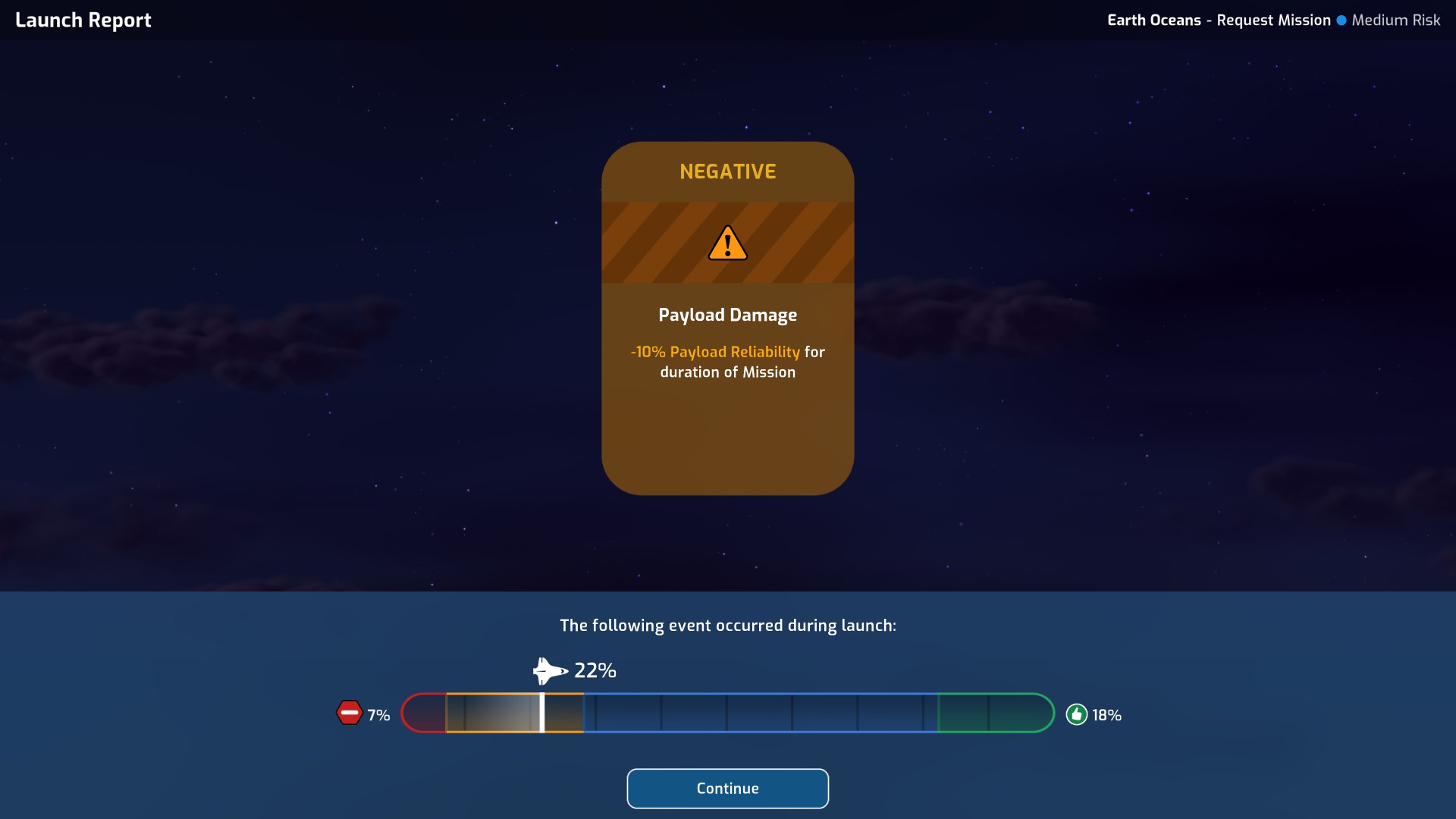
When it comes to the actual mission launches, there’s a lot of RNG. There’s a roll to determine how the launch goes (failure, negative, normal, or positive) with a penalty or bonus depending on the value. A higher reliability makes it easier to get normal or positive results. I haven’t had a launch failure yet, but I’m sure it’s accompanied by a large explosion.
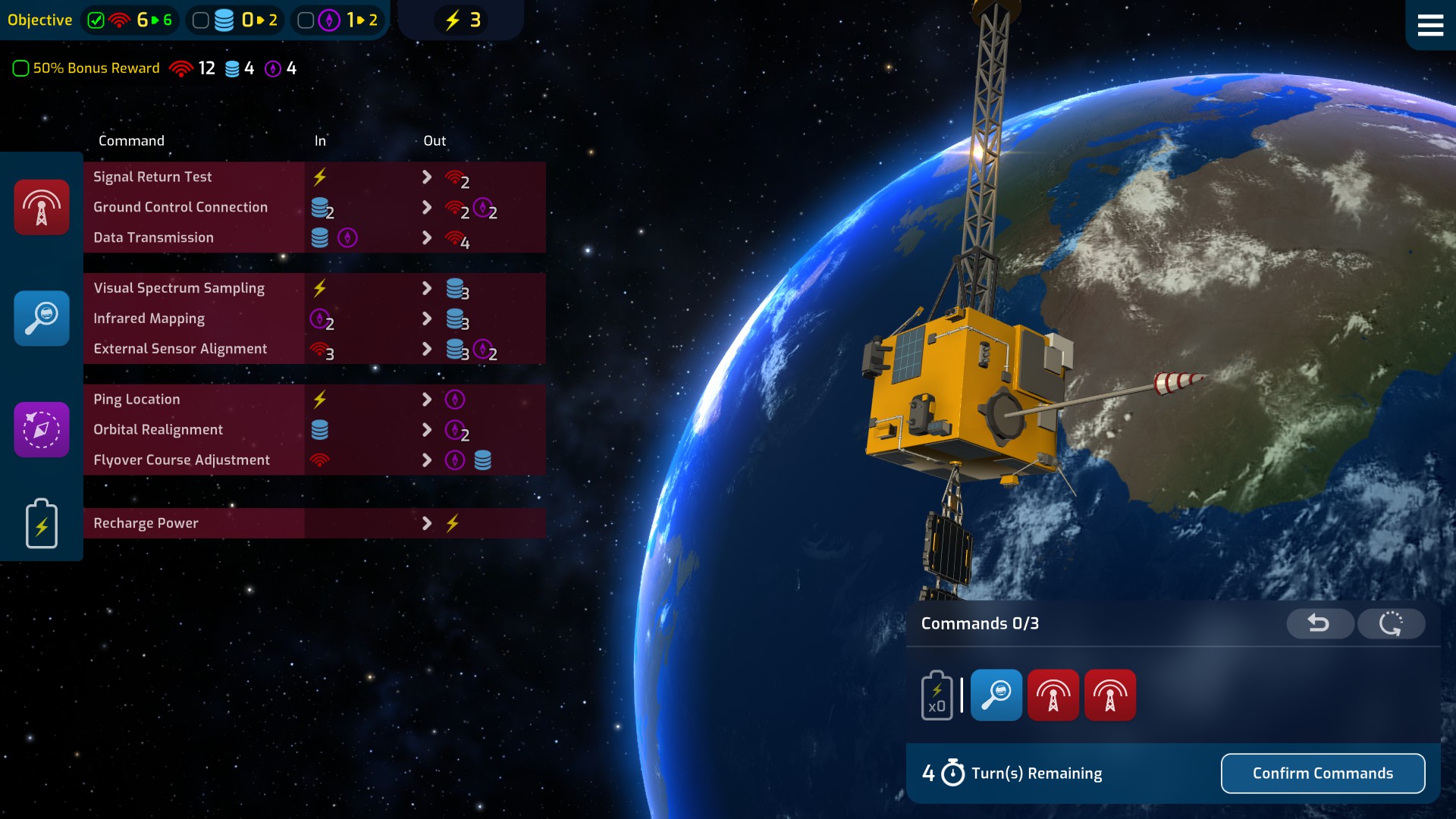
Once the mission is off the ground, there may be a number of phases where you manage resources in an attempt to achieve a goal. Each phase will have different resources you’re managing, and you only have a handful of turns to achieve the results. It’s a fun little minigame, but it can get boring after a while; though there’s an “auto-resolve” option that will determine the outcome based on the payload reliability. Like the launch, each command gets a roll to determine if it’s successful, with a bonus on a high roll and a penalty on a low roll (though you can use power to negate a penalty).
In other reviews I’ve read, the RNG of the missions is the biggest annoyance people seem to have with the game, but it doesn’t bother me. Even the most well-prepared mission can go awry, and at least the RNG is well-communicated rather than hidden as it is in most games.
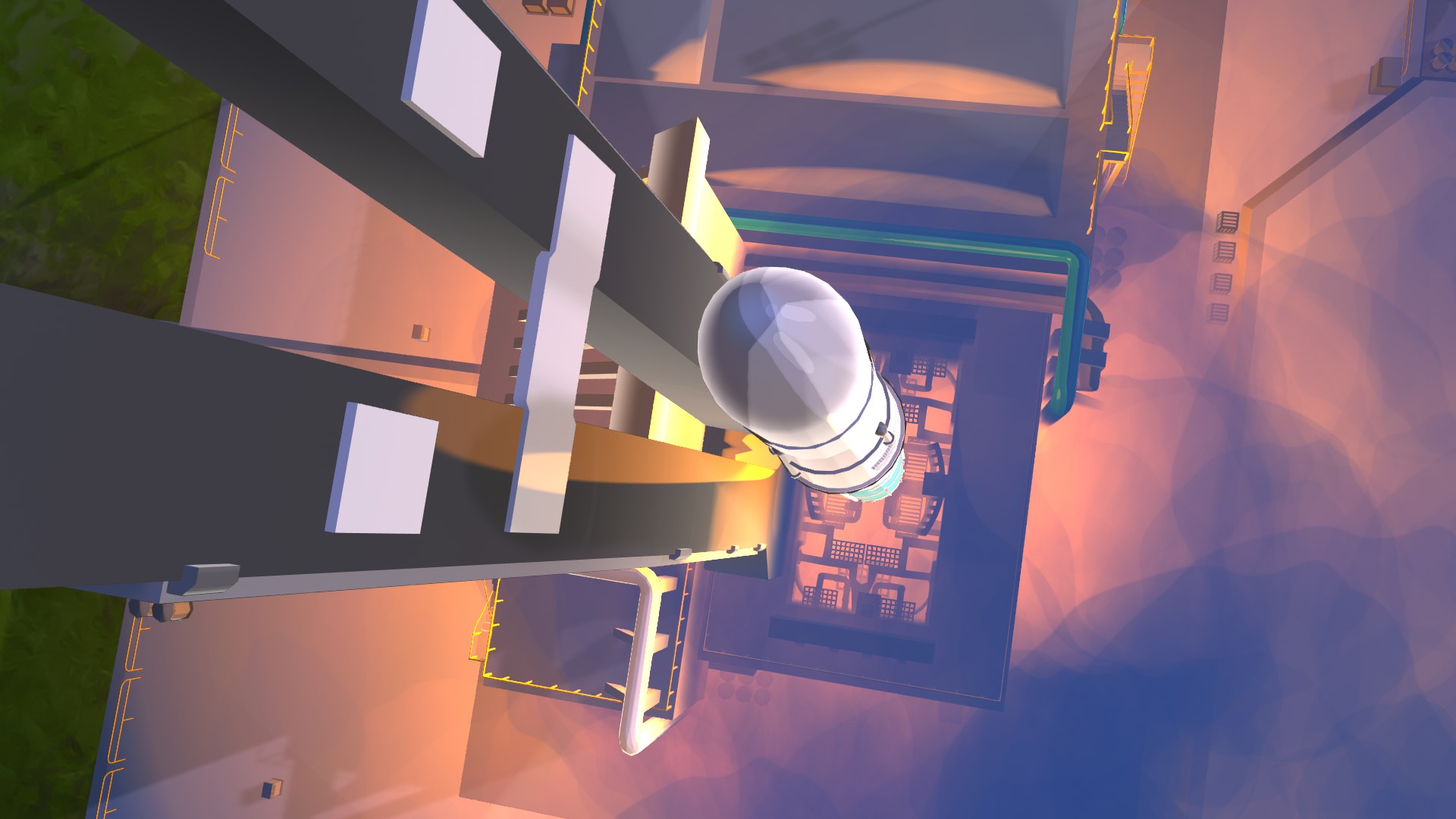
Mars Horizons is very easy to play, and has some great visuals. You can skip a lot of the cinematics and UI animations to speed things up (some of the animations take their time). Everything is kept pretty simple – there’s no photorealism here – but is still attractive. While I’m not sure how re-playable it is, I love how accurate it is to real life (with several achievements for beating the real-world dates of several missions), and I know I’ll get plenty of playtime managing my space agency.