One game series that I look back on very fondly is Wing Commander. I absolutely loved those games, and played every last one of them. Then the series just died. There was a movie that should have been killed during its infancy and an XBLA shooter that was attached to the series only by name and the fighters themselves, but as far as I’m concerned, the series is still dead.
Spaceflight games in general have been few and far between, largely left to indie developers who have fond memories of Wing Commander and the like. And thanks to Kickstarter, we’re starting to see these games make a bit of a comeback in the indie game realm.
And so we come to Strike Suit Zero, with the tag line “Space. Combat. Reborn.” If this is the rebirth of spaceflight games, I think I’ll be pretty happy.
Gameplay
Strike Suit Zero is very fast paced. Throughout the campaign, you’ll fly four different ships: a fighter, bomber, interceptor, and the eponymous strike suit. Each ship has slightly different stats – the fighter is a balanced craft, the bomber is slow but armed with an unlimited number of capital-ship destroying torpedoes, the interceptor is fast and agile, and the strike suit… Well, I’ll get to that later.
You’re allowed to customize the weapons on your ship. Most ships have two primary weapons – a plasma cannon that does moderate damage to shields and hull, and a rapid firing machine gun (“rapid projectile emitter”) that chews through shields but does less damage to armor. As you progress, you unlock new weapons to fill these slots, though they’re just stronger or weaker variants with different stats.
The real customization comes in your secondary weapons, where you have a variety of missile and rocket systems to choose from. You can mix and match, or simply load up on a single type. Personally, I like the swarm missiles. They do low damage, but you get a ton of them and can lock up to 10 at a time.
The game is by no means easy. You’ll have to face enemy fighters, corvettes, frigates, cruisers, and carriers, and they’re all deadly. Luckily, there are checkpoints during missions where you will respawn if you die, with full armor and restocked ammo. Sometimes a few extra missiles make all the difference.
Large ships like frigates and carriers are armed with a number of turrets – flak, plasma, and beam cannons. You often have to prioritize which to target – flak turrets are going to chew you up, but that beam cannon is hammering away at friendly capital ships. However, once a capital ship has been relieved of turrets, it’s basically giant, slow-moving target practice.
The missions in the game give you a variety of tasks, from protecting capital ships, to assaults on enemy bases, to your standard dogfights. You can replay the missions whenever you like, attempting higher scores or unlocking upgrades for your ships.
The Strike Suit
I love this thing so much I’m giving it its own italicized section. The strike suit is a transformer, changing from a fighter form to a mecha-style robot with unlimited ammo. When you transform, the controls change allowing you to strafe, lock-on, and dodge. You’re not invulnerable, but in strike suit mode your damage increases significantly.
The controls for the strike suit work so well that it is perfectly possible to pull off moves you’d see in stuff like Macross or Gundam (or any anime with giant transforming robots). There were several times I’d race to my carrier as torpedoes were headed its way, arrive just seconds before the torpedoes would hit, transform, spin toward the torpedoes, destroy them all, transform back into a fighter, and blast away. It felt amazingly badass.
Of course, with so much power in strike suit form, there has to be a balance, and that comes in the limited use of the mode. The strike suit runs on “flux” energy, which slowly accumulates over time but can be filled much more quickly by destroying enemies. Once filled, it’s usually a good idea to transform and empty your flux so you can start acquiring more strike-suit energy. You can remain in strike suit mode as long as you like, but your weapons drain your flux energy.
The strike suit is armed with two weapons: a flak cannon that does significant damage, and a powerful missile that can lock on up to 40 at a time, across multiple targets. You’re only given 40 missiles at a time, but they recharge slowly. Your flak cannon will drain your energy more slowly, but it’s fairly inaccurate. Your missiles, on the other hand, drain energy with each lock, so how many lock-ons you can acquire is dependent on how much energy you have.
Graphics and Sound
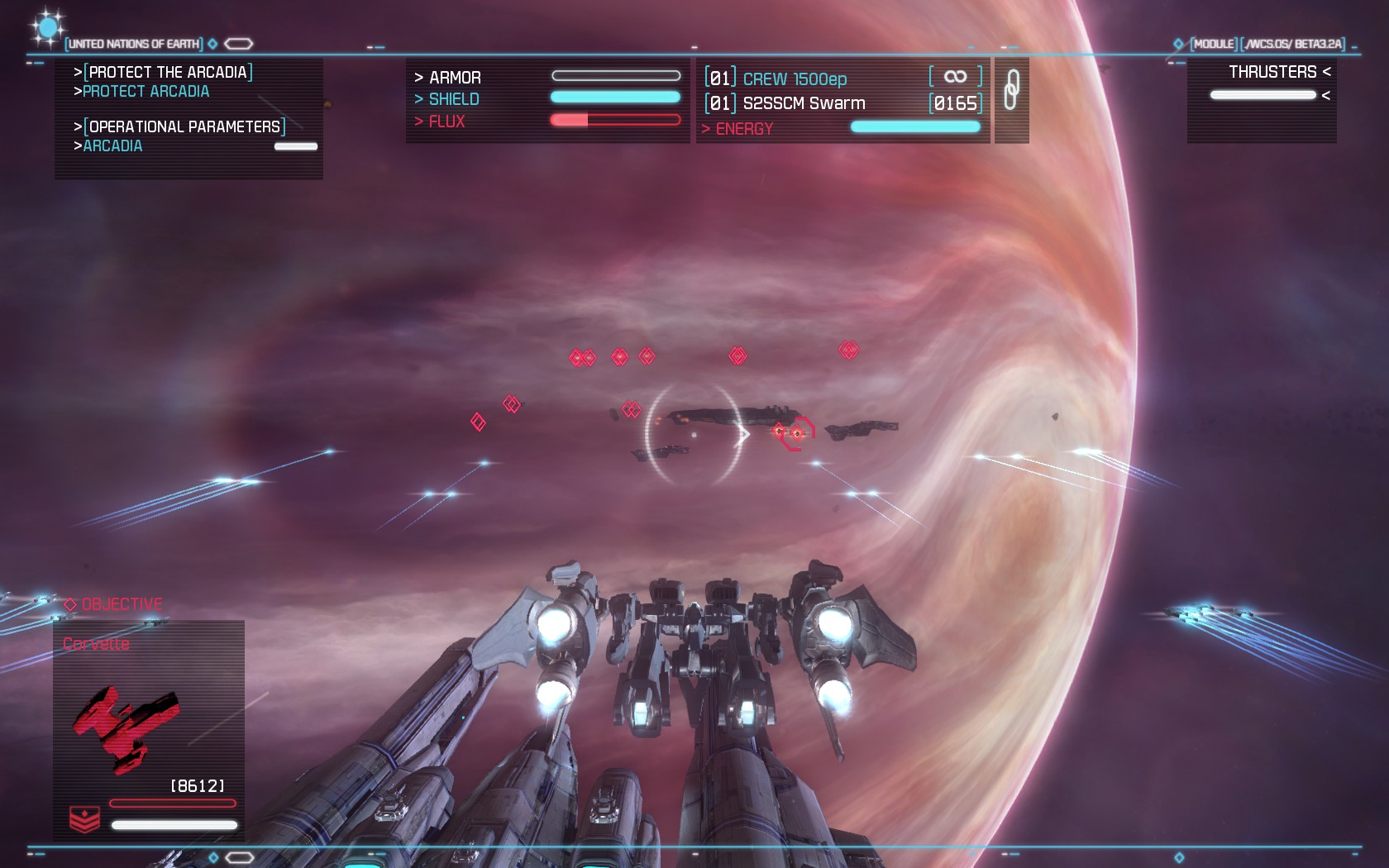
The game is beautiful, with colorful backgrounds, detailed ships, and ribbons of color that trail fighters. Screenshots look gorgeous, but the game is just as lovely when it’s in motion.
Ships are also a bit color-coded. Friendlies all sport blue colors and trails, while enemies have red colors and trails. It’s easy to see where you’re needed most.
Sound is also fantastic. All the effects sound great and work perfectly in the style of the game. But the music deserves a special note. The music was written by the same person behind Homeworld’s soundtrack. It’s moody and dramatic and fits the story perfectly.
Controls
I’ve already touched on the strike suit controls, but I want to mention that all the controls work great. I played the majority of the game with a joystick (and I was overjoyed to have a game that works well with a real joystick), but I played the beta with the keyboard and mouse, which works surprisingly well. It takes some getting used to, with the mouse controls pitch and yaw, and the keyboard controlling speed and roll, but it’s fairly easy to understand, and probably a bit easier overall. (I still think the joystick was more fun)
Story
Honestly, the story is a bit generic, but not bad. The closest approximation might be Battlestar Galactica, but there are a lot of elements similar to other sci-fi stories. It doesn’t feel like there’s a lot of depth to the world (it’s no Halo or Mass Effect), but the backdrop for the game is fleshed out enough to be interesting, if a bit cliché.
Summary
I love Strike Suit Zero. It’s beautiful. It’s hectic. It’s fun. Sometimes the game felt difficult, but success was never out of reach. There are only 13 missions, but each can take an hour to finish at times (especially if you die a lot), putting it somewhere around 8-10 hours to complete. There’s not much here for replayability, other than the sheer enjoyment of the dogfights, which might be enough.
Strike Suit Zero retails at $20, which might be a bit high for an indie game, but it’s worth every penny, as far as I’m concerned.