SimCity launched on March 5, 2013. I bought it on release day excited to play the first new SimCity game in ten years. (Societies doesn’t count.) Like most people who experienced SimCity’s launch, I was extremely disappointed. Actually, that’s an understatement… If I hadn’t bought from Origin and been stuck with it, I would have returned it and been done with it. The issues with the launch are well documented. For me, at least, part of the problem was that I could see a great game under all the problems.
The new SimCity did a great job of making the complicated workings of a city (water, electricity, sewage, etc) easy to understand. Watching power travel across the map slowly powering buildings is simply beautiful. However, the new always-online multiplayer-only aspects caused numerous problems. For what it’s worth, the network problems were ironed out relatively quickly, though I lost several cities while they fixed the problems. I stuck with the game for about two months, and the problem that finally killed the game for me was something so basic: traffic.
I had cities that functioned perfectly: smooth traffic and raking in simoleons. Suddenly, something would happen in the region and my cities would be flooded with traffic that would never disappear. I saw cars get stuck inside black holes in intersections, constant traffic jams that no amount of public transport would fix, and just bug after bug that made the game impossible to play. Instead of playing the game and having fun, I was searching for a way to relieve the traffic pressures. Instead of building my city, I was trying tricks and gimmicks to produce a barely-functioning city. My best city, with a highly educated population, slowly devolved into a slum as traffic prevented the police, fire department, and hospital from reaching homes. Traffic kept people from my university, turning the highly-educated workforce into an uneducated mob. Shortly after, my nuclear power plant suffered a meltdown due to the lack of educated workers. Any city I started was just a ride toward disappointment. It was extremely frustrating and made the entire game a chore to play.
Fast forward to early January. I had been thinking about SimCity for a while, wanting to give it another try and see how it’s improved. A friend said it was much better and that the expansion, Cities of Tomorrow, was fun to play. It was just the push I needed to give it another try. I fired up the game for the first time in nearly a year expecting very little in the way of improvements; I didn’t want to get my hopes up. To my surprise, my traffic problems magically disappeared simply by loading my cities. And while two of my cities seem to be lost (can’t load them, can’t recover, can’t abandon), the ones I can access seem to be working fine. SimCity was actually fun to play, so I decided to give the expansion a try as well.
Cities of Tomorrow adds several new structures, two new resources, and some very interesting ways to deal with running your city. With SimCity, there are generally two paths: clean and expensive green cities, or dirty and profitable industrial cities. In Cities of Tomorrow this continues with the introduction of The Academy and Omega Co.. The Academy is a high-tech research center which produces green technologies that keep cities clean and running smoothly. Omega Co. specializes in industry and slowly monopolizing entire regions. Both paths produce a dystopian futuristic city that’s fun to play with. I’ve always preferred clean, green cities to industrial cities, so I immediately gave “The Academy” a try.
Some of the new technologies from The Academy include a Sewage Sanitizer that converts sewage to clean water, a Garbage Atomizer that destroys garbage without pollution, a Wave Power Plant that can produce power from ocean waves, and a fusion power plant that produces vast amounts of clean energy. All this fancy technology is powered by a new resource called “ControlNet”, which is produced by The Academy and ControlNet Facilities. Without ControlNet, your structures will stop operating, and bad things start to happen. So while many of them are quite useful, their non-ControlNet counterparts are often easier to deal with. However, if your city is focused on being green, The Academy is definitely a good path to take.
After playing with a green city I decided to try out the Omega Co. vision of the future. The goal of Omega Co. is to turn every factory and store into an OmegaCo franchise, while making every sim buy OmegaCo products. All this starts with an Omega Factory, which produces Omega; a resource that slowly turns buildings into franchisees. Each franchisee earns you a bit of extra cash, so taking this route can produce a wealthy city very quickly. After planting an OmegaCo HQ and a Robotics HQ you can start to produce drones, which are one of the best parts of Omega technology. Drones can be used to put out fires (“FireDrones”), catch criminals (“LawDrones”), and heal injured sims (“MediDrones”). Drones can only be used once (putting out a single fire, apprehending a single criminal, or healing a single sim) so you have to constantly produce more. On the other hand, drones fly so they can’t be caught in traffic. Drones can even be shipped out to homes and converted to “BuyDrones”, which will go shopping for your sims, relieving traffic. But the best thing about OmegaCo’s path for the future is the Blade Runner-esque style your cities take.
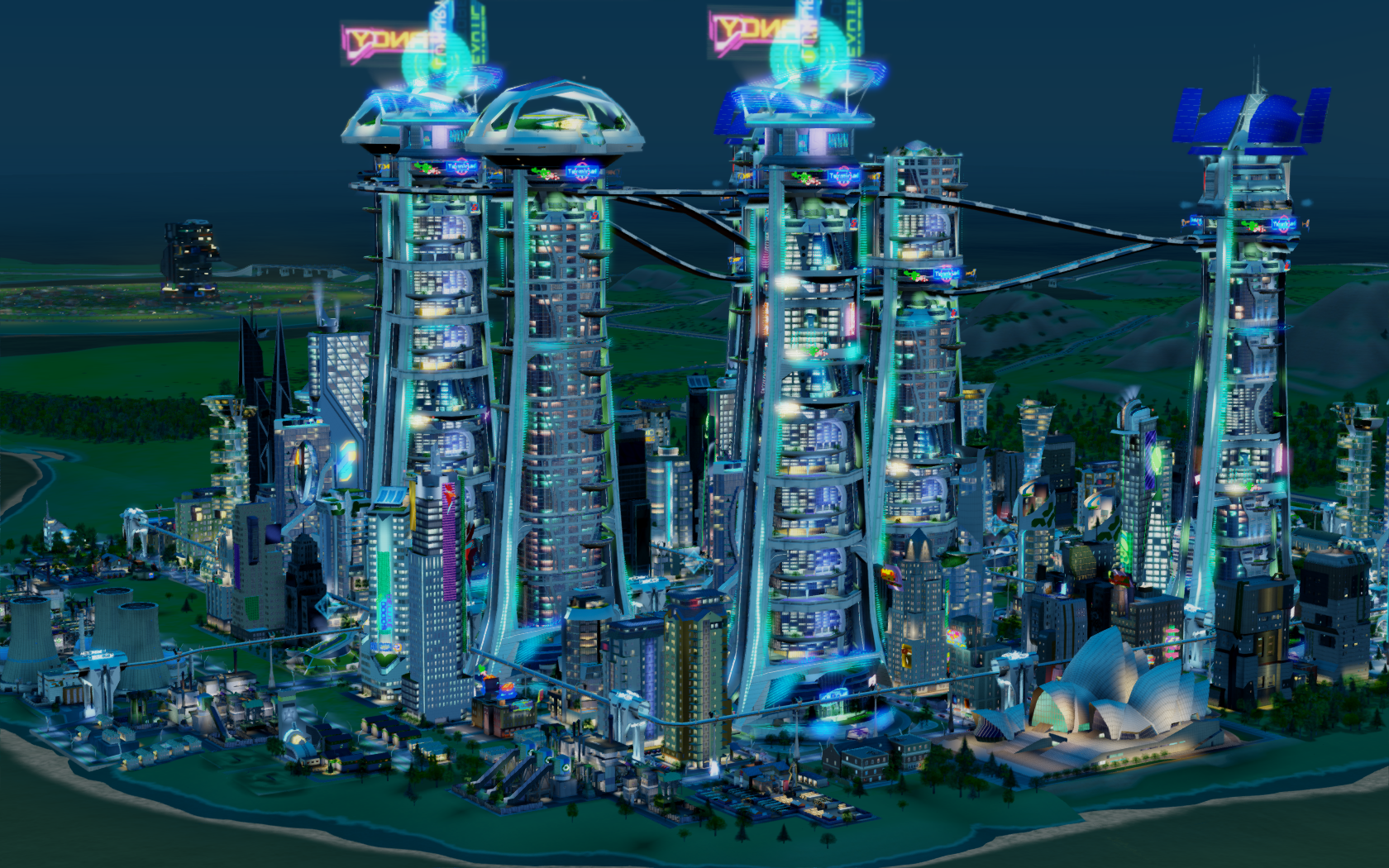
Whichever path your cities take, you can build huge “Megatowers” which are tiny arcologies you can build with housing, shopping, workplaces, and service facilities. You can connect these towers with “Skybridges”, giving sims a way to move between them without using the streets. Towers are topped with a “crown”, which can provide a nice bonus to the tower. They’re an excellent way to expand your city without needed more room.
To summarize: SimCity is much improved and Cities of Tomorrow is fun to play and adds a lot of new stuff. That said, I think the $30 price tag on the expansion is a bit high – $20 is probably a more appropriate price. I can at least recommend SimCity now that it’s working much smoother, and the promise of offline play in the near future makes it worth it.