I generally hate PVP games. When games support PVP but have an option to disable it, I usually will. I just have no interest in competing with people who measure their worth by their ability to “own noobs” in a video game. That said, I’ve begrudgingly played PVP in Destiny for several years now; typically just to earn special gear or complete seasonal objectives. I find PVE in Destiny far more satisfying since you don’t have to play the “meta” to get ahead. And as a solo player, it’s a chore finding a team and disheartening when I enter a PVP match against a full clan.
But Bungie has been improving things for solo players. Over the last year, they’ve added “Freelance” modes to several PVP modes (Crucible, Iron Banner, Gambit, and Trials) for solo players where everyone in the match is playing solo. I found I did far better in Iron Banner when solo queueing (maybe I’m not quite as bad as I thought?), making PVP a bit less of a nightmare.
How Trials of Osiris Works
Trials of Osiris is Destiny’s end-game PVP mode, where two teams of three compete over several short rounds (I think there’s a time limit of two minutes), with the first to five wins victorious. Trials is a little different from typical 6v6 PVP, but works a bit more like high-level PVE: when you die, you have to wait for an ally to revive you. A team wins by eliminating the other team, or by capturing a point after the time limit. To enter Trials, you need a “passage” ticket purchased from Saint-14 in the Tower that tracks your wins. If you win seven matches with no losses, it’s a “flawless” ticket and lets you access The Lighthouse, where you can redeem special rewards like “Adept” weapons with slightly better stats or special armor.
Within the past few seasons, Bungie introduced Freelance mode for Trials in a “Trials Labs” option that isn’t always available (unfortunately). This weekend was the first time it’s been available this season, and I’ve been wanting to give it a try (for a chance at some of that sweet Trials loot), so it seemed like it was about time. I headed to Saint-14 to purchase my ticket.
There are four types of passages: Passage of Mercy, which forgives one loss; Passage of Ferocity, which awards a bonus win after your third win; Passage of Wealth, which increases your rank points from reaching 3, 5, and 7 wins on a ticket; and Passage of Confidence, which requires a previous flawless win and grants a bonus reward from the flawless chest.
Dipping my toes
I purchased a Passage of Mercy as a feeble attempt to go flawless. I won my first match thanks to some far better players on my team, but lost my second match relatively quickly, spending my free loss on the ticket. I could have bought another ticket (resetting my progress), but just decided that next time I’ll use Ferocity to get a bonus win and finish the ticket faster.
The rest of my matches over the weekend were about 50/50. Sometimes there were players on the other team that were simply better at PVP, or played the meta better. After seven wins, my ticket was completed and I started getting better rewards after matches; typically just extra Trials engrams, which I opened for a random piece of Trials equipment. (Though I wasted several engrams early trying to get good rolls of one of the few weapons I had unlocked.)
I started off running a PVP build I had seen on YouTube build around the Lorely’s Splendor Titan helm and the Le Monarque bow. Loreley’s Splendor lets you spawn a sunspot when you cast your Barricade, and allows sunspots to heal you, making them a great defensive ability. The Titan’s bottom-tree Sunbreaker subclass gives you a buff called “Sun Warrior” while standing in a sunspot and for five seconds after. This buff gives a 20% damage increase, and a precision shot from Le Monarque against a player with no defensive buff will result in a kill (the headshot does a big chunk of damage, and lingering poison damage finishes them off). I was doing fairly well with the build, but got bored with it and started trying other things. Toward the end, I decided to run with a hand cannon to try to finish an objective, but I’m not very good with hand cannons and had only middling success.
Regardless, I actually found it… Fun? I think? It was great unlocking some new weapons that are actually really effective. No god rolls, but all Trials weapons have an origin trait called “Alacrity” which increases your reload speed, stability, aim assist, and range whenever you’re the last living member of your fireteam or running solo. That last bit surprised me – there’s some really great solo weapons locked behind an endgame team-based PVP mode, which seems odd.
Final Thoughts
I think the “Freelance” mode for Trials needs to stick around just to open it up to more of the Destiny community (all us solo players). I did some searching and found that there’s actually some debate as to whether or not it should be permanent (or exist at all).
The arguments against seemed to be limited to a minority of players that see it as only for “elite PVP players” and there’s no room for filthy solo players or casuals. (The people I mentioned above who measure their worth by their Trials score.)
The arguments for were far more numerous. People generally seem to like opening up the accessibility and letting more players access the content, along with making it easier to earn the special Trials gear. I also saw these players typically acknowledge the general issues with Trials, which mostly just boil down to too much focus on going flawless. A common complaint is around matchmaking, where a top 10% team may get matched against a bottom 20% team, which is far from fair, and a loss kills a chance at flawless. Removing the “flawless” quest would alleviate the problems around getting matched with a far superior team.
My biggest issue with most of Destiny has been the gating of rewards behind certain activities that are inaccessible to some players (typically solo players). I’m fine if the rewards are cosmetic to show off an achievement, but often those rewards are weapons or armor that are significantly better than what can be found elsewhere, which can give an edge to players who are able to engage that content more easily.
All that said, I’ll likely continue playing Freelance Trials whenever it’s available, and hopefully Bungie takes some notice of players like me and makes it a permanent option.
The first week of Destiny 2’s latest expansion, The Witch Queen, is nearly complete and I wanted to share my impressions of the new content and changes that came along with it.
There may be some minor spoilers in here, but nothing that hasn’t been revealed in trailers or introduced almost immediately upon starting the campaign.
Also, I’m going over a lot in here – practically everything that I’ve noticed in my first week – and a lot has changed, so brace yourself.
Story
I’m a longtime fan of Bungie’s ability to craft a world. I loved Halo’s lore to the point of reading several of the novels to learn more about it. There was a dark time in Destiny 2’s history (*cough*Activision*cough*) where there was little story progression each year in Destiny, but the past year changed all that: we saw humanity create allies from former enemies and fight several threats that were all building up to this new expansion. While the end of the last season, Season of the Lost, was a little underwhelming (though the final mission was a lot of fun), so far The Witch Queen campaign and Season of the Risen has been fantastic.
I’ve recently been reading the Destiny grimoires to learn more of the lore, and the grimoire starts with The Book of Sorrow, which details the beginnings of the Hive as we know them in the game. It turns out The Witch Queen delves pretty deeply into this lore as well – during one of the initial cinematics, there were several details that were straight from the lore I’ve been reading. We’re likely to learn a lot about the history of the Hive this year, so if you’re interested in Destiny lore, I think is is going to be a great year.
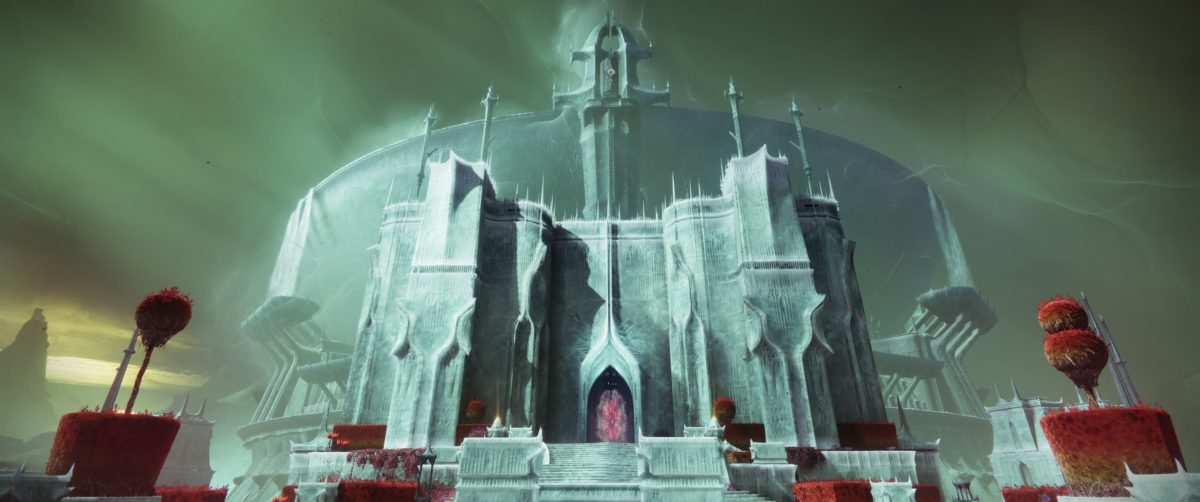
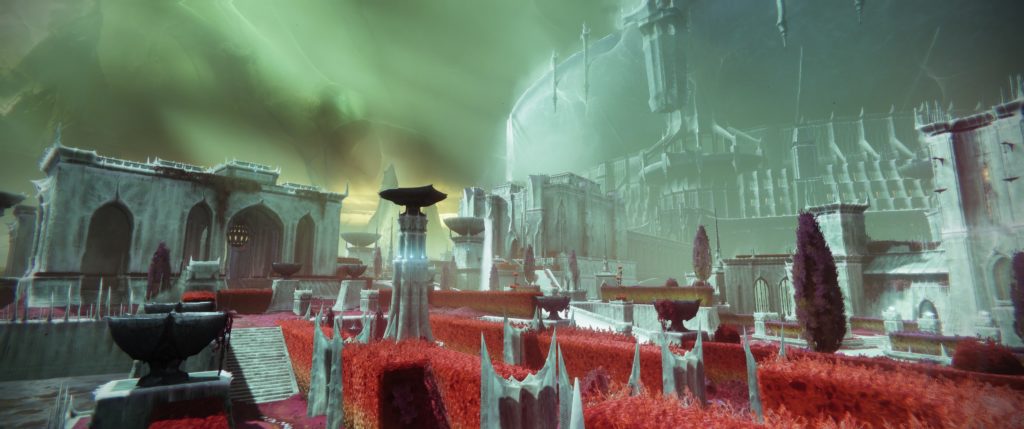
There are a few main themes in The Witch Queen: memory, mystery, deception. They all revolve around the titular character, Savathûn, the Witch Queen herself, and her Throne World – a world of her own creation on another plane. The Throne World destination is pretty large and labyrinthine – while on the surface it may seem about the same size as past destinations in Destiny, there are hidden paths and passages scattered throughout, reflecting Savathûn’s character. As Savathûn has been chasing the light for some time, there are areas that reflect her Hive background (and desire to distance herself from it) next to areas of odd beauty – her chase of the Light.
Within these areas, you use a new “Deepsight” ability to find hidden paths, which are “echos” – memories – of the past state of the world. Below Savathûn’s Throne World, Mars has areas where you can see its past – echos of humanity’s Golden Age. Much of the Witch Queen campaign involves revealing these memories to learn more about how Savathûn now possesses the Light.
And that is the core mystery of the expansion: how did Savathûn steal the Light? The Traveler gifted humanity the Light (and the Eliksni before that); why would it give the Light to the Hive? Did they trick the Traveler somehow? Did she steal the Light from Guardians? In order to find out, you have to chase Ghosts and capture new Hive Lightbearers to extract information with the help of our new Cabal allies. The campaign itself has some great twists and some pretty stunning reveals.
Check out this crater I made.
On a side note, I love Savathûn’s character, and the voice actress does an amazing job bringing her to life.
The Legendary Campaign
I’ve beaten the Witch Queen campaign on Legendary difficulty (took about three days, playing one or two missions a day), both to extend the life a bit and for the rewards granted for completing it at that difficulty. It was tough – there were three bosses I had to use the Destiny app to pull a fireteam together for – but it was still a lot of fun and made the missions feel more dire.
The levels themselves are extremely well designed, with plenty of cover in the respawn-restricted areas. I had to cheese a few encounters or exploit geometry and sightlines to stay safe and get my damage in, but completing these levels mostly solo felt very rewarding and I was able to approach them at my own pace.
Playing the campaign on legendary left me wanting to play past campaigns at a higher difficulty (with appropriate rewards), just because of how harrowing they feel at certain times. It’d be nice to allow matchmaking as well (which might be available when replaying the missions; I haven’t tried).
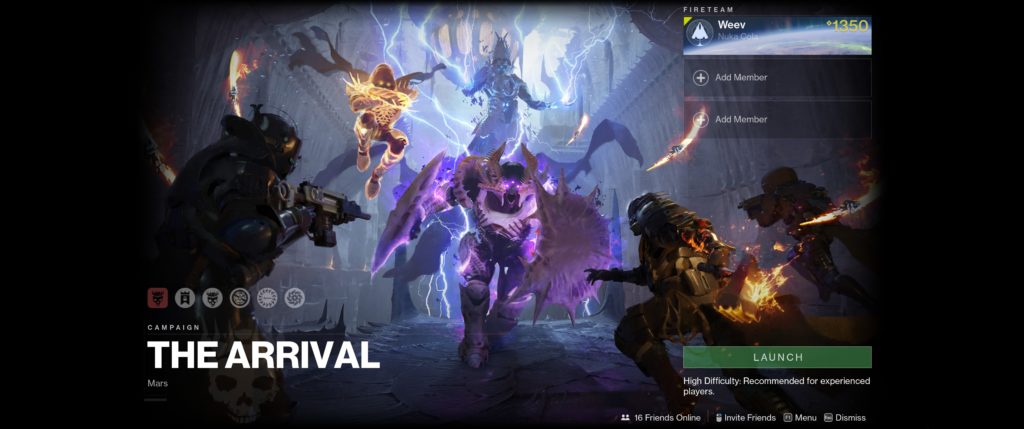
The Legendary Campaign launch screens show the new Hive Lightbearers looking particularly terrifying.
Hive Lightbearers
One of the big changes with The Witch Queen are new Hive Lightbearers, one matching each of the three player classes: Titan, Hunter, and Warlock. The first time you encounter one of these in the campaign, it’s a big deal, and on legendary difficulty is appropriately scary (coming in at the minimum light level for the new content).
Hive Lightbearers tend to be mini-bosses, but I’ve found they’re not too difficult to deal with. Fighting them can be a bit like playing PvP – you can handle them the same way you handle players that use their supers: you can retreat and hide to run out their super timer, or you can try to fight while dodging their attacks. Fortunately, the AI is pretty bad for these guys: Hive Knight Lightbearers – the Titan equivalent – will sometimes stand behind obstacles and hurl their shields at walls right in front of them, to the point where they’re not even a threat. None of the them are as strong as a player Guardian, but they can still be deadly if you don’t keep moving.
Each of the “subclasses” use abilities similar to player classes, with a few exotic variants tossed in. The Titan equivalent for the Hive uses the Void subclass: summoning barricades, throwing suppression grenades, and throwing shields during their super. The Warlock equivalent uses Arc abilities and can summon a rift to heal (and maybe empower?) themselves. Finally, the Hunter equivalent uses Solar abilities, throwing knives during their super and sometimes becoming invisible.
Overall, the Hive Lightbearers are really just new bosses with attack styles that mimic players. They can be difficult at times, but more often you just fight them like any other boss – with ample use of cover and frequent movement.
Void 3.0
Another big change with this expansion is the introduction of a Void subclass rework, dubbed “Void 3.0”. As a Titan main, Void was my least-used subclass; it generally felt less powerful than other subclasses, though the Ward of Dawn was useful for high-level content. The Void 3.0 updates have changed that – it’s now one of my favorite subclasses for survivability. I wouldn’t have made it through the legendary campaign without the new overshield mechanics for Titans.
As they did with the Stasis subclass, Bungie focused the Void changes around a handful of keywords: Overshield, Invisibility, Devour, Volatile, Weaken, and Suppress. Each class has a buff and debuff it specializes in, though all classes have some access to the entire set. Along with the ability changes are the aspect and fragments like the Stasis subclass.
I’m most familiar with the changes for Titan, but I’m going try to give a brief update for each class:
Titans
I love the changes to Titans. Void Titans now specialize in overshields and making enemies volatile, which causes them to explode when killed. What I love best about the changes is that it clearly turns Void Titans into a “protector” class – they deploy shields and barriers to give their teams extra durability.
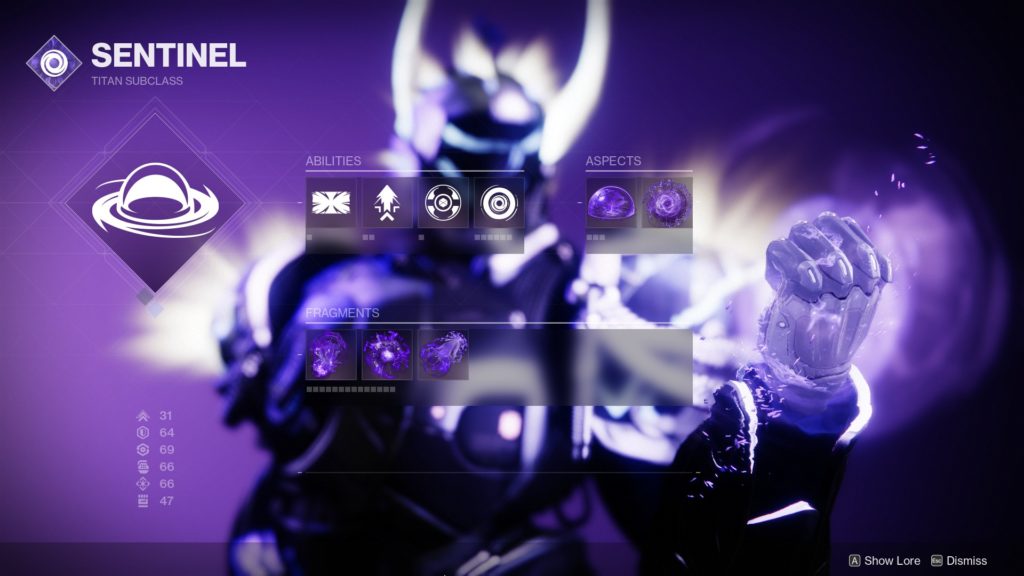
While the other classes get three super options (matching the old Void trees), Titans only get two: Sentinel Shield and Ward of Dawn. The Sentinel Shield basically works like the previous Code of the Commander shield, where guarding creates a barrier that allies can shoot through for increased damage. Ward of Dawn has a significantly decreased cooldown, so you can use it more often now, which is great for moments when you need some breathing room or need to control an area. (I played the campaign with Sentinel Shield and really wish I had used Ward of Dawn.)
While the Titan Barricade and Jump abilities didn’t change, the melee abilities did, and Bungie included something that seems like a no-brainer in hindsight: a shield throw melee ability. Along with the old shoulder charge melee, Titans have an option where they throw their shield, which will bounce off terrain and enemies. It takes some practice, but you can hurl it across large areas and deal some damage with the ricochet. It doesn’t seek as much as the super shields, but if you’ve got a line of enemies coming at you, it can typically plow through them. And while the Barricade abilities themselves didn’t change, their animation did: instead a shoulder-bash style deployment, Void Titans summon their shield and slam it into the ground to create their Barricade.
The Titan aspects allow builds to focus on overshields granted from barricades and supers, or making enemies volatile to create chain explosions. I ran the campaign with Bastion and Offensive Bulwark, granting me regenerating overshields behind my barricade and increased grenade recharge. It was a heavy-defense build, but that’s what was most important during the campaign.
Warlocks
From what I’ve read, Warlocks arguably got the best upgrades with Void 3.0. Warlocks specialize in Devour (increased grenade recharge and heal on kill) and Suppression (blinds enemies and prevents ability use). Their super options remain the same as before, as well as their class and jump abilities. They have an aspect called “Child of the Old Gods”, which lets their Rift summon a Void Soul that can weaken nearby targets and deal damage, as well as recharging abilities or healing (based on the type of Rift used).
Hunters
That leaves Invisibility and Weaken for Hunters. I’ve seen a lot of complaining from players online about the changes, but the changes seem in line with the way Void Hunters operate. I had a few Hunters in my team during the campaign, and they’re still plenty strong; they just don’t have the survivability options Titans and Warlocks have (though being able to become invisible is pretty powerful). I can admit the changes seem less drastic for Hunters, however.
Like Warlocks, Hunters keep their previous three super options, as well as jump and class abilities. Their Aspects generally cater to staying invisible and granting invisibility to allies.
Fragments
Fragments are the same for all classes, and I won’t go into each, but I used three throughout my entire campaign run: Echo of Exchange, which grants grenade energy on melee kills; Echo of Resistance, which causes Void buffs to have increased duration (longer-lasting overshields); and Echo of Expulsion, which causes enemies killed by Void abilities to explode. There are a few other I’d like to try out, like Echo of Remnants (increased duration for grenade effects) and Echo of Provision (melee energy on grenade damage), but I was pretty happy with the ones I chose.
PsiOps Seasonal Activity
Each season comes with a new seasonal activity, and this season’s “PsiOps Battleground” is a fine addition. I feel like Bungie has a solid formula for creating these activities, with a clear structure that consists of several “stages” to complete. While PsiOps probably isn’t the best they’ve produced, it’s still pretty simple and straightforward. I imagine it’ll evolve over the course of the season.
New Weapons and Perks
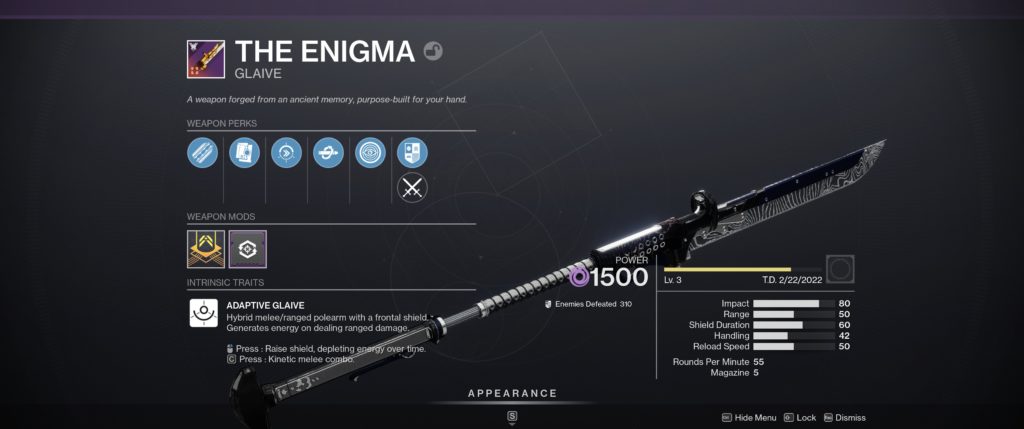
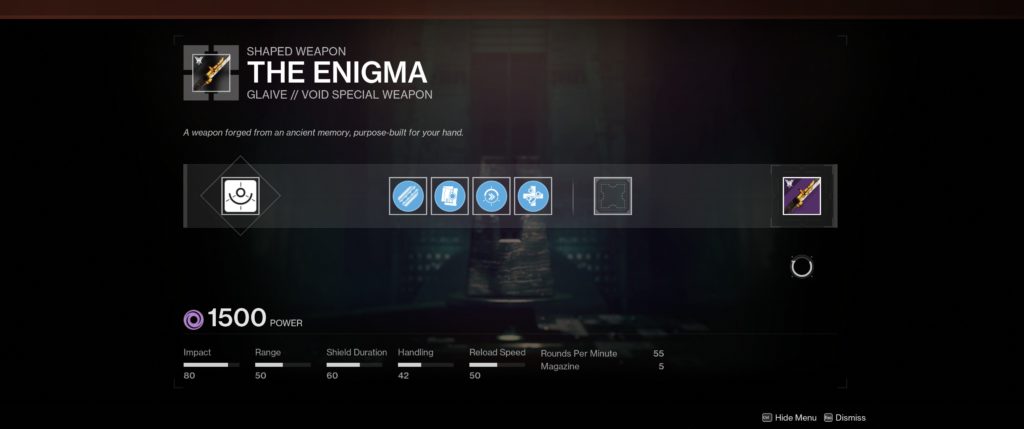
The big new weapon this season is the glaive, which feels great. When wielding it, your melee ability is replaced with glaive strikes, which have a strong three-hit combo. They can also fire a ranged blast that uses special ammo. And finally, they can deploy a short-duration shield to block incoming fire (which recharges a bit on projectile kills). My only complaint on the glaive is the difficulty in recharging the shield, but that might be a balance consideration; I could see them being annoying in PvP if everyone could just charge into melee range with a shield up constantly. There are also several seasonal mods this season to buff glaives, making them very useful.
The new “origin” traits for weapons are nice, subtle effects. They don’t make a huge difference most of the time, but they can be handy. Most new weapons have an origin trait based on the “make” of the weapon, and activities like Strikes, Crucible, and Gambit give an additional origin trait option based on where you found the weapon. I’m most excited about the Vanguard trait, which causes final blows to heal.
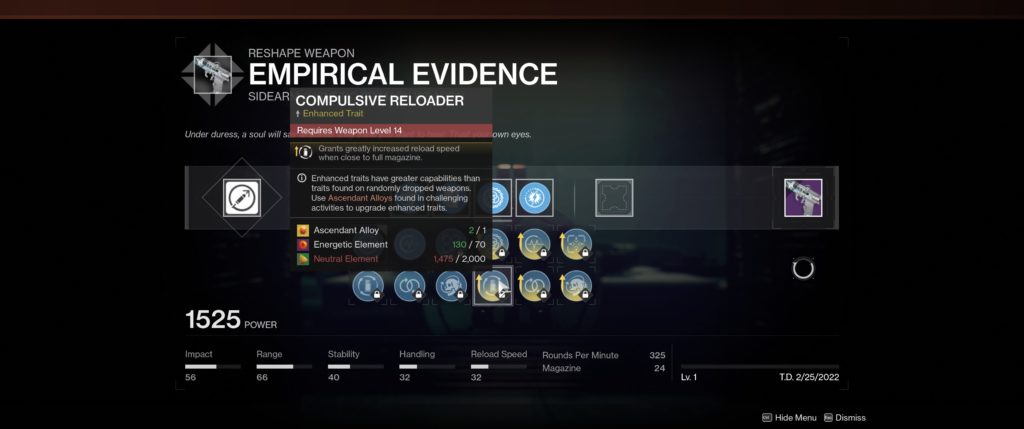
There are also a lot of fun new perks, like “Compulsive Reloader”, which gives you faster reload speed when close to a full magazine (basically the opposite of the existing “Alloy Magazine”, which reloads an empty clip faster).
Weapon Crafting
Finally, the thing I’ve been most excited about with this expansion: weapon crafting. I’ll say what’s here is a decent start, but it’s far from what the game needs.
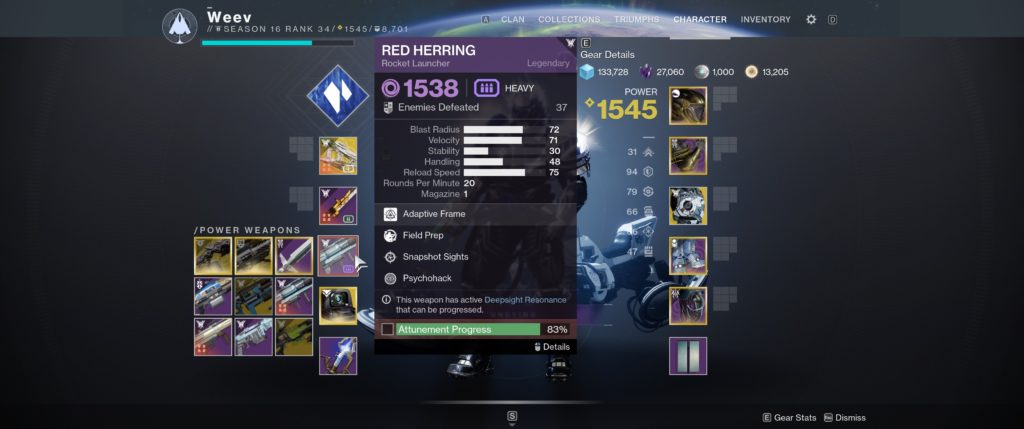
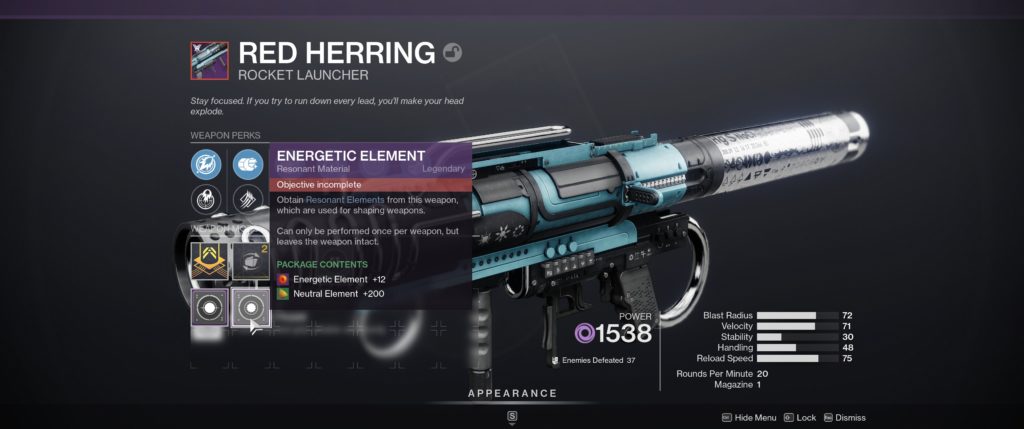
Crafting a weapon requires a “pattern” and a variety of resources. You can obtain weapon patterns from quests or by extracting materials from weapons that have “Deepsight Resonance”, which drop randomly in the world. Once you have a weapon with resonance, you need to use it (getting kills or completing activities) before you can extract the materials from them. It’s basically a mini-quest on random weapons that encourages you to try them out, and you can typically complete them in about 10-20 minutes using them at a destination (or with a single run of an activity like a strike). Extracting materials from some of these weapons will progress you toward unlocking the pattern (some patterns require extraction from multiple copies), at which point you can craft your own version with whatever perks you want. Requiring use of the weapon can help you get a feel for which perks you like best, but it also means that sometimes you have to use a poorly-rolled weapon just to get the resources.
I guess it works like Play-Doh.
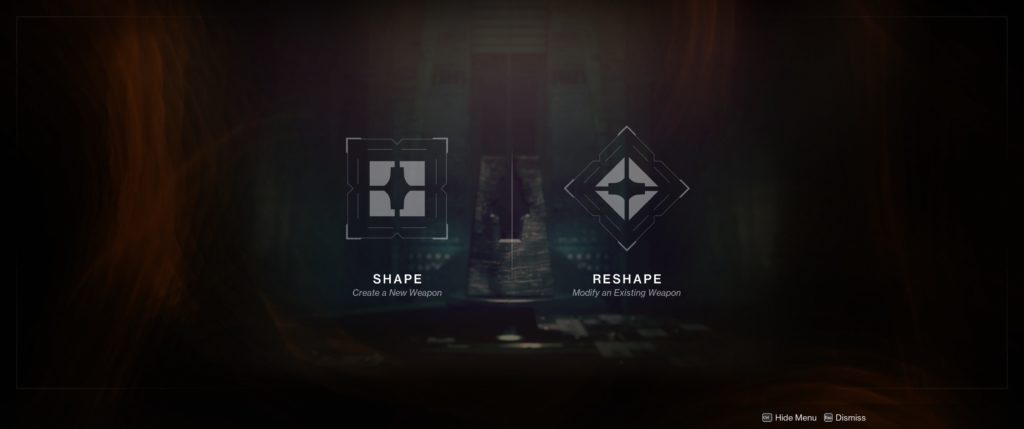
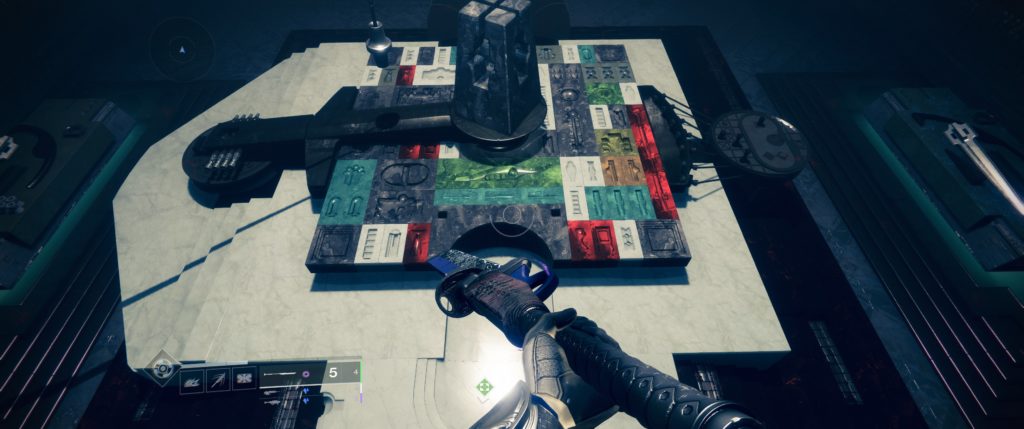
Once you have a pattern and the necessary resources, you just head to the Enclave on Mars (a new area) and use the “Relic”, which is basically a big table with molds for different weapons. You get to select the weapon you want to shape, the frame and perks you want, and finally create the new weapon. Most of the options for perks on the weapon are locked until you level it, which comes through extensive use.
I know one of the goals Bungie had for the system was creating a connection between the player and their weapons. In that regard, the system largely works – because of the effort you put into obtaining the pattern, gathering materials, and finally levelling the weapon, it creates an affinity for the weapon. Crafted weapons even show the date they were crafted, so you can celebrate their birthday if you like. I know I’ll always keep the glaive I crafted on release day, just as a memento, even if better options come along.
My concerns with the system are around the variety of materials needed (and acquiring those materials) for crafting and the cost of reshaping a weapon. Different perks use different materials (which you can choose when extracting the material from resonant weapons), which means you have to stockpile different types of materials to match, but you can only store 250 of each type so your ability to stockpile is limited. If you select the materials based on the perks you like when you used the weapon, you should be able to keep plenty on hand, but a single resource (with a large storage limit) would streamline the system. This is in addition to a basic material that you get every time you extract (a few hundred each time), but is consumed in large amounts during the shaping/reshaping process (advanced perks can use 2000 each).
Reshaping also has a large cost involved, especially for higher-level perks, and even after a perk has been used before, you have to pay a cost to select them again. I was hoping that as you unlocked perks, they’d permanently be available at no cost (similar to how mods work, just for a particular weapon). This would help to balance the shifting meta, where a god-roll weapon one season may be supplanted the next; being able to add the best perks and swap on-the-fly would help players adapt to the changes without stockpiling weapons. Without this, players will just need to stockpile different versions of crafted weapons with different perk sets since it costs a fortune to reshape a weapon to try out something new. You’re also limited by the RNG nature of acquiring weapons to extract resources from (drop rates are apparently very low), and limitations on acquiring Ascendant Alloys – a costly resource required for high-level perks.
This has happened before – the launch of the transmog system had a lot of issues at first, and they were quickly resolved by the next season. (I was just hoping Bungie had figured out that time-gating and reliance on random drops was a bad thing; apparently not.) I enjoy the ability to craft weapons, and I think this change is definitely a step in the right direction, but there’s some work still to be done to improve things. I know more weapons are coming to the crafting system, but I’d like to see weapon crafting become a more integral part of the game, replacing random drops with a directed system for players to obtain weapons built exactly as they like.
Miscellaneous
Along with all the changes above, there have been a bunch of UI tweaks (tightening up a few things so the new weapon perks can all fit on the screen), some welcome masterwork changes to armor (vastly reducing the cost to change the element on masterwork armor), and changes to Banshee’s reputation (doesn’t require inventory materials). They’re little changes that add up.
Unrelated: my space minivan that I acquired during the 30th Anniversary event.
Summary
So far I’m really happy with the new expansion. Although weapon crafting needs some work, I already have a few weapons I’m growing attached to (my glaive isn’t even a week old and already level 14! they grow up so fast), and I’m really enjoying the new story arcs.