I found Vampire Survivors while looking through my Steam discovery queue. With 99% positive reviews and priced at $3, I figured I’d give it a try.
I’m not typically into rogue-lites or bullet hell shooters, but a while back I picked up Nova Drift and had a great time with it – runs may only last a few minutes, but you always get to try something new. Vampire Survivors is similar, but you don’t control when you fire (your abilities just constantly fire without input), so you’re only focused on dodging enemies and picking up experience and various power-ups. Your abilities don’t combine quite like Nova Drift, but there are a few weapon and passive combinations that allow you to “evolve” the weapon into a significantly more powerful version.
You earn coins during each run that you can use to buy permanent buffs and unlock new characters. Each character starts with a different weapon and has a custom buff that improves as they level. My favorite is Mortaccio, who has a custom bone weapon they toss out that bounces around between enemies. (And his buff is a max +3 projectiles, which is really powerful.)
If you last 30 minutes, all the enemies disappear and Death appears, darts to your location, and instantly kills you, ending your run and granting you bonus coins. Along the way, swarms of enemies fill the screen and you mow them down.
Overall a lot of fun for a small price. It’s still in early access, so I’m hoping they continue to add new characters, levels, and abilities to keep mixing things up. It’s a lot of fun, though definitely an easier and “lighter” game than Nova Drift. (Which I recommend if you like Vampire Survivors.)
Back in July, Fallout 76 came to Xbox Game Pass and I decided to give it a try. I had avoided the game since its launch because everything I heard about it sounded distinctly non-Fallout: PvP focus, no NPCs, etc. Even since I started playing, there have been updates that have improved the game, so Bethesda is definitely doing a good job making the game better. I’ve played frequently since I started, and since I’ve reached level 100, I feel like this is a good time to put my thoughts about the game down. As with all games, there are good and bad elements, but ultimately, however, I don’t think Fallout works as a multiplayer game.
The Good
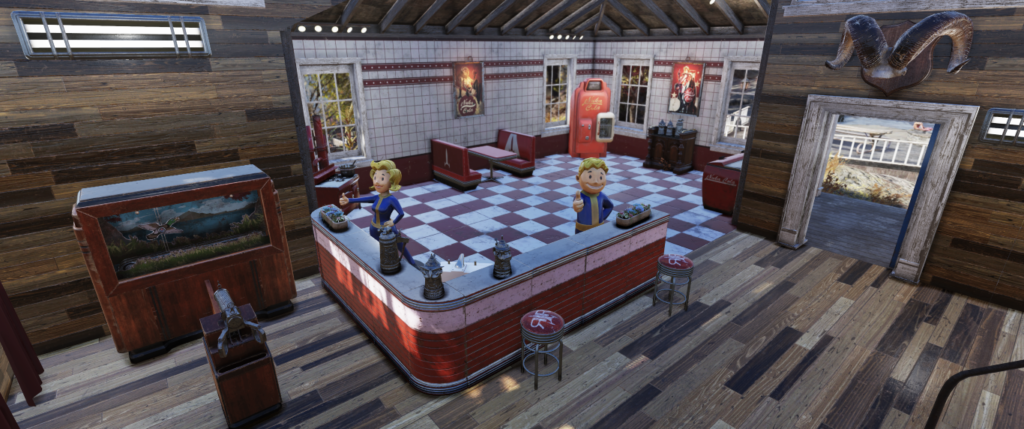
A player camp from Fallout 76 with a lovely diner design.
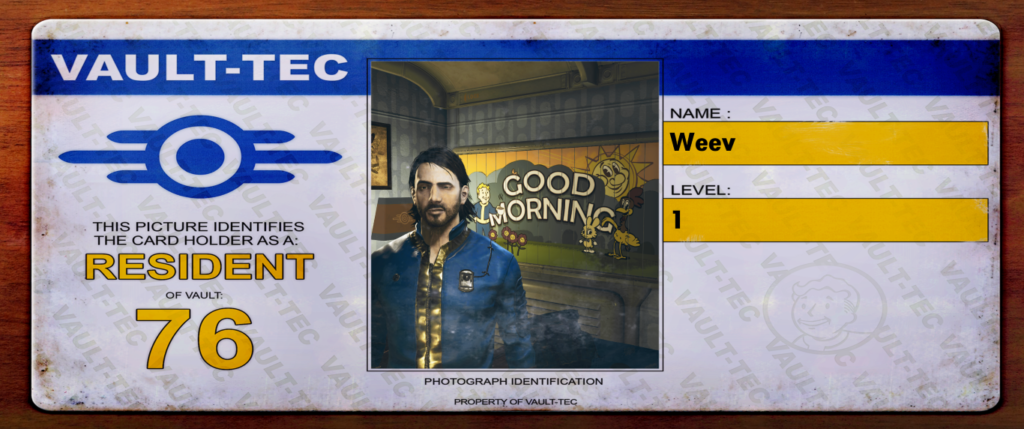
Just recently, the One Wasteland for All update has been a great update and actually solved a lot of problems I had with the game before. The update causes enemies to scale to your level, so you’re free to explore the wasteland without encountering the random high-level creature. Before, there were several low-level quests that would lead a player into high-level territory, preventing progress until the player is higher level. Since the update, I’ve been able to freely explore places I was less comfortable exploring before, and I can join any event I like. I’ve seen players just freshly out of Vault 76 (in the level 1-10 range) joining endgame events and contribute just as well as the level 400+ players. Everyone is fighting the same enemies, but always at their level.
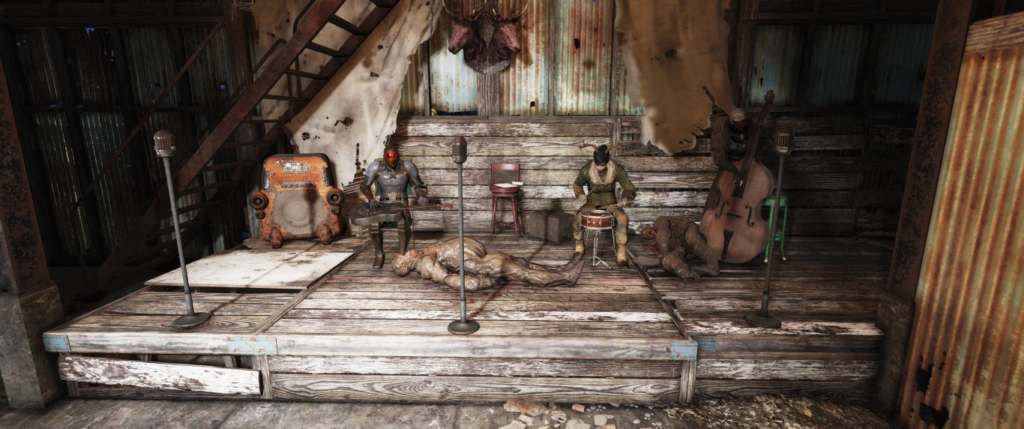
Me (left) and a few others playing instruments during an event.
My favorite parts of the Fallout experience have always been exploring the wasteland and learning about what happened before the bombs fell. When I started, the Wastelanders expansion was already out, which introduced NPCs and new quests, so I can’t compare to how the game felt before that point, but the Appalachian wasteland feels like classic Fallout now. I learn about characters and their stories without ever meeting them; I learn about what happened both before and after the Great War; I get to learn about the real-world West Virginia in it’s fictionalized version. The classic Fallout experience is all here.
A picture of my CAMP in Fallout 76.
In Fallout 4, one of my favorite features was building up the various settlements, but the build limits always felt restrictive – I remember my settlement in Sanctuary had a wall around the island, a single building, and a bunch of shops on a concrete foundation. In 76, you get your own “C.A.M.P.” to place and build up wherever you like. While the amount of space you get to build within and the budget for building still feel restrictive, I’ve loved building up my wasteland home. It’s my own personal workshop, shelter, and farm. I’ve spent hours building and decorating. I get excited when I find new plans for something else I can build in my camp. The building elements from Fallout 4 have been expanded and improved in Fallout 76.
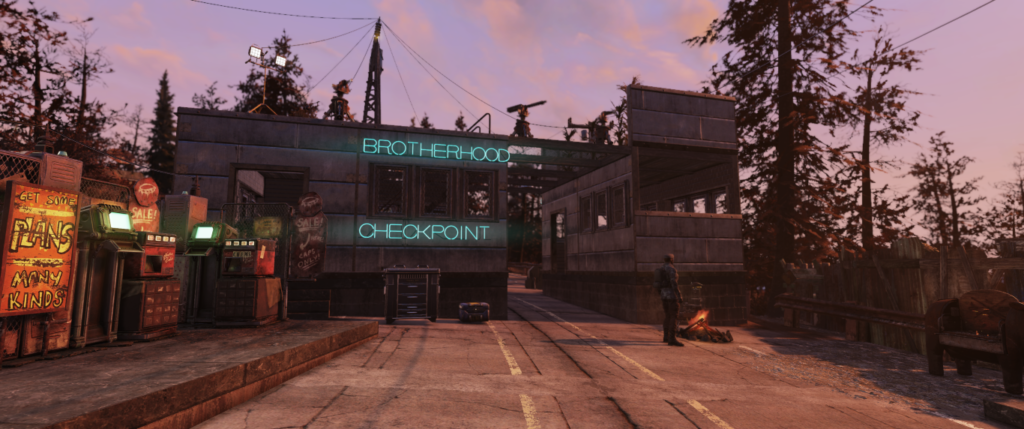
A player CAMP from Fallout 76 designed to look like a Brotherhood of Steel checkpoint.
Finally, there are certain multiplayer elements of the game that I really enjoy. I enjoy seeing other players visit my camp and make use of my workstations or buy from my vending machines. I love seeing how other players have built their camps. I enjoy the world events that groups of players can join and face waves of enemies. Bethesda has made it really easy to join up with other players in many different ways. I generally play solo, and you can play the majority of the content completely alone. Most endgame content has to be played with other players, but you don’t have to team up with other players during events. I like being able to play the game alone with other players wandering around, occasionally encountering another player in the wasteland or at my camp, then continue on my way. And generally, other players are very friendly and well-meaning, which improves the overall experience of the game.
The Bad
While there’s a lot to the game that I enjoy, there are some constant annoyances that I encounter that continually detract from the game. Most of these issues are ultimately caused by the multiplayer aspect of the game, unfortunately making what could be a truly fantastic game disappointing.
I don’t enjoy PvP in the slightest. There are plenty of games that I completely avoid because they’re primarily competitive (e.g., the entire “battle royale” category). In Fallout 76, you can turn on a “pacifist” flag that will prevent you from hurting other players and other players hurting you. While I’ve never killed another player (and never intend to), I’ve been killed by other players twice. The first time was after I picked a lock in a workshop claimed by another player. Typically locks have red text when unlocking them is bad (I assume); this one wasn’t, but still put a ten cap bounty on me. Later, I was turning in a quest when I was one-shotted by a high-level player. The second time, I was preparing to defend a workshop I had claimed from a wave of enemies, when I was one-shotted by a player, losing 50 caps. Both of these experiences soured me on Fallout for a short time, so I can’t imagine how bad things were when the game first came out. The experiences will also shape how I plan to play from now on – I never intend to stay at a workshop for very long, for instance, to avoid opening myself up for PvP. (I don’t understand why you’re forced into PvP for owning a workshop anyway.)
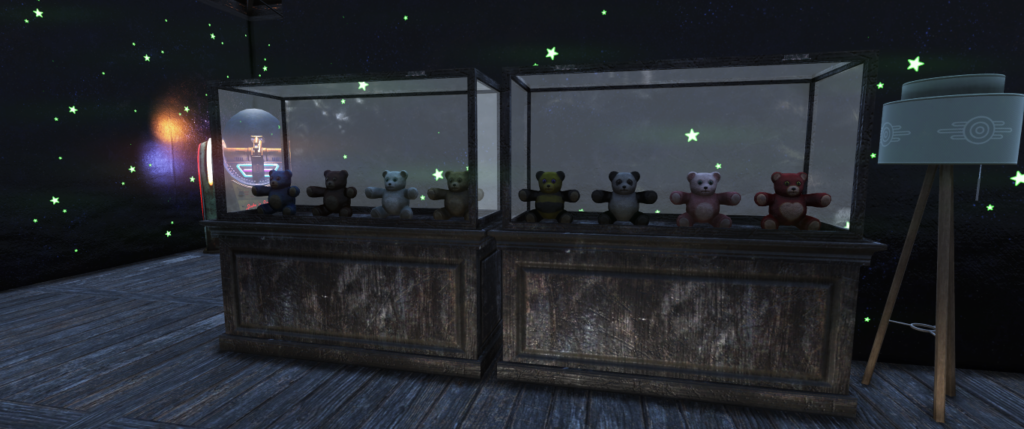
My teddy bear collection.
You do a lot of building things in Fallout 76. This requires a lot of scrap that you need to keep around to build things. Unfortunately, the stash at your camp only holds 800 pounds of stuff, including guns (which can be very heavy), armor, chems (also oddly heavy), miscellaneous items, and junk – including your scrap. Apparently early players could only keep 400 pounds in their stash and I have no idea how they managed, as I’m constantly fighting my 800-pound limit. It’s difficult to actually keep the items you’d like to keep because of the stash capacity. Making matters worse, vendors and the legendary exchange machine (used to scrap legendaries) have a limit to how much you can get from them per day, meaning I’ve sometimes had to quit the game to come back the next day and get rid of unwanted gear. In general, weight management is a giant pain, even with perks and equipment to reduce weights or increase carry capacity. I’ve gotten better at managing my own inventory since I managed to complete the quest line to craft a backpack (a quest that takes far too long to complete), but I still occasionally face problems with the weight of items.
Most games like this contain a lot of grinding, but Fallout 76 takes it to a new level. Nearly everything you do in the game is another grind: gaining experience beyond level 50; earning gold bullion; earning reputation with the raiders and settlers; finding good legendary equipment and scrapping the bad for legendary scrip; gaining perk coins to level up legendary perks; seasonal score; daily quests. At a certain point, the grind just gets boring. One thing I’ve used to break up the grinding are some of the quests in the game – what I mentioned above as one of my favorite parts of Fallout. Unfortunately, 76 almost seems to discourage completing quests – the rewards for an hour-plus quest line are worse than a fifteen-minute event. It seems like spending time with the lore of the game should be rewarded better than a short event; especially considering those quests can only be completed once anyway.
There are also numerous, lingering bugs in the game – things typical to the Fallout series, but aren’t a major issue in single-player games. Controls have stopped working while at a terminal or picking a lock; equipment has spontaneously duplicated itself; I’ve been unable to use a workbench because it’s “in use” by no one. The worst issue I’ve encountered is in combat: I’ll have to “kill” an enemy multiple times, when my headshot doesn’t register properly (their health bar is reduced to zero) and they heal back to full health after a second or two. Some of these are likely things I’ve seen in past Fallout games, but they’re made worse simply by being in a multiplayer game.
The Ugly
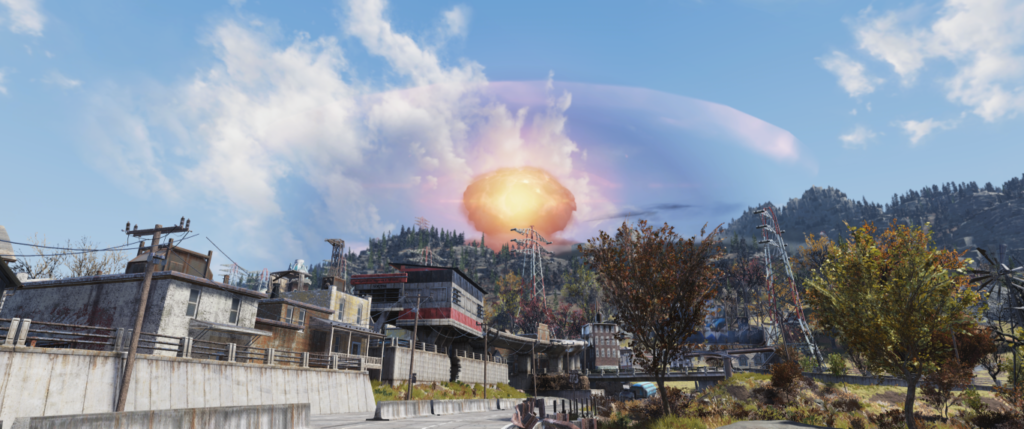
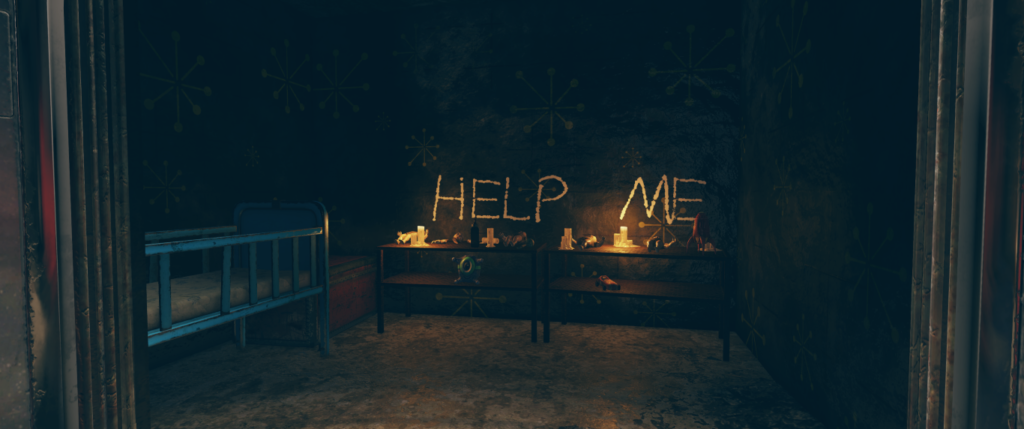
This happens relatively often.
There are some parts of the game that aren’t necessarily bad, they’re just implemented in a way that doesn’t work well.
There are a few “cap taxes” in the game that aren’t necessarily bad (they’re meant to pull caps out of the economy), but they’re annoying. I don’t have any problem with the vendor-based tax (10% of what a player pays doesn’t go to the seller), but the fast travel tax is simply annoying. It can cost more than 30 caps just to travel across the map. Bethesda recently made the two faction bases – Crater and Foundation – free to fast-travel to (and you visit them frequently as part of their quest lines and daily quests), so you can use them as a free fast-travel before paying to get to wherever you’re headed. However, making any location free for fast travel only makes it obvious how silly it is to charge caps for fast travel in the first place. If they need to take caps out of the economy, just put something worthwhile, expensive, and repeatable into the game. You can buy mutation serum recipes for around 20000 caps, and they’re worth buying; the game just needs more things like that.
A picture of the interior of my CAMP in Fallout 76.
In the latest patch, they’ve introduced a new event called “Daily Ops”. These are meant to be short, objective-based missions within an instanced area. Unfortunately, these events aren’t balanced very well. The enemies will have a random mutation, and some are incredibly annoying. One that was common for several days was “resilient”, where enemies can only be killed with a melee attack – not even a nuke would kill them. In addition, the enemies always have a “perceptive” mutation which allows them to see any player, even my high-stealth invisible character. Since I play a stealth build with relatively low resistances, I’m at a severe disadvantage playing the daily ops.
The seasonal system is a huge grind and requires you to do things you may not enjoy. Daily goals may include claiming workshops, playing the new “Daily Ops” event, or killing a particular type of enemy. Most of the time, these goals are pretty easy to accomplish, but the limited nature prevents much progress on the seasonal scoreboard. Destiny handles this much better, where you gain progress for earning experience, so you can simply do whatever you want and be rewarded with seasonal progress. I’ve been playing nearly every day since the latest season began (about a month now), and I’m only just getting to the halfway point. Even if I continue to play every day through the rest of the season (until November 24th), I’ll probably only barely reach the end. Games that demand my attention daily generally turn me off these days, and the least Bethesda could do is make the seasons last longer or provide ways to complete the season faster.
Finally, there’s the “Fallout 1st” subscription. I’m not opposed to a subscription for the game, but the asking price here – $13/month or $99/year – is far too high. I have no interest in private servers, and I don’t care about the premium-currency stipend (if I’m desperate to buy things, I can just buy the currency separately), but there are a few quality-of-life items locked behind the subscription. Fallout 1st players get a “scrapbox” to hold all their scrap with unlimited storage, and a “survival tent” they can place as a mini-camp to act as a free fast-travel point. If the price were much lower – maybe $5/month or $50/year – I’d consider joining for the QOL items, but at it’s current price, it’s just not worth it, and this leaves a lot of the non-paying players feeling like second-class citizens.
Summary
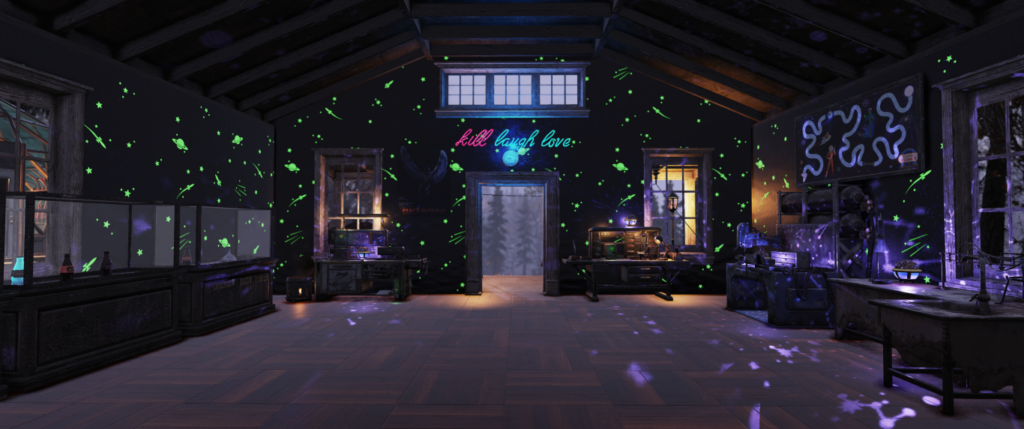
A player camp in Fallout 76. I like the “kill laugh love” neon sign above the door.
I’m disappointed and frustrated by Fallout 76. I can tell there’s a good game in there, but it’s buried under annoying systems and tons of grinding. It’s at least at a point where I can recommend it to fans of the Fallout series (barely) – but I definitely wouldn’t suggest it to anyone else. I want desperately to love this game, but I keep finding things that annoy me and make me want to stop playing. I’ll likely try to finish this season, but I may not play any more after that (especially considering there are a lot of games coming at the end of November that I’m going to want to put time into).
One game series that I look back on very fondly is Wing Commander. I absolutely loved those games, and played every last one of them. Then the series just died. There was a movie that should have been killed during its infancy and an XBLA shooter that was attached to the series only by name and the fighters themselves, but as far as I’m concerned, the series is still dead.
Spaceflight games in general have been few and far between, largely left to indie developers who have fond memories of Wing Commander and the like. And thanks to Kickstarter, we’re starting to see these games make a bit of a comeback in the indie game realm.
And so we come to Strike Suit Zero, with the tag line “Space. Combat. Reborn.” If this is the rebirth of spaceflight games, I think I’ll be pretty happy.
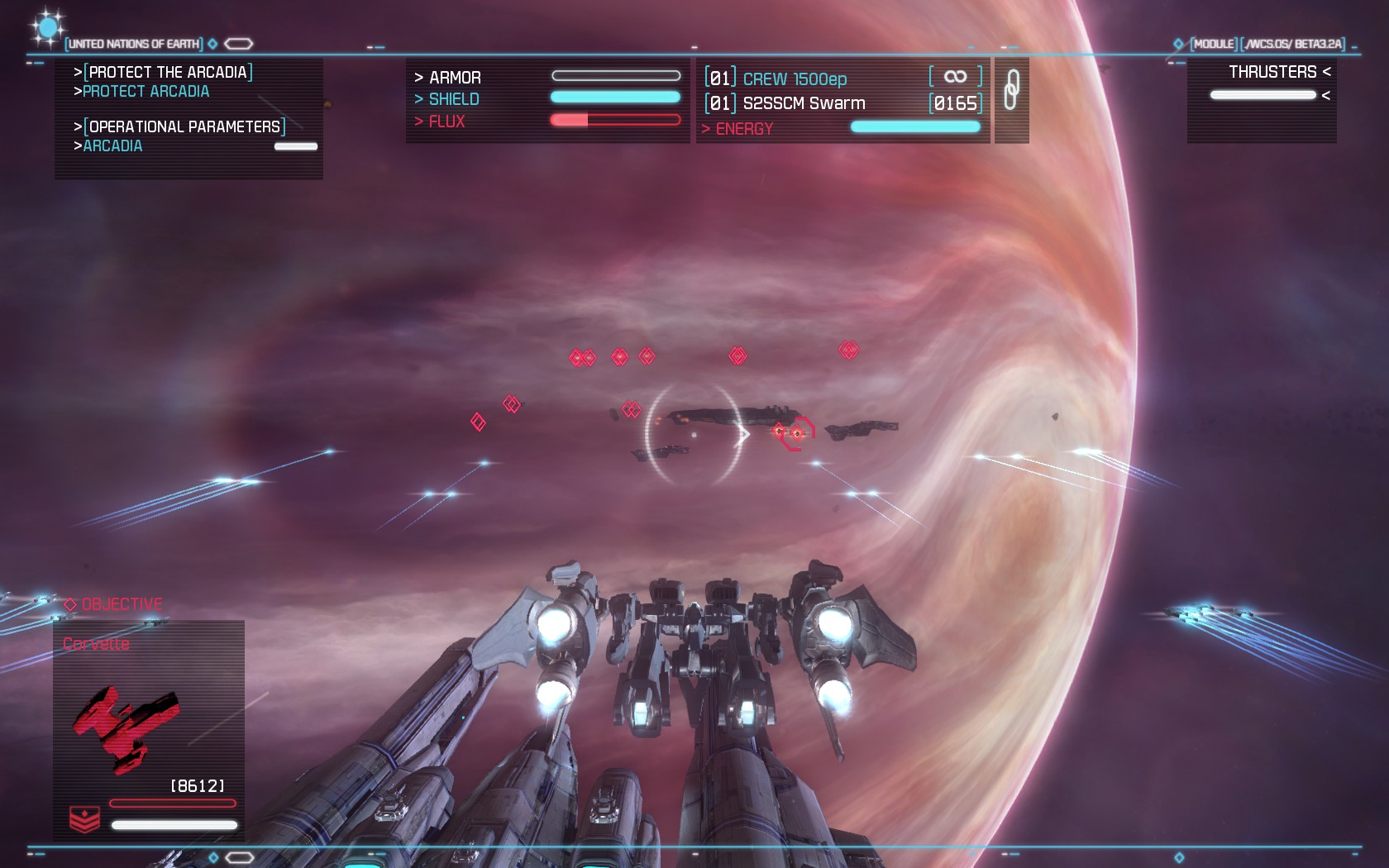
Gameplay Strike Suit Zero is very fast paced. Throughout the campaign, you’ll fly four different ships: a fighter, bomber, interceptor, and the eponymous strike suit. Each ship has slightly different stats – the fighter is a balanced craft, the bomber is slow but armed with an unlimited number of capital-ship destroying torpedoes, the interceptor is fast and agile, and the strike suit… Well, I’ll get to that later.
You’re allowed to customize the weapons on your ship. Most ships have two primary weapons – a plasma cannon that does moderate damage to shields and hull, and a rapid firing machine gun (“rapid projectile emitter”) that chews through shields but does less damage to armor. As you progress, you unlock new weapons to fill these slots, though they’re just stronger or weaker variants with different stats.
The real customization comes in your secondary weapons, where you have a variety of missile and rocket systems to choose from. You can mix and match, or simply load up on a single type. Personally, I like the swarm missiles. They do low damage, but you get a ton of them and can lock up to 10 at a time.
The game is by no means easy. You’ll have to face enemy fighters, corvettes, frigates, cruisers, and carriers, and they’re all deadly. Luckily, there are checkpoints during missions where you will respawn if you die, with full armor and restocked ammo. Sometimes a few extra missiles make all the difference.
Large ships like frigates and carriers are armed with a number of turrets – flak, plasma, and beam cannons. You often have to prioritize which to target – flak turrets are going to chew you up, but that beam cannon is hammering away at friendly capital ships. However, once a capital ship has been relieved of turrets, it’s basically giant, slow-moving target practice.
The missions in the game give you a variety of tasks, from protecting capital ships, to assaults on enemy bases, to your standard dogfights. You can replay the missions whenever you like, attempting higher scores or unlocking upgrades for your ships.
The Strike Suit I love this thing so much I’m giving it its own italicized section. The strike suit is a transformer, changing from a fighter form to a mecha-style robot with unlimited ammo. When you transform, the controls change allowing you to strafe, lock-on, and dodge. You’re not invulnerable, but in strike suit mode your damage increases significantly.
The controls for the strike suit work so well that it is perfectly possible to pull off moves you’d see in stuff like Macross or Gundam (or any anime with giant transforming robots). There were several times I’d race to my carrier as torpedoes were headed its way, arrive just seconds before the torpedoes would hit, transform, spin toward the torpedoes, destroy them all, transform back into a fighter, and blast away. It felt amazingly badass.
Of course, with so much power in strike suit form, there has to be a balance, and that comes in the limited use of the mode. The strike suit runs on “flux” energy, which slowly accumulates over time but can be filled much more quickly by destroying enemies. Once filled, it’s usually a good idea to transform and empty your flux so you can start acquiring more strike-suit energy. You can remain in strike suit mode as long as you like, but your weapons drain your flux energy.
The strike suit is armed with two weapons: a flak cannon that does significant damage, and a powerful missile that can lock on up to 40 at a time, across multiple targets. You’re only given 40 missiles at a time, but they recharge slowly. Your flak cannon will drain your energy more slowly, but it’s fairly inaccurate. Your missiles, on the other hand, drain energy with each lock, so how many lock-ons you can acquire is dependent on how much energy you have.
Graphics and Sound The game is beautiful, with colorful backgrounds, detailed ships, and ribbons of color that trail fighters. Screenshots look gorgeous, but the game is just as lovely when it’s in motion.
Ships are also a bit color-coded. Friendlies all sport blue colors and trails, while enemies have red colors and trails. It’s easy to see where you’re needed most.
Sound is also fantastic. All the effects sound great and work perfectly in the style of the game. But the music deserves a special note. The music was written by the same person behind Homeworld’s soundtrack. It’s moody and dramatic and fits the story perfectly.
Controls I’ve already touched on the strike suit controls, but I want to mention that all the controls work great. I played the majority of the game with a joystick (and I was overjoyed to have a game that works well with a real joystick), but I played the beta with the keyboard and mouse, which works surprisingly well. It takes some getting used to, with the mouse controls pitch and yaw, and the keyboard controlling speed and roll, but it’s fairly easy to understand, and probably a bit easier overall. (I still think the joystick was more fun)
Story Honestly, the story is a bit generic, but not bad. The closest approximation might be Battlestar Galactica, but there are a lot of elements similar to other sci-fi stories. It doesn’t feel like there’s a lot of depth to the world (it’s no Halo or Mass Effect), but the backdrop for the game is fleshed out enough to be interesting, if a bit cliché.
Summary I love Strike Suit Zero. It’s beautiful. It’s hectic. It’s fun. Sometimes the game felt difficult, but success was never out of reach. There are only 13 missions, but each can take an hour to finish at times (especially if you die a lot), putting it somewhere around 8-10 hours to complete. There’s not much here for replayability, other than the sheer enjoyment of the dogfights, which might be enough.
Strike Suit Zero retails at $20, which might be a bit high for an indie game, but it’s worth every penny, as far as I’m concerned.
I came into Far Cry 3 without any expectations. I played – but never finished – Far Cry, and I never even started Far Cry 2. Far Cry 3 had me hooked within the first few hours, and quickly became one of the best games I’ve played in a long time.
Gameplay Far Cry 3 is an open-world first-person shooter. As you play, you slowly unlock an arsenal of weapons from which you can carry four. These weapons can also be upgraded with various attachments – like silencers, scopes, or extended magazines – so you can customize them to fit your play style.
The game is played in a jungle, and you spend a good bit of time just running from one place to another. The jungle is filled with animals – some dangerous – that you can hunt and skin. You use animal skins to upgrade your equipment, then to sell once your equipment is fully upgraded.
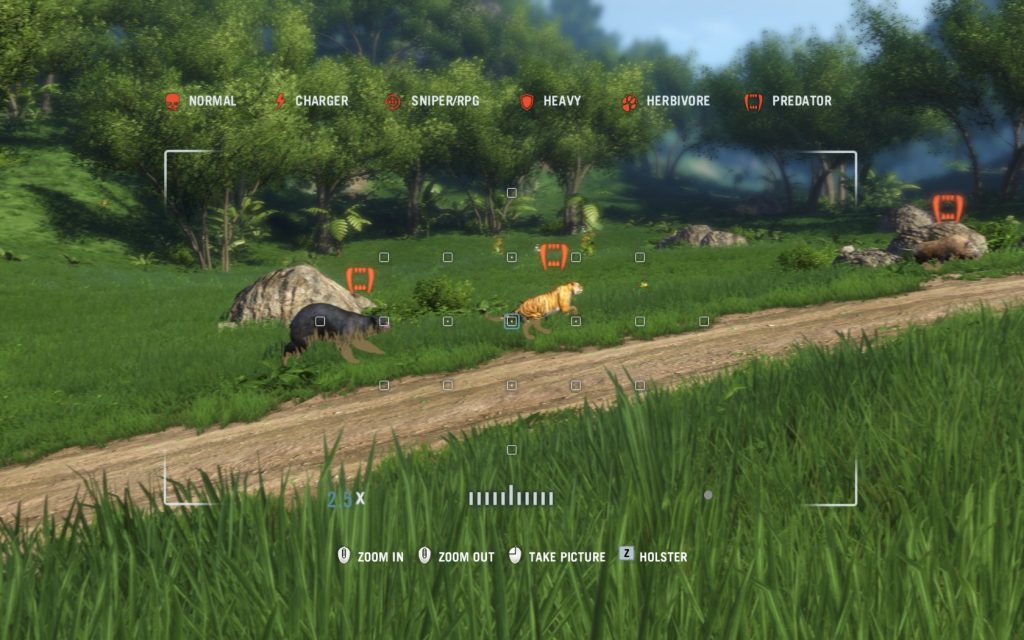
A boar being chased by a tiger and a bear at the same time.
Initially, much of the map is hidden. You slowly reveal the map by activating radio towers. The radio towers are like small puzzles – you have to find the path to the top of the tower to remove a jamming device and reactivate it. It’s usually not difficult to find the correct path, but it’s a nice change of pace from the rest of the game, and you’re rewarded with a quick overview of what’s in the area when you reactivate the tower.
There are also enemy outposts scattered across the map. While these outposts are in enemy hands, you’ll see enemy jeeps and patrols in the area, which will attack you on sight. Once you clear an outpost, however, these patrols are replaced by allies, who will come to your aid if you enter battle nearby. Clearing an outpost also unlocks it as a fast-travel location, so it’s usually a good idea to clear them soon after finding them (if only to make getting around easier). Clearing an outpost also rewards you with a decent bit of experience.
While the game encourages being stealthy by rewarding you with extra experience for stealth kills or clearing an outpost while remaining undetected (if you’re detected, you’re only given a third of the experience), playing the game loaded with RPGs and light machine guns is just as viable, and sometimes much easier. Running through the game mowing down enemies with a hail of gunfire is probably going to slow down your progression, though. I played the game with a silenced sniper rifle, crossbow, silenced SMG, and silenced assault rifle – if at all possible, I killed everyone without being noticed. The AI is a bit dumb, so they can be eluded fairly easily, but there are times when they’ll immediately spot you if you poke your head out. These times were few and far between, however.
The AI will react fairly well to your actions. If you leave a body in the open, someone will notice (“Is that a body?!”) and start investigating. If you headshot the person standing next to someone, they’ll immediately go on alert (“Holy shit!”) and head toward the source of the shot. You’re given the ability to throw a stone as a distraction from the start of the game, but I rarely used it, preferring to snipe from a distance instead. However, you could probably make use of the distraction to get close-range takedowns throughout the game, and there are a few missions where you’re required to use the stone-throw ability,
With each level you gain, you earn a point to spend in the skill tree, which is split into three sections focused on certain abilities – takedowns (stealth melee kills), guns, or survival. Nearly every ability in the tree is useful, and by the end of the game it’s easy to acquire every skill. Some skills unlock new abilities, while others simply make existing abilities stronger or add convenience (like auto-looting enemies when you use a takedown).
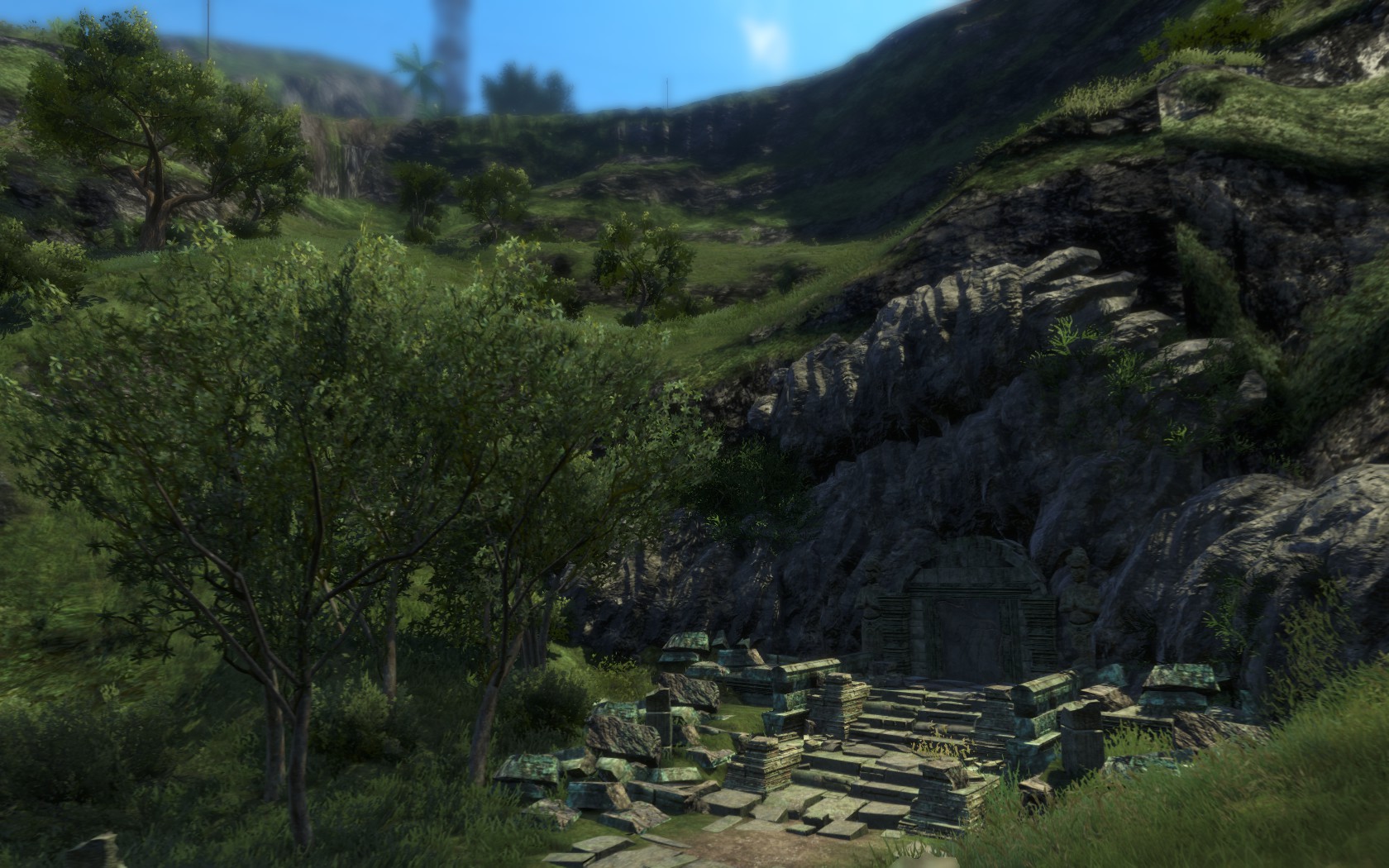
Graphics and Sound Far Cry 3 is gorgeous. The jungle is a beauty to behold, with a full day-night cycle. The game is played entirely from a first-person view, even when driving and during cutscenes. It’s a good thing, too, because your character looks like a total d-bag. (My reaction when I saw my character in the game’s “handbook” was: “Oh god, that’s what I look like?”)
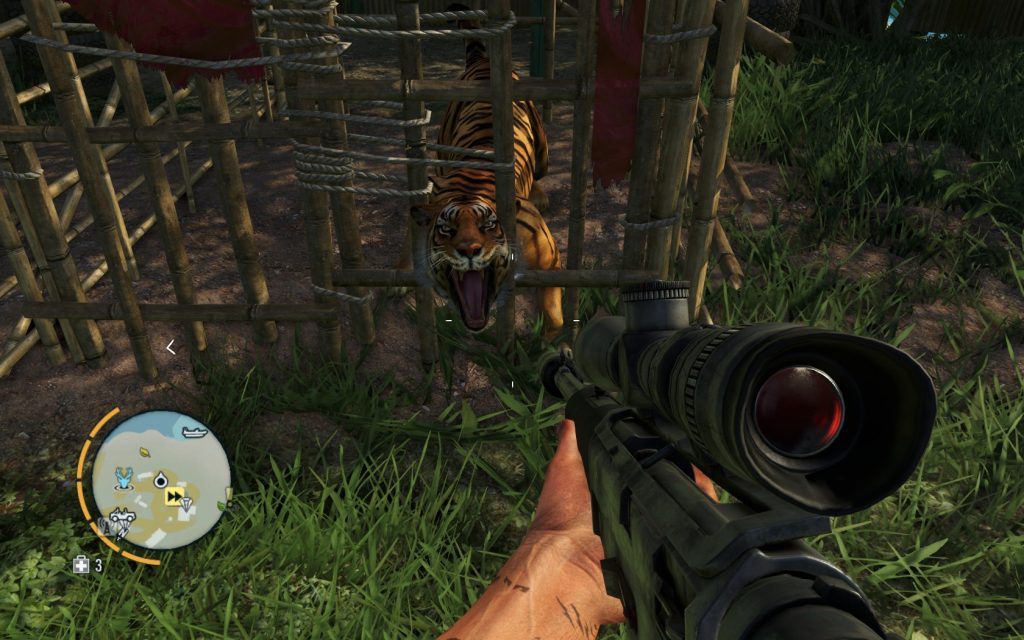
The sound is equally fantastic. I’d often be sprinting through the jungle then suddenly stop and crouch when I heard the growl of a tiger nearby. Enemies will shout to their comrades when they see you or find something suspicious. Music cues are also used well, making it easy to know when an enemy or animal knows you’re around.
Good tiger.
Summary Far Cry 3 was fun to play from start to finish. The game is structured and paced very well – there was never a point where I was bored. The gameplay never felt repetitive, despite doing the same few things over and over again (like outposts and radio towers). There’s plenty of extra things to do (hunts, assassinations, challenges, and random side quests) so you can always take a break from the story. In fact, I spent the first several hours of the game just hunting and upgrading my equipment. As a whole, Far Cry 3 is a fantastic game that I could recommend to almost anyone.
I bought and enjoyed the original Steel Battalion, difficult as it was.
I like the Kinect.
That said, let’s move on to the review:
I don’t care how good the graphics, how elaborate the storyline, or how realistic the gameplay: if your controls don’t work, you don’t have a game. After playing the tutorial and having my virtual self flail about the cockpit like an idiot, I quit, packed the game back in its GameFly sleeve, and put it in the mail. The Kinect controls simply don’t work. The tracking is terrible and it’s a chore to do anything via the Kinect. Unfortunately, the Kinect part of the game is required. Therefore, the game is not fun, and nigh unplayable.
Congrats, Steel Battalion. You’ve set the low bar for any review I do in the future.
I’ve seen Towns compared to Dwarf Fortress, and they have a lot in common. They both have you control a group of people by giving them tasks to perform. They both feature town building, resource management, and combat. They’re also both very hard to get into, but extremely rewarding if you can get past the learning curve.
Gameplay
When you start a new game of Towns, you’re given a handful of townies (apparently what your people are called) in the middle of a randomly generated world. From there you have to set about acquiring resources like wood and stone and building up a small town to support your handful of townies. If you’re lucky, they’ll survive long enough to get a good settlement going. If you’re me, one or two might manage to survive until immigrants arrive.
Most of the game consists of you building your town. You don’t directly command your townies; you simply choose what you want done, and your townies will make sure it gets done. For instance, you can pick where your townies should mine or build, and they’ll set about performing the task. Sometimes this works as expected, but more often than not, you’re left wondering why your townies are doing one thing instead of another. The townies tend to work as a group, but this results in odd behavior at times; I’ve seen a single townie running out to an area where I’ve marked stone for mining, they’ll mine a single block, then run back to town to do something else, while another townie has to travel out to the same spot to mine a different block. Also, the “haul” task is separate from everything else, so even once you have storage areas set up, your townies are more likely to drop materials on the ground randomly instead of carrying it to a nearby container. It’s also difficult to prioritize what they’re doing (beyond a basic priority list). However, when it works, it works well. If things are set up properly, your townies can maintain themselves fairly easily with little assistance; it’s just hard to get to that point.
The user interface is the biggest hindrance to Towns. There’s a lot of information that would be useful if it was presented more clearly (or at all). I’ve had countless townies die because they were stuck on top of a building I was constructing, and all I needed was a “Hey, I’m stuck!” message and I could have saved them. Some messages show up that help, like when you can’t create something because you’re missing a prerequisite. These messages are great, but they’re buried in a menu. A chat-like log would be extremely helpful.
Towns also lacks an effective tutorial. The tutorials provided are very basic – simply a page of text describing what you need to do, and a few objectives like “Get 10 wood”. I played through all the tutorials and still didn’t understand how to create a thriving town. While the tutorials teach you some of the core concepts, they leave out a lot of the detail required to be successful. Luckily, there’s a wiki (www.townswiki.com) that explains what you should be doing much better than the game does. After reading through the wiki, I found I could get the basics set up pretty easily.
Graphics and Sound
The graphics are simple and plain, which works on a certain level but leaves much to be desired. Chopping trees consists of a townie standing on a tree and making a wood chopping sound. Combat shows townies ramming into their enemy repeatedly. Townies will sometimes team up on foes, which creates an awkward-looking orgy as your townies surround the enemy and thrust themselves into it repeatedly.
Sound is similarly bland, though some effects – like chopping wood and mining stone – are easily recognizable and help to indicate what your townies are doing. Death sounds are annoying, especially when animals are naturally dying around your village.
Summary
Towns is still in an alpha state, and it shows. I think Towns will be a fantastic game with a bit more polish. The interface needs a lot of work especially, since I find myself confused about what’s going on most of the time. Even when I think I understand what’s going on, I still can’t figure out why things aren’t working sometimes.
That said, I find myself enjoying the game, so there’s definitely something interesting here. It’s just not ready yet. I’m hoping development continues and the game becomes easy to get into and still remain rewarding when your town thrives.
Towns is currently $15 (on sale for $12) on Steam, and I think that’s a bit much for the current state of the game. $5 or $10 would have been more reasonable. For all these reasons, I can only recommend Towns to someone coming from Dwarf Fortress or deeply interested in micromanagement. Even though I enjoy it, it’s definitely not for everyone.